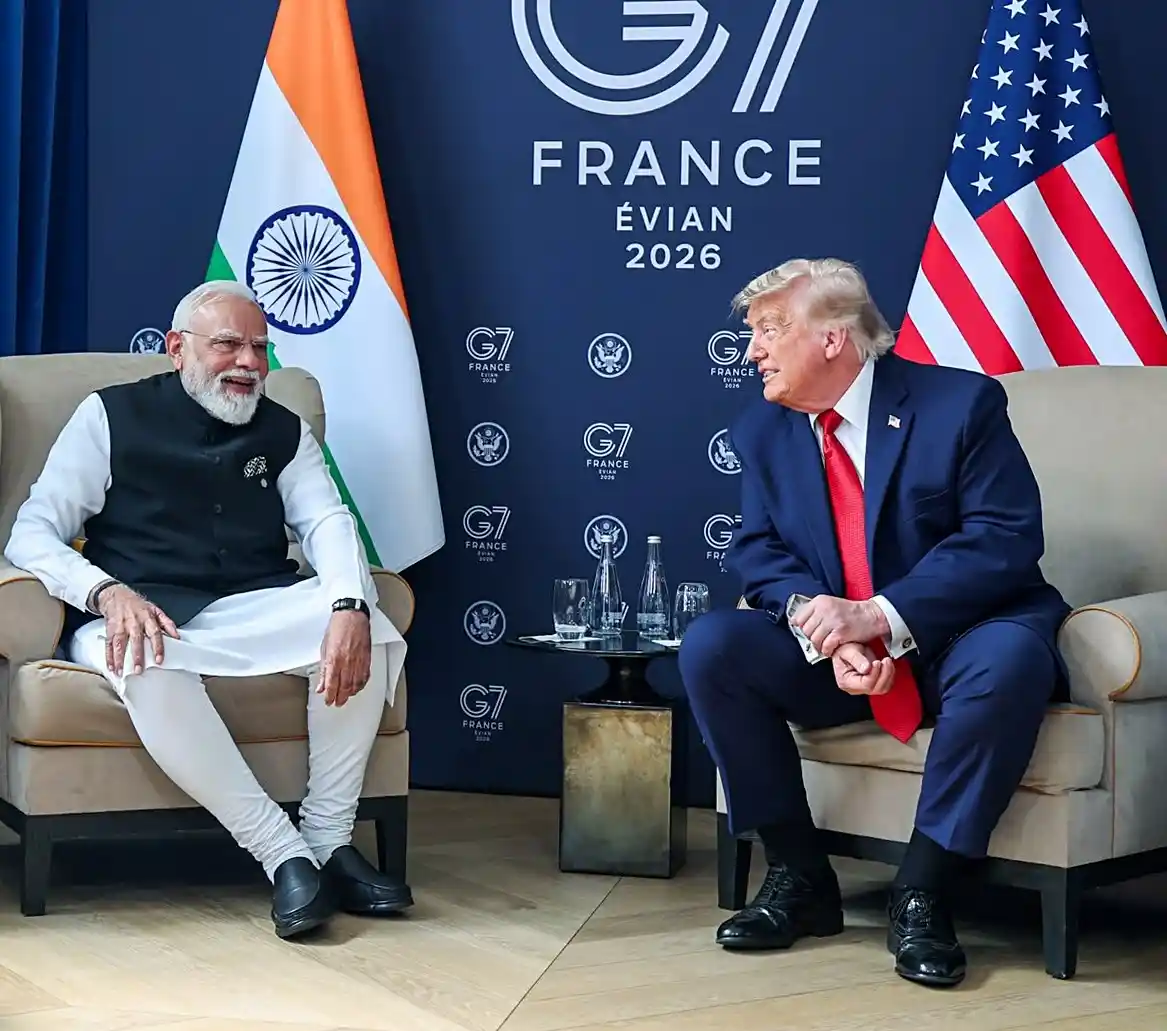
The recent interactions between Indian Prime Minister Narendra Modi and US President Donald Trump on the sidelines of the G7 summit suggested a relationship defined less by spectacle than by strategic calculation. The optics were measured and the messaging careful, but the underlying signal was clear: both governments want to preserve momentum in a partnership that has become too consequential to neglect, even as trade friction, defence delays, and regional differences continue to test trust.
That is the central point about the India–US relationship today. It is not an alliance built on automatic alignment, nor is it a sentimental partnership sustained by political rhetoric alone. It is a pragmatic compact between two major democracies that increasingly need each other in a world marked by fragmented supply chains, rising geopolitical rivalry, weakened multilateralism, and the steady diffusion of power away from the old centres of Western dominance.
The G7 conversation: steady, not dramatic
The G7 summit did not produce a grand bilateral breakthrough, but it did reveal something arguably more important: a shared preference for keeping the relationship stable and functional. Reports on the leaders’ exchange indicated discussions on trade, tariffs, defence cooperation, energy, and regional security, all of which point to the broadening scope of the bilateral agenda. There was also visible effort on both sides to maintain a constructive tone rather than allow disagreements to dominate the public narrative.
A neutral reading of the summit exchange is essential. India did not appear eager to subordinate its diplomatic posture to American expectations, and the United States did not suggest that closeness with India would erase hard bargaining on trade or strategic questions. Instead, both leaders seemed to approach the conversation with realism: India emphasising autonomy and issue-based cooperation, the US signalling that it sees India as a serious partner whose value lies precisely in its weight, capability, and regional influence.
This restrained attitude should not be mistaken for weakness or lack of ambition. On the contrary, it reflects a maturing relationship in which both capitals understand that durable partnerships are sustained less by personal chemistry than by institutional depth, predictable delivery, and the ability to manage friction without derailing the larger strategic purpose.
Why the relationship matters now
The international environment has changed profoundly. The post-Cold War phase of American primacy has given way to a world of sharper contestation, especially with the rise of China, ongoing war-linked disruptions in Europe and West Asia, and growing anxiety over technological dependence and supply-chain vulnerability. In such a setting, India and the United States are drawing closer because their interests increasingly overlap in critical domains, even if they are not identical.
For Washington, India represents a democratic counterweight in the Indo-Pacific, a large and growing market, and a potential hub in efforts to diversify strategic production away from concentrated geographies. For New Delhi, the United States is a key source of advanced technology, capital, defence cooperation, educational linkages, and geopolitical support in a regional environment that is becoming more demanding. This convergence is not absolute, but it is substantial enough to make the relationship one of the defining partnerships of the present era.
Beyond security: the widening agenda
One of the most significant features of contemporary India–US ties is that the relationship now extends well beyond traditional security concerns. The agenda increasingly includes semiconductors, critical and emerging technologies, artificial intelligence, clean energy, resilient supply chains, maritime coordination, and innovation partnerships. This expansion matters because it gives the relationship structural density. A partnership anchored across multiple sectors is more likely to endure temporary shocks in any one area.
The G7 context reinforced this trend. India’s engagement at the summit connected its ties with the United States to larger conversations about economic resilience, technology governance, and the future architecture of global growth. The bilateral relationship is therefore no longer confined to strategic signalling; it is increasingly about shaping the material foundations of power in the 21st century.
Trade: the opportunity and the test
Trade remains both the greatest opportunity and the most persistent source of bilateral tension. Reporting around the G7 interactions suggested that tariffs, trade imbalances, and market access were central themes in the leaders’ conversation, even as both sides reiterated the ambition to expand bilateral trade substantially in the years ahead. This duality captures the nature of the relationship: deepening strategic trust coexists with sharp economic bargaining.
India’s position is understandable. It seeks policy flexibility, protection for sensitive domestic sectors, and terms of engagement that support development and industrial growth. The American position is equally understandable. Washington wants more predictable market access, reduced barriers, and commercial arrangements that are politically defensible at home. Neither side can simply concede its core concerns, which is why trade negotiations must move beyond reactive bargaining toward a phased and credible framework that aligns economic goals with strategic intent.
If managed well, trade can become the ballast of the relationship. If mishandled, it will remain the issue most likely to create recurring political friction.
Defence, technology, and credibility
Defence cooperation continues to occupy a central place in the bilateral relationship, but here too the real challenge is implementation. The logic for closer ties is clear: India wants access to advanced platforms, technology partnerships, and co-production opportunities, while the US wants a stronger and more capable partner in the Indo-Pacific security architecture. Yet reported concerns over delayed engine supplies and other defence frictions show that strategic intent must be matched by reliable execution.
The same applies to technology cooperation. The promise of collaboration in semiconductors, artificial intelligence, and other critical sectors is substantial, but such cooperation will only become transformative if it is insulated from bureaucratic hesitation, export-control mistrust, and political inconsistency. Trust in this domain is built not through declarations, but through timely delivery, transparent rules, and mutual confidence in long-term commitment.
India’s autonomy in a changing order
A serious reading of India–US ties must also recognise that India’s strategic value to Washington is linked to, not diminished by, its autonomy. Carnegie’s analysis of India in the emerging world order notes that India is increasingly aligned with the United States on China, while still refusing to place itself squarely in Washington’s camp on all issues. That posture often frustrates external observers, but it is entirely consistent with India’s self-conception as an independent pole in a multipolar order.
The G7 conversation reflected this reality. India was engaging the West, but not dissolving its distinct voice; it was cooperating with the United States, but not abandoning its broader Global South positioning. For the US, the practical lesson is that India will be a stronger partner when treated as a sovereign strategic actor rather than a quasi-ally expected to conform. For India, the lesson is that autonomy carries greater weight when backed by economic capability, technological depth, and credible implementation capacity.
The way ahead
The future of India–US relations will depend less on summit symbolism and more on policy delivery. Both governments should institutionalise a clearer roadmap on trade, with phased commitments and realistic benchmarks. They should deepen cooperation in emerging technologies and supply chains, not as abstract strategic talking points but as concrete industrial partnerships. Defence cooperation should focus on co-development, co-production, and dependable fulfilment of commitments rather than headline-grabbing announcements.
Most importantly, both sides must preserve a neutral, respectful understanding of each other’s strategic compulsions. The United States must accept that India’s foreign policy will remain shaped by autonomy and Global South credibility. India, in turn, must recognise that a stronger partnership with Washington requires regulatory predictability, implementation capacity, and a willingness to translate political convergence into institutional outcomes.
In the final analysis, the G7 summit did not redefine India–US relations overnight. What it did reveal was perhaps more important: a calm and realistic leadership-level attitude that recognises both the value and the limits of the partnership.