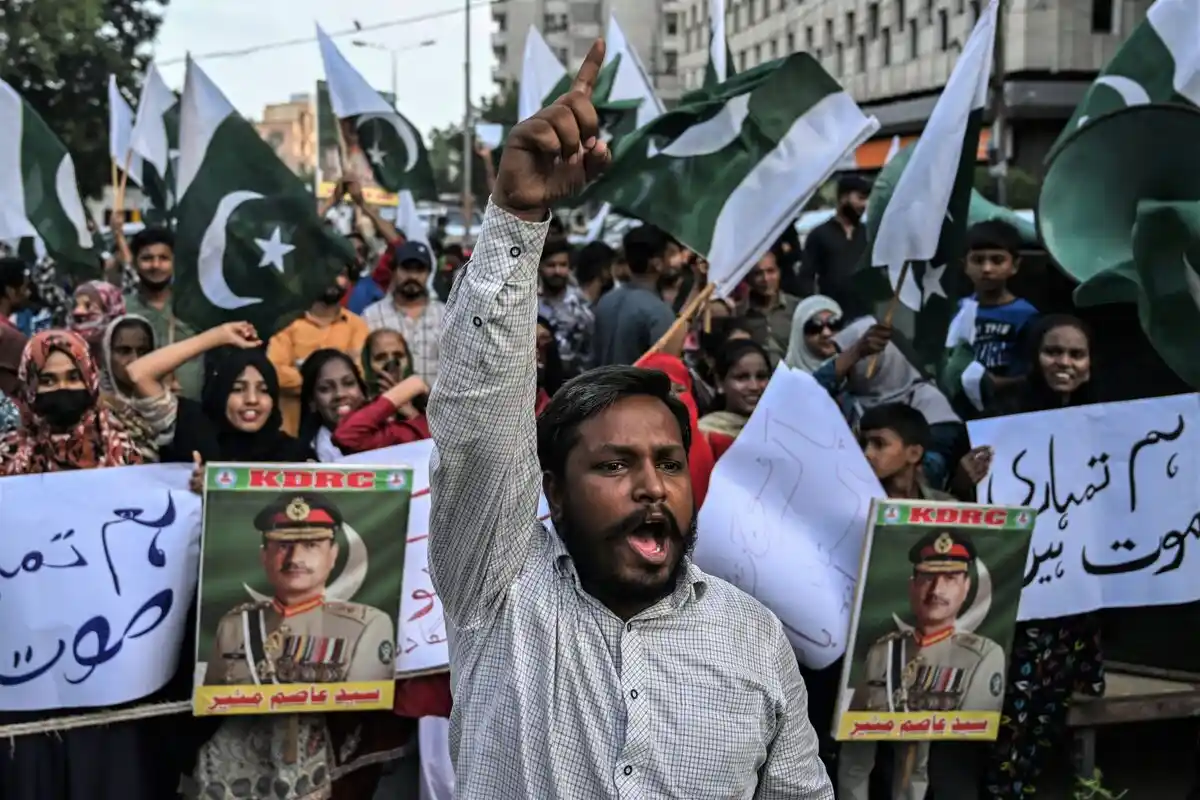
Pakistan’s current crisis reflects the consequences of prolonged military dominance over political and economic decision-making. As governance becomes increasingly security-driven, multiple internal and external pressures continue to intensify.
When you have a hammer in your hand, every problem looks like a nail that requires a hammer to solve it. The same is happening in Pakistan, where the Pakistan military, under Asim Munir, is running the country, calling the shots, and effectively emerging as the country’s de facto ruler. When the military runs a country, it views every problem—whether political, economic, domestic, or otherwise—through a hard security lens and a militaristic mindset, believing that every issue requires a military solution.
Internal Unrest and Regional Isolation
That is what explains today’s crisis in Pakistan. Today, the Pakistan Army has opened multiple fronts, and more fronts are likely to emerge. There are problems in Balochistan, problems in Khyber Pakhtunkhwa (KPK), problems in Sindh, problems in Punjab, along with economic issues, corruption, and institutional dysfunction. Now there are also problems in Pakistan-occupied Kashmir (PoK), a region that has been denied political, economic, and civil rights since 1947. The region is now burning as people demand basic facilities and fundamental rights. Instead of addressing these concerns, the Pakistan Army is using force to quell the protests and has now sealed all entry and exit points to Rawalakot, where large-scale protests and demonstrations are taking place at Eid Gah Ground. The army is now engineering shortages of essential items such as food, medicines, and other basic necessities in an attempt to force the protesters into submission.
Similarly, when it comes to its neighbours, Pakistan has problems with Afghanistan, where it has repeatedly carried out airstrikes, killing innocent civilians. Most recently, it reportedly targeted the Omid drug rehabilitation centre in Kabul, killing more than 400 people undergoing treatment for drug addiction who were seeking a second chance at life. It also has problems with India and its other neighbours. As Pakistan’s senior political leader, Maulana Fazlur Rehman, recently admitted in this context, “India is our enemy, Afghanistan is our enemy, and even Iran and China are upset with us.” He further acknowledged Pakistan’s growing diplomatic isolation by stating that “Pakistan has lost every friend it once had.” Even with China, things are not as good as they appear. However, these issues rarely come into the open because of geopolitical considerations. Given China’s strategic rivalry with India and Pakistan’s utility in that context, Beijing has little incentive to publicly acknowledge or highlight its growing concerns with Islamabad. Behind the public rhetoric, Pakistan-China relations are arguably at their lowest point in recent years. Pakistan, under Asim Munir, has moved closer to US President Donald Trump and is increasingly pursuing American interests in the Af-Pak region, thereby undermining China’s broader strategic interests, including the China-Pakistan Economic Corridor (CPEC), in the region.
Besides, Pakistan has been directly undermining China’s interests by creating and promoting instability in Afghanistan in pursuit of American interests. It is clear that if Pakistan gets control of Bagram Air Base, for which Trump has reportedly given responsibility to Munir, the base would be used to advance US strategic objectives against China by facilitating intelligence gathering, surveillance, reconnaissance, and the monitoring of Chinese military activities and strategic infrastructure in western China. Moreover, instability in Afghanistan is not in China’s interest because of its potential spillover effects. Recognising these risks, China recently hosted Pakistan and Afghanistan for talks in Urumqi, Xinjiang, in an effort to reduce tensions and restore stability, but the initiative failed to produce any meaningful breakthrough. A volatile Afghanistan could once again become a safe haven for extremist groups, particularly Uyghur militant organisations that China believes threaten the security and stability of Xinjiang. Continued instability also risks the spread of terrorism, arms and narcotics trafficking, refugee flows, and cross-border militancy across the region, while simultaneously undermining the security of Chinese personnel, the China-Pakistan Economic Corridor (CPEC), and China’s broader Belt and Road Initiative.
Optics Diplomacy and the Search for Legitimacy
Moreover, to gain domestic legitimacy through external image-building, what Pakistan’s military dictator, Asim Munir, is currently doing is engaging in optics diplomacy by presenting himself as a peacemaker on the global stage. The regime is reportedly paying some editors of international newspapers to publish articles and editorials claiming that Pakistan’s global role has increased by acting as a mediator in the Iran-US conflict, even though it was Qatar that did the heavy lifting after Pakistan’s efforts failed. Its current approach is centred on remaining in the limelight by visiting important countries and inviting foreign leaders to visit Pakistan. The military regime seeks visibility and recognition as a regional power, a perception that is far removed from reality. The objective behind all this is to gain domestic legitimacy, but it is unlikely to achieve that because the military has imprisoned the country’s most popular leader, Imran Khan, while people across the country remain deeply dissatisfied with the regime due to corruption, the deteriorating economy, and the worsening security situation.
Moreover, according to recent reports, Pakistan’s military regime, planted a fake story in the international media claiming that Israel’s intelligence agency, Mossad, was planning to assassinate its Army Chief, Asim Munir. This was merely an attempt to play the sympathy and victim card in order to gain domestic support, as Munir’s military regime remains highly unpopular at home and is facing growing public discontent.
Both internally and externally, the military establishment has created multiple crises and opened several fronts, pushing the country closer to breakdown. Moreover, Pakistan’s economy remains dependent on IMF bailout packages, but this cannot continue indefinitely. The purpose of IMF assistance is to help a country recover economically and regain financial stability, not to make it permanently dependent on repeated bailouts. However, it now increasingly appears that IMF bailout packages have now turned out to be a permanent feature of the Pakistan’s economy rather than temporary assistance meant to restore self-sufficiency. Furthermore, there is little chance of genuine economic recovery or rejuvenation because the military maintains a significant presence in key sectors of the economy through a vast network of foundations and corporate entities, including the Fauji Foundation, Army Welfare Trust, and other military-linked organisations. These entities operate across a wide range of industries, including fertilizers, cement, banking, real estate, housing development, food production, energy services, logistics, and aviation. In such a system, meaningful economic reforms are highly unlikely, as entrenched institutional control and vested economic interests effectively block or dilute any serious attempt at structural change.
Given Pakistan’s deteriorating security situation, growing political instability, and regional tensions, there is little chance of meaningful economic activity or foreign investment. No country would want to invest under such conditions. Even Pakistanis are leaving the country because they see little hope or future there. This sentiment is not limited to ordinary citizens; even those employed within the state apparatus are increasingly reflecting the same sense of uncertainty. Many bureaucrats, military officers, and members of the elite also see little future in Pakistan, and most have already secured dual citizenship or maintain strong foreign residency links, with recent reports submitted to parliamentary bodies and cited in the media indicating that more than 22,000 government officials have held dual nationality across various levels of the state apparatus, including the bureaucracy and senior administrative cadres.
The Limits of Propaganda and Narrative Building
Moreover, multiple investigative reports, including the Pandora Papers, have documented offshore holdings linked to members of Pakistan’s political and business elite, highlighting a broader pattern of wealth accumulation and asset protection outside the country. At the same time, IMF reports and governance assessments have repeatedly pointed to issues of corruption, weak accountability, and elite capture, which continue to undermine economic stability and investor confidence. Moreover, while the country is surviving on IMF support and high taxes are being imposed on ordinary Pakistanis, the Pakistan Army has recently approved a 25 percent increase in salaries for its personnel. The package also includes a significant increase in allowances, including a tripling of the disturbance allowance, along with revisions in other compensation heads.
When one looks at these problems, they are so enormous that there is little hope for Pakistan. The propaganda Pakistan is spreading in the international media by paying journalists will not change reality or resolve its underlying structural problems. Narrative building and social engineering are unlikely to address Pakistan’s underlying problems.
Those Pakistanis who are celebrating this so-called “coming into the limelight” have little reason to rejoice, because what it actually signifies is not a stronger Pakistan but the further consolidation of military dominance at the expense of democratic governance. Every visit that Asif Munir makes, and every compliment that Shehbaz Sharif publicly offers to Asif Munir, further tightens the grip on what little democratic space and hope remains in Pakistan. In fact, Prime Minister Shehbaz Sharif will likely be remembered in history as someone who, through repeated praise and open political deference to the military establishment, further strangulated Pakistan’s already fragile democratic prospects and effectively sounded its death knell rather than strengthening civilian rule.
This consolidation of military dominance has not occurred through coercion alone. It has also been sustained by decades of narrative building, in which Pakistan’s media has played an important role since 1947. Although the media cannot be held entirely responsible because of military control and the conditions under which it has operated, it nevertheless bears part of the responsibility. Pakistan’s political and economic situation is becoming increasingly serious. One must understand that the military has a fundamentally different approach to governance and problem-solving. Civilian leadership is generally better equipped to address such challenges because it brings a different perspective. Had Pakistan been governed by a democratic civilian leadership instead of experiencing prolonged military dominance, the country’s trajectory might have been very different.
If this trajectory continues, the consequences will extend far beyond political stagnation, resulting in long-term economic decline, deepening social fragmentation, and an increasing risk of the eventual disintegration of the Pakistani state itself.