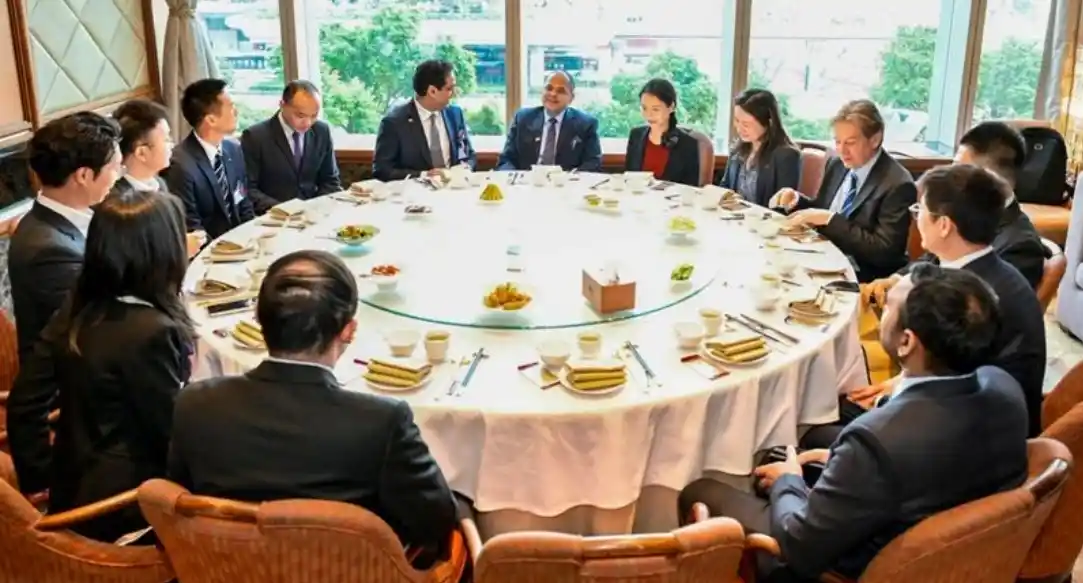
The recent visit of an Indian business delegation to China—after a freeze of more than five years—marks a quiet but meaningful reset in the economic angle of India–China relations. Organised by the Punjab, Haryana, Delhi Chambers of Commerce & Industry (PHDCCI), an eight‑member group travelled to Shanghai and Jiangsu province between late March and early April 2026, engaging Chinese firms and financial institutions in clean‑energy ecosystems, electric mobility, and battery technologies. Coming on the heels of senior‑level diplomatic engagements between Prime Minister Narendra Modi and President Xi Jinping at major multilateral summits in 2024–25, the trip signals that both sides are now willing to translate a cautious political thaw into concrete commercial dialogue.
From diplomatic thaw to business engagement
The visit’s importance lies not in the size of the delegation but in its symbolism. After the 2020 Eastern Ladakh standoff, cross‑border business travel and high‑level industry exchanges were effectively suspended, and Chinese‑linked investment faced tighter scrutiny in India. The fact that PHDCCI could mount what is being framed as its first renewable energy–EV‑focused business delegation to China indicates that the bureaucratic and political friction that blocked such visits has partly eased. The delegation is also engaging with major Chinese corporations and financial players, underscoring that Beijing is not only tolerating renewed contact but actively encouraging business‑to‑business linkages.
The Indian Consulate‑General in Shanghai hosted a business roundtable that framed India as a fast‑growing, demographic‑advantaged partner for global capital and technology flows. Emerging sectors such as new and renewable energy, electric vehicles, infrastructure, connectivity, and information technology were explicitly highlighted as priority areas for collaboration. For New Delhi, this is a calibrated message: India wants to deepen access to Chinese technology and supply‑chain efficiency, but within a framework that promotes India‑centric capability‑building and fits into the broader “developed India by 2047” narrative.
EVs, batteries, and clean‑energy ecosystems
The PHDCCI delegation’s core agenda is to explore partnerships in clean‑energy ecosystems and to study China’s leadership in electric mobility and battery technologies. The group includes six startups working on EV charging, electric trucks, battery storage, and energy trading, which are exactly the weak links in India’s otherwise ambitious EV and renewable‑energy roadmap. As India seeks to raise EVs’ share of new vehicle sales to around 30 per cent by 2035, the lack of robust charging infrastructure, affordable batteries, and grid‑linked storage has been a major bottleneck.
China, by contrast, has developed a vertically integrated and cost‑competitive value chain in solar PV, batteries, EV manufacturing, and EV‑charging infrastructure, supported by dense industrial clusters and policy‑driven scale. Indian firms are keen to understand how these clusters operate, how Chinese firms integrate battery packs, charging equipment, and software platforms, and how resilient supply‑chain models withstand external shocks. The intention is not wholesale dependence on Chinese hardware, but selective technology partnerships, joint ventures, and strategic sourcing arrangements that can lower costs and speed up deployment in India.
Strategic context beyond the Iran war
While commentary around this visit often links it to the Iran war and Middle East energy disruptions, the deeper narrative is one of bilateral economic recalibration. The conflict in West Asia has heightened India’s vulnerability to oil‑price spikes and supply‑chain disruptions, reinforcing the imperative to reduce fossil‑fuel dependence and accelerate deployment of renewables and EVs. In this context, China’s dominance in batteries, solar manufacturing, and grid‑scale storage makes it a natural, if uncomfortable, partner for Indian firms seeking to build out charging networks and energy‑storage projects.
At the same time, for China, the value of a more stable economic relationship with India is also clear. A less adversarial India–China economic interface helps Beijing diversify its export base, retain access to a large, fast‑growing consumer and investment market, and avoid being locked into a purely U.S.‑centric or “decoupling”‑driven global order. The fact that European business groups also participated in the Shanghai roundtable—highlighting the India–EU free‑trade‑agreement prospects—shows that multiple external actors see India as a potential node in more resilient, Asia-linked supply chains involving, but not confined to, Chinese firms.
Implications for India and China
For India, the immediate gain is access to technology, scale, and operational know-how that can compress the time needed to build a nationwide EV‑charging and clean‑energy infrastructure. However, this also raises long‑term questions about digital‑ and energy‑security. If Chinese firms dominate key components such as charging hardware, energy‑management software, and grid‑linked storage, Delhi will need clear rules on data‑localisation, critical‑infrastructure exclusions, and diversification of suppliers. The government’s recent easing of FDI rules for Chinese capital in certain sectors suggests that it is willing to accept some risk exposure, provided it is offset by technology‑transfer benchmarks and strategic‑sector safeguards.
For China, the upside is the stabilisation of an important Asian economic relationship at a time of heightened U.S.‑China tensions. By positioning itself as a partner in India’s clean‑energy transition, Beijing can both deepen economic ties and project a more “partnership‑oriented” image in the Global South and among non‑Western states. Yet Beijing will also be wary of appearing to subsidise India’s de‑carbonisation in a way that materially strengthens a long‑term strategic rival, especially given continuing irritants such as the border dispute and China’s support for Pakistan.
A cautious, issue‑specific rapprochement
Overall, the PHDCCI delegation is best read not as a one‑off diplomatic show‑piece but as a marker of a more complex issue‑specific rapprochement. In green‑energy and EV‑related value chains—where competition is intense but also highly interdependent—India and China are finding enough mutual interest to overcome the baggage of the last decade. Security‑related differences along the border and divergent alignments in multilateral groupings will remain, but they are increasingly being compartmentalised from areas of economic and technological cooperation.
This trend suggests that Beijing’s overall strategy is not simply to “decouple” from the West, but to selectively deepen ties with non‑Western economies that can act as both partners and buffers in a multipolar order. For Delhi, the lesson is that economic pragmatism can coexist with strategic caution, but only if India builds its own capabilities faster than it accumulates new dependencies.