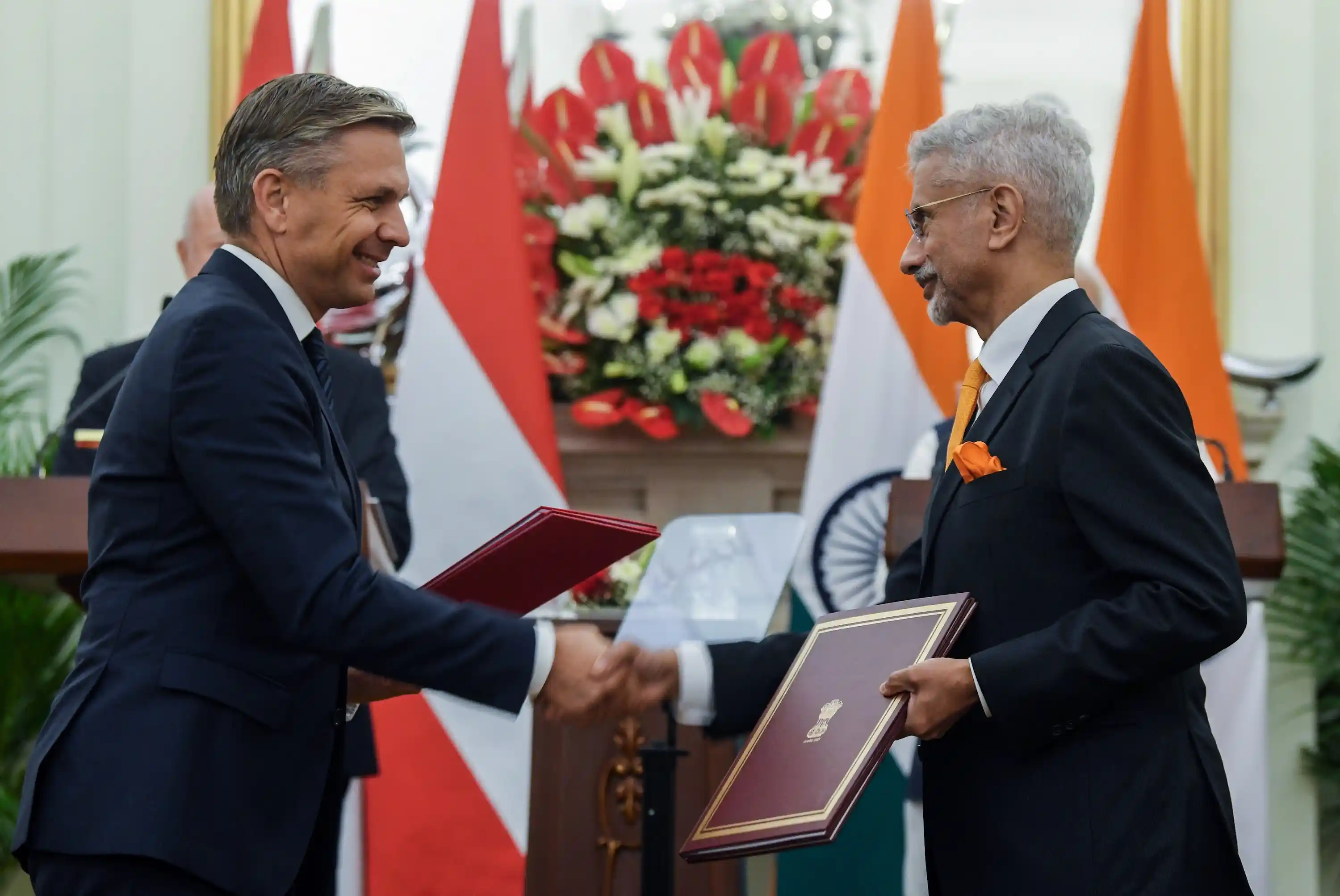
India and Austria have significantly bolstered their bilateral partnership through high-level engagements in April 2026, yielding 15 concrete outcomes across defense, technology, trade, and innovation. These developments build on the momentum from Prime Minister Narendra Modi’s landmark 2024 Vienna visit and align with the newly inked India-EU Free Trade Agreement (FTA). Official press releases underscore a shared vision for mutual growth, positioning the two nations as complementary partners in a dynamic global landscape.
Diplomatic relations between India and Austria, formally established in 1949, celebrated their 75th anniversary in 2024. This milestone prompted Modi’s historic trip to Vienna—the first by an Indian Prime Minister in 41 years—culminating in a Joint Statement on Enhanced India-Austria Partnership. The statement emphasized collaboration in sustainable economic domains such as green technologies, digital innovation, infrastructure development, and life sciences. A key initiative launched during that visit was the India-Austria Start-up Bridge, designed to connect entrepreneurs and foster cross-border innovation ecosystems.
The April 2026 visit by the Austrian Federal Chancellor to New Delhi marked another milestone: his first official trip outside Europe and the first by an Austrian Chancellor to India in over four decades. Occurring shortly after the India-EU FTA, it aimed to accelerate bilateral trade, currently valued at €3 billion annually, with over 160 Austrian companies actively operating in India. This timing reflects strategic intent to leverage Europe’s economic gateway through Austria while tapping India’s burgeoning market potential.
On April 16, 2026, the Chancellor called on President Droupadi Murmu at Rashtrapati Bhavan. In a cordial exchange, President Murmu highlighted the shared commitment to democracy, rule of law, and pluralism. She praised the expansion of ties post-Modi’s 2024 visit, pointing to immense opportunities for Austrian firms in India’s high-growth sectors like semiconductors, green energy, artificial intelligence (AI), renewable hydrogen, water management, and urban waste solutions. Both leaders agreed that the knowledge-based economies of the two nations offer fertile ground for collaborative ventures.
Parallel bilateral talks between PM Modi and the Chancellor produced 15 tangible outcomes. These included a Memorandum of Understanding (MoU) on food safety standards, letters of intent for military-technical cooperation, and the establishment of a Joint Working Group (JSG) on counter-terrorism. Discussions prioritized defence manufacturing, semiconductor supply chains, quantum technologies, biotechnology, and sustainable development initiatives. PM Modi emphasized how India’s scale and demographic dividend pair seamlessly with Austria’s precision engineering and R&D prowess to address global challenges.
The Press Information Bureau (PIB) release (ID: 2252729) detailing the Chancellor’s meeting with President Murmu exudes optimism and strategic foresight. It frames the visit as a post-India-EU FTA catalyst for trade expansion, spotlighting India’s vibrant start-up ecosystem—home to over 100 unicorns—and the pivotal role of the 2024 Start-up Bridge. The release commits to advancing all facets of bilateral relations: political dialogue, economic partnerships, and innovative exchanges, while inviting greater Austrian investment in cutting-edge sectors.
Complementing this, PIB release 2253105 covers the India-Austria Business Forum held at Vanijya Bhawan, co-chaired by Commerce and Industry Minister Piyush Goyal and Austria’s Minister for Digital and Economic Affairs, Wolfgang Hattmannsdorfer. A flagship announcement was the launch of the Bilateral Fast-Track Mechanism (FTM)—a dedicated portal for investors to swiftly address regulatory hurdles and enhance the ease of doing business in India. Minister Goyal highlighted India’s reforms in advanced manufacturing and digital infrastructure, while his counterpart lauded India as a “strategic anchor” for Austria’s €3 billion trade footprint.
The meetings have catalyzed several emerging highlights:
- Defense & Security: The new JSG on counter-terrorism and military cooperation, MoIs represent a proactive shift, addressing transnational threats in an era of heightened geopolitical risks.
- Trade & Investment: The FTM, alongside FTA provisions, targets labor-intensive industries, MSMEs, and services, with ambitions to surpass €3 billion in trade volumes.
- Technological Synergies: Renewed focus on AI, quantum computing, biotech, and renewables harnesses mutual strengths for next-gen solutions.
- Business Ecosystem: CEO roundtables and the Start-up Bridge extension promise sustained private-sector momentum.
These 15 agreements provide a structured roadmap, transforming rhetoric into actionable frameworks and reinforcing Austria’s role as India’s key EU conduit.
From a geopolitical standpoint, particularly through an Indo-Pacific lens, these ties exemplify India’s multi-alignment strategy. Austria serves as a reliable EU partner for diversifying supply chains away from China-centric dependencies, especially in semiconductors and critical minerals. Defence technology transfers align with Atmanirbhar Bharat (self-reliant India), enhancing indigenous manufacturing capabilities. Green energy pacts support India’s net-zero ambitions by 2070, while fostering knowledge exchange in hydrogen and waste-to-energy technologies.
For Austria, India offers a counterbalance to Europe’s economic headwinds, with its 1.4 billion consumers and 7-8% GDP growth providing market stability. The FTM mitigates investment uncertainties, safeguarding the interests of its 160+ firms. This partnership embodies “de-risking” diplomacy: innovation-driven, resilient, and forward-looking. Amid global flux—from Ukraine to the Middle East—these engagements promote “peace diplomacy,” as articulated in joint statements.
The recent visit has infused “new energy” into India-Austria relations, as PM Modi noted, setting the stage for exponential growth. Expect accelerated FTM implementation, JSG activations, and trade doubling by 2027. As both nations navigate multipolar dynamics, this alliance could emerge as a model for EU-Indo-Pacific synergy, blending Europe’s tech finesse with Asia’s scale for shared prosperity.