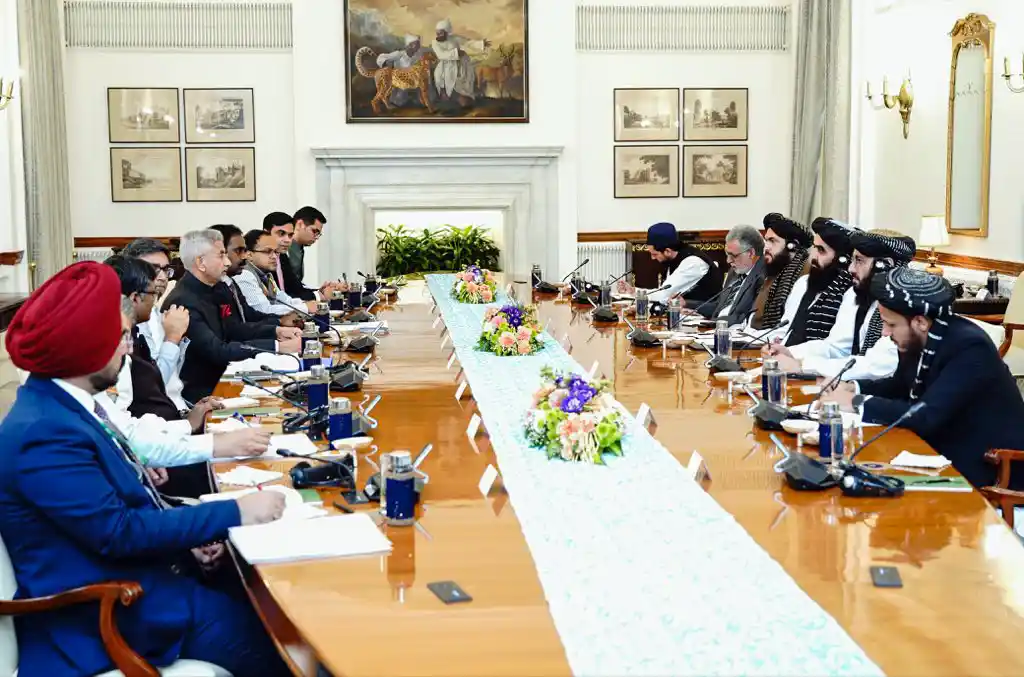
The appointment of Noor Ahmad Noor as the Taliban regime’s new chargé d’affaires to India this January, when juxtaposed with the direction of Taliban Minister for Tribal Affairs Nurullah Nouri to Afghan frontier forces to defend every inch of Afghanistan (against Pakistani aggression), highlights the standard Kautilyan ‘enemy’s enemy is my friend’ foreign policy strategy.
The appointment of Noor Ahmad marks a significant turnaround in India-Taliban relations. While India has welcomed the Taliban’s first-ever envoy, the move is also momentous when contrasted with the Taliban’s deteriorating relations with Pakistan. The appointment comes after India agreed to accept Taliban-appointed diplomats for the Afghan Embassy in New Delhi during the visit of Taliban Foreign Minister Amir Khan Muttaqi in October 2025, who was accompanied by Noor.
Indeed, it was part of India’s recalibration of its Taliban strategy, aimed at improving relations. The acceptance of Noor as Taliban envoy—whose regime India has yet to officially recognize—is part of a series of steps taken by both sides to broaden the scope of cooperation, especially in health and humanitarian assistance. In a way, India is gradually emerging as a viable alternative to Pakistan for the Taliban.
The developing India-Taliban relationship is increasingly being viewed in the context of the latter’s ties with Islamabad. When the Taliban hails India’s role as an alternative to Pakistan as a source of Afghanistan’s pharmaceutical needs, it not only highlights its need for health assistance but also magnifies the common distrust it shares with India toward Pakistan.
The Taliban’s decision to ban the import of Pakistani medicines (in November 2025), following the conflict, is the latest in a series of import bans on Pakistani supplies, inflicting heavy losses on Pakistani farmers and traders. The Taliban has accused Pakistan of using commerce as leverage in broader political disputes and has asserted unambiguously “no trade under duress,” despite incurring heavy losses.
Islamabad, on the other hand, accuses the Taliban of supporting the militant outfit Tehrik-i-Taliban Pakistan (TTP), which has wreaked havoc in Pakistan, and has frequently used commerce as a pressure tool to force the Taliban to withdraw its alleged support. The visit of Taliban Health Minister Mawlawi Noor Jalal Jalali to India (in December 2025), soon after the suspension of pharmaceutical trade with Pakistan, highlighted India as an alternative source. India’s high-quality pharmaceutical sector—ranking third worldwide by volume of production and 14th by value—naturally draws Taliban interest.
The Taliban regime seeks to continue benefiting from the advantages Afghans enjoyed through relations with India prior to 2021. One important sector in this regard is healthcare. Medical tourism from Afghanistan to India flourished over the last two decades, given the dire state of Afghanistan’s healthcare system. India introduced medical visas for Afghans in 2005, with hospitals offering websites in Dari and Pashto, as well as separate payment and service desks for Afghan patients.
Interestingly, Pakistan had been a natural destination for Afghan nationals seeking medical treatment, primarily due to shared cultural ties, linguistic similarities, and affordable healthcare services, with cities like Peshawar becoming hubs for Afghan medical tourists. However, Pakistan’s increasingly suspicious attitude toward Afghan nationals—making visa acquisition difficult, requiring compulsory police reports and security clearances, and imposing unnecessary checks at border crossings—along with rising medical costs, has eventually backfired. Pakistan now laments the loss of Afghan medical tourists to India.
Now, as Pakistan wages war on its neighbour and reportedly bombs hospitals in Kabul, the Taliban sees India as a crucial healthcare destination for Afghans. India has duly responded by issuing 200 medical visas to Afghans (between August and December 2025) after unveiling a new Afghan visa module in April 2025 that prioritizes medical cases.
What is evident from the Taliban’s gesture toward India is its strong urge to relieve its regime of the burden of dependence on Pakistan. Pakistan has long been accused of covertly interfering in Afghan civil wars by conducting ‘proxy jihad’. Even on the eve of Kabul’s fall to the Taliban in 2021, there was widespread conviction in Afghanistan that Pakistan was once again engaging in such activities, pushing the country into turmoil.
Although Pakistan exerted significant influence over the Taliban 1.0 regime (1996–2001), the current Taliban 2.0 leadership understands the value of external assistance that has flowed into Afghanistan since 2003 and thus insists on its continuation. A fragile economy like Pakistan’s, engulfed in sectarian violence, cannot match the world’s fifth-largest economy, whose share in the global economy has doubled from 1.6 percent in 2000 to 3.4 percent in 2023.
The Taliban 2.0 regime is therefore inclined to augment trade and consultative mechanisms with India and is “open for business,” supported by air, sea, and land connectivity. Indeed, its priority appears to be the economic development of Afghanistan, prompting it to look toward India while viewing Pakistan as a persistent hurdle.
For India, this presents a golden opportunity to reset relations with a war-ravaged but geostrategically crucial country. Economically, Afghanistan is gaining significance, with Indian investors eyeing its mineral resources. Moreover, developing relations with the Taliban serves India’s strategic objective of countering similar ambitions of Pakistan—and, more importantly, China.
China became the first country to welcome a Taliban ambassador to Beijing (without formally recognizing the regime) in 2024, a move driven by dual considerations: counterterrorism and economic opportunity. However, China’s attempt to expand the China-Pakistan Economic Corridor (CPEC) into Afghanistan reveals a broader strategic objective—one that seeks to create a contiguous sphere of Chinese influence across regional fault lines, potentially affecting a key strategic chokepoint and circumventing India’s western access.
This development is viewed as a challenge to India, which opposes the CPEC for undermining its sovereignty over Kashmir, through which the route passes, and for diverting Afghan trade from India-backed routes such as the Chabahar port in Iran. However, this undesirable scenario now appears uncertain given the ongoing Taliban-Pakistan conflict, which has disrupted Chinese plans.
China is currently attempting to mediate and de-escalate tensions, but the failure of a similar initiative by Turkey earlier provides grounds for skepticism regarding a positive outcome. The root of the conflict lies in Pakistan’s demand that the Taliban rein in the TTP—a demand the Taliban has refused. This issue is easier said than resolved, given the historically complex and deeply entrenched relations between the ‘unruly’ tribal communities of the frontier and the Pakistani state.
Therefore, as tensions with Pakistan persist, India increasingly appears as a viable alternative for the Taliban, potentially reshaping regional strategic dynamics and constraining the manoeuvring space of its rivals.