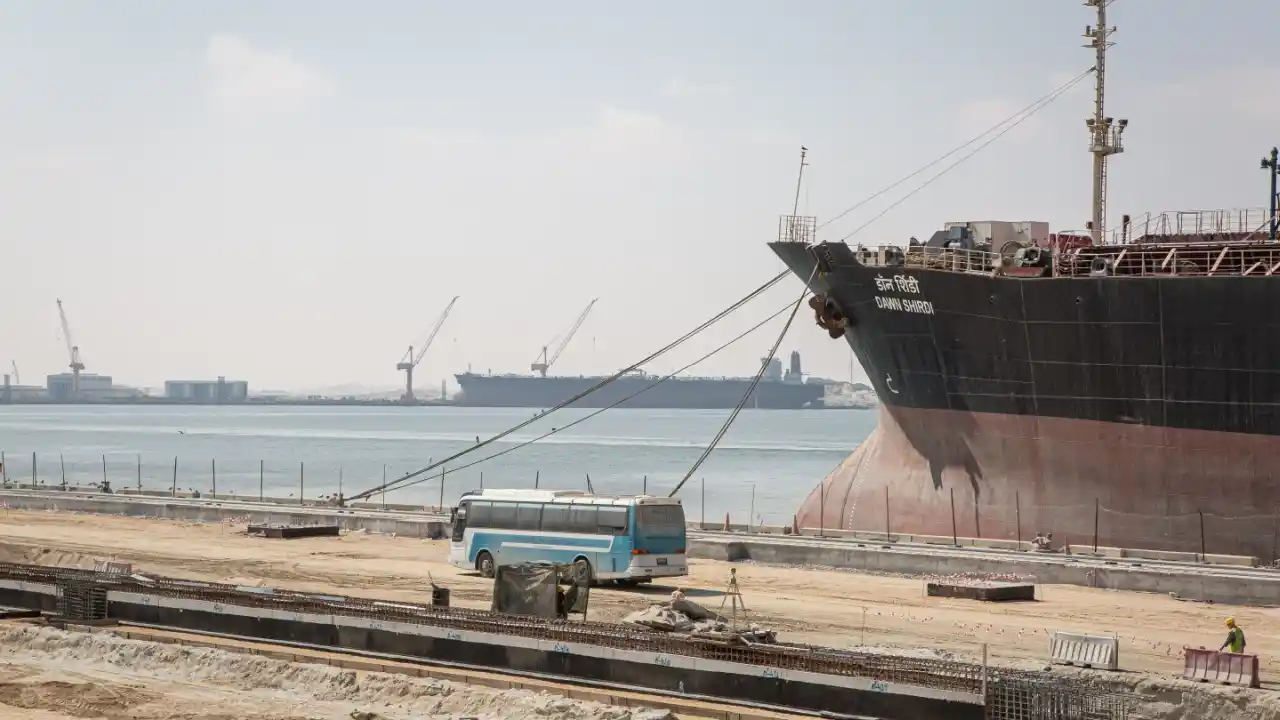
The India–Oman Comprehensive Economic Partnership Agreement (CEPA) came at a time when maritime uncertainty, regional conflict, and supply chain disruptions have transformed economic agreements into instruments of strategic resilience. India–Oman CEPA carries significance beyond economics because of Oman’s geostrategic location and India’s growing concern regarding vulnerabilities associated with the Strait of Hormuz. What is important to understand is whether this agreement is economically beneficial and if it can reduce the struggle for India due to vulnerabilities involving maritime chokepoints and energy security.
The Strait of Hormuz remains among the most strategically significant sea lanes of communication (SLOC) globally. A substantial proportion of global oil trade and LNG shipments pass through this corridor. In the case of India, the disruptions in the Strait of Hormuz translate directly into economic stress, rising shipping costs and insurance premiums, energy insecurity, and supply chain instability. The recurring issue of regional tensions and disputes, drone warfare, and broader regional militarisation indicates major dependence on vulnerable chokepoints, eventually creating structural risks for economies that are dependent on oil trade from the Middle Eastern region. The India–Oman CEPA does not eliminate these vulnerabilities, but it can provide mechanisms through which some of these risks may be mitigated.
Oman’s geostrategic positioning is one of the facilitators for countering these maritime challenges. Unlike several Gulf economies, Oman occupies a unique position stretching from the Arabian Sea to areas adjacent to the Strait of Hormuz. This geographic advantage makes Oman a significant trading partner, especially for India. This also allows New Delhi to engage with a state having access points that are relatively closer to open sea routes and wider Indian Ocean connectivity.
Oman’s ports provide the strongest option for this advantage. The development of logistics infrastructure and economic and industrial zones allows Oman to function as an alternative maritime node within India’s wider maritime connectivity strategy. Such diversification is important because supply chain resilience increasingly depends on the existence of multiple routes rather than single corridors. Further, CEPA contributes toward energy security through institutionalization rather than simple trade expansion. India’s relationship with Oman already includes substantial cooperation in hydrocarbons, LNG, fertilizers, and petrochemicals. The agreement creates a more predictable framework for investment and supply arrangements, reducing transactional uncertainty and encouraging long-term contracts. Stable access to energy, ammonia, and fertilizer inputs becomes particularly important during periods of regional volatility.
This agreement is also significant because disruptions around Hormuz rarely produce complete blockages; rather, they generate uncertainty and speculation. So, nations possessing stronger contractual relationships, diversified suppliers, and embedded investment linkages are generally better positioned during such crises. Thus, CEPA contributes to resilience by increasing predictability rather than by removing geographic risk. And Oman offers connectivity advantages that extend beyond hydrocarbons. India increasingly views economic corridors as strategic assets, demonstrating that maritime initiatives and connectivity now function as an element of geopolitical competition. Oman can serve as a complementary node linking India not only with the Gulf markets but also with East Africa, North Africa, and portions of Central Asia. This wider connectivity dimension helps because chokepoint vulnerability can only be reduced through diversification. The existence of multiple trade routes reduces exposure to disruptions affecting any single corridor. Oman therefore functions as a diversification mechanism within India’s maritime strategy.
The most important limitation is geographical reality. Oman itself cannot fully escape the consequences of instability in Hormuz. Even if there are certain logistical advantages, major military escalation would affect regional maritime traffic broadly. In a similar manner, CEPA cannot solve structural energy dependence. There are also operational limitations. Tariff liberalization alone does not automatically create resilient supply chains. Non-tariff barriers, logistics costs, customs procedures, infrastructure bottlenecks, regulatory inconsistencies, and financing constraints continuously influence trade performance. Unless investments in logistics, warehousing, industrial cooperation, and shipping connectivity expand alongside CEPA implementation, the agreement risks underperforming its strategic potential. Another challenge could be the broader regional security environment. Oman has historically maintained balanced diplomacy and has often acted as a mediator in regional disputes. This diplomatic positioning increases its significance as a stable partner. Nevertheless, regional security remains shaped by actors beyond Oman’s control. Maritime security around Hormuz depends not merely on bilateral relationships but also on wider geopolitical interactions involving Iran, Gulf monarchies, external powers, and non-state actors. Consequently, the India–Oman CEPA cannot be a full-fledged solution to vulnerability in the Strait of Hormuz. Rather, it is a broader risk management strategy.
Ultimately, the value of the India–Oman CEPA lies not in replacing Hormuz but in reducing the strategic consequences of excessive dependence upon it. In an era where economic security increasingly overlaps with geopolitical competition, the agreement reflects a broader shift in Indian policy—from merely securing access to actively building resilience. Oman therefore emerges not simply as another trade partner but as a strategic stabilizer within India’s wider Gulf and maritime calculus. The larger message is that resilience does not emerge from avoiding geography, but it emerges from creating alternatives within geography.
The views expressed are those of the author and do not represent the institution.