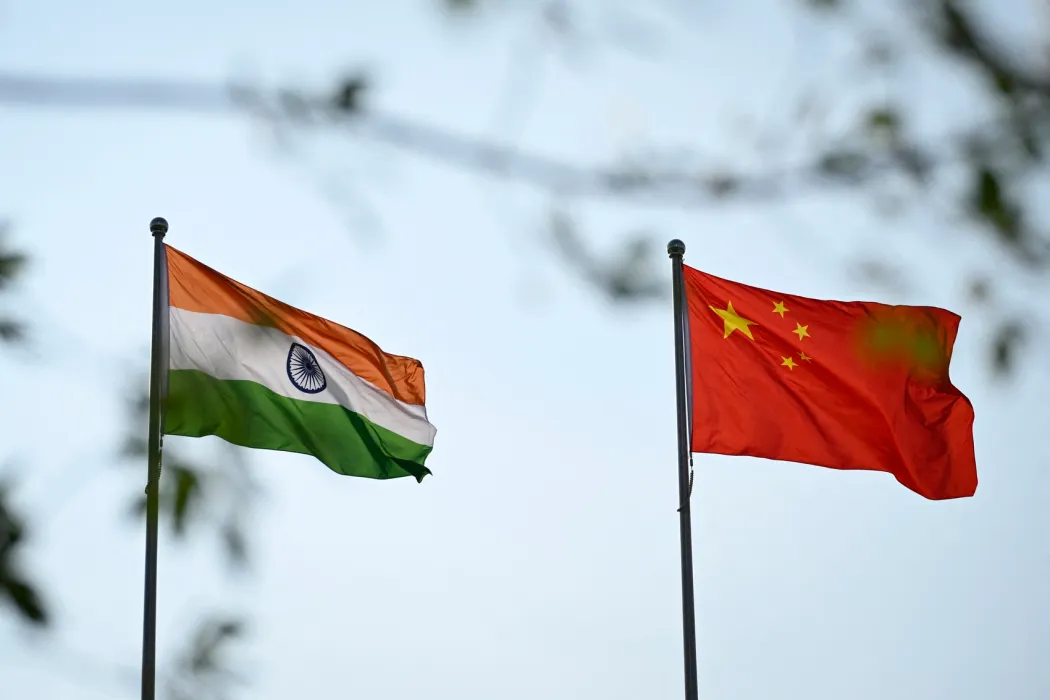
Analysts like to compare India with China.
While there is no doubt that the Middle Kingdom is in advance on India in terms of economic development, advanced research and in other innovative domains, it should be pointed out that India is decades in front of China in terms of freedom and true democracy, though the Indian system is far from being perfect (this is also true for the legislative and judiciary, which is presently being debated in the Indian media).
Free and fair elections is one of the domains where India and China diametrically differ.
On March 15 in Delhi, Chief Election Commissioner Gyanesh announced the schedule for Assembly elections in Assam, Kerala, Puducherry, Tamil Nadu, and West Bengal. It will set in motion an electoral sequence that will determine governments across 824 constituencies; according to a release, “Some 17.4 crore (174 million) people will vote across the five regions.”
A Model Code of Conduct (MCC) immediately came into force across the five states; nearly 24 enforcement agencies have been instructed to ensure elections are free from inducements and violence. District Collectors and Superintendents of Police have been directed to act impartially.
Things are different in China.
Though the Communist Party of China (CPC) is fond of using the word ‘People’, i.e. People’s Republic, People’s Liberation Army (PLA), Great Hall of the People, it is the Party which is supreme is selecting and removing ‘people’ from their posts or functions. This was seen in early March with the PLA delegation shrunk to about half its normal strength of 275 delegates to the National People’s (one more) Congress (NPC).
A day earlier, the NPC had passed a new law about ‘Promoting Ethnic Unity and Progress.’
For the Washington-based International Campaign for Tibet (ITC): “The legislation advances a PRC strategy of demographic homogenization for Tibetans and other non-Chinese peoples behind anodyne language.”
For example, the law says that “it helps better support people of all ethnic groups across the country in advancing national development and rejuvenation through Chinese-style modernization.”
While the Indian States will vote for their own government and Legislative Assembly, China will move in the opposite direction, i.e. eradication of the rich distinct cultures of China’s so-called ethnic minorities.
It is something truly serious as ultimately, it will weaken the cohesion of the Middle Kingdom, fuelling more resentment among ‘minorities’ which today occupy two-thirds of China’s landmass.
ITC observes: “Several provisions in the law serve to legitimize CCP policies forcing Tibetans and others to assimilate into the CCP-defined ‘Chinese’ nation. …The law provides a legal tool for the CCP to establish and enforce a unified national identity and singular idea of China, shaped by CCP and authoritarian ideology.”
The US think tank added: “While the regulations refer to non-discrimination in recruitment and the right to criticize discriminatory practices, they impose a top-down vision of ‘ethnic unity’ which upholds Chinese ethnic identity as the norm. …The regulations also violate the right to freely pursue social and cultural development, pursuant to Article 1 of the Convention on Economic, Social and Cultural Rights, which China ratified in 2001.”
The law has significant ramifications for Tibet and the Tibetan people.
Further, in China, there is no public debate, no court to appeal (even if the process is slow and frustrating in India, it exists).
Laura Bicker, BBC’s China Correspondent, commented: “China has approved a sweeping new law which claims to help promote ‘ethnic unity’ – but critics say it will further erode the rights of minority groups.”
Bicker further observed: “On paper, it aims to promote integration among the 56 officially recognised ethnic groups, dominated by the Han Chinese, through education and housing. But critics say it cuts people off from their language and culture.”
Unfortunately, it mandates that all children should be taught Mandarin before kindergarten and up until the end of high school. In the past young students would study in their native language such as Tibetan, Uyghur or Mongolian.
In a report, Magnus Fiskesjö, an associate professor of anthropology at Cornell University, noted: “The law is consistent with a dramatic recent policy shift, to suppress the ethnic diversity formally recognized since 1949. …The children of the next generation are now isolated and brutally forced to forget their own language and culture.”
It may help the students to find a job, but what about their own cultural identity?
Two days after the new law was passed, Xinhua News Agency announced that Beijing had unveiled its new five-year plan running from 2026 to 2030, emphasizing Artificial Intelligence (AI), computing power and ‘smart economy’.
Xinhua nonetheless noted: “Running through this plan is another important thread. China’s vast frontier regions have assumed a more prominent role in the national masterplan to build a unified domestic market, strengthen energy security, and expand opening up. This emphasizes that the Chinese modernization endeavor is aimed at securing prosperity for all.”
In core sections about transport, energy, digital infrastructure and regional integration, the frontier regions (Tibet and Xinjiang in particular) “are being closely woven into China’s modernization tapestry.”
According to Zhang Bin, deputy director of the Institute of World Economics and Politics at the Chinese Academy of Social Sciences, the Plan highlights among other things, “the strategic importance of Xinjiang. With its location, resources and industrial base, it can serve as a key hub in China’s broader opening up.”
Xinhua explains that the 15th Plan emphasises “continued expansion of westbound freight train services and accelerated development of port infrastructure …thus further boosting westward trade flows.”
For Beijing, Xinjiang had a nearly 20 percent year-on-year increase in the total value of its foreign trade in 2025, ranking first in terms of growth rate among all Chinese provincial-level regions, hitting more than 75 billion U.S. dollars. However, Uyghur culture is lost in the process.
This ‘expansion’ practically means a complete assimilation of the local populations whether it is in Xinjiang, Tibet or Inner Mongolia.
Another domain, where India is in a far better position is the military domain.
The top echelon of the Indian defence forces will witness several changes in the next three months, starting with Gen Anil Chauhan, the present Chief of Defence Staff (CDS), retiring on May 30; the transfer to his successor will be smooth and follow a seniority and merits criteria. A Defence website said: “The selection of CDS apart, the Army and the Navy are also up for many changes at the top level. The Chief of Naval Staff (CNS) Adm. Dinesh Tripathi, is due to retire on May 31 and his school mate, Gen Upendra Dwivedi, the Chief of Army Staff (COAS) will superannuate a month later, on June 30. Choosing their successors appears to be easy.”
The entire process will follow a democratic well-oiled procedure.
In contrast, the PLA has been decimated by ideological purges, with no obvious move or capacity to replenish the sacked generals.
This huge difference between Delhi and Beijing will give a tremendous advantage to India for the future.
Views expressed in the above piece are personal and solely those of the writer.