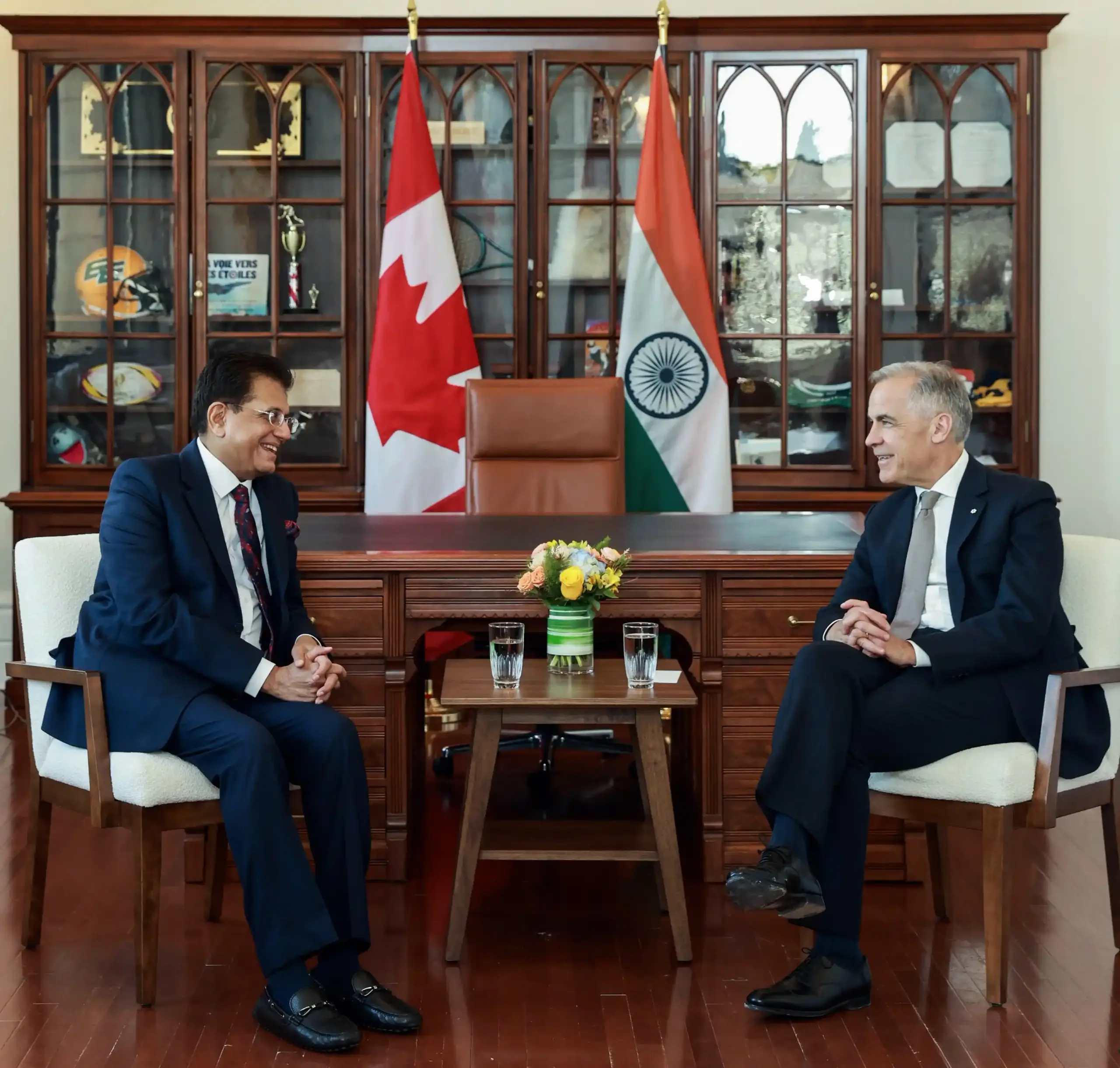
The most significant shift in India–Canada relations in recent years is not found in a single ceremonial visit, but in the decision by both capitals to rebuild the relationship through trade rather than through high-decibel diplomacy. Canada Prime Minister Mark Carney’s outreach to India, followed by Indian Commerce and Industry Minister Piyush Goyal’s engagement in Ottawa, created a clear political consensus: the relationship must be “reset very rapidly,” with CEPA and a shared target of lifting bilateral trade to $50 billion by 2030 as the central instruments of recovery. This marks a decisive move away from the nearly two-year diplomatic freeze that followed the 2023 killing of Hardeep Singh Nijjar, an episode that pushed the relationship into public acrimony, expulsions and visa disruptions.
The strategic logic is straightforward. For Ottawa, deeper commercial engagement with India serves a broader non-U.S. diversification strategy; Canada’s trade officials have explicitly linked India to a larger goal of unlocking close to $300 billion in additional non-U.S. exports. For New Delhi, Canada offers a technologically advanced, resource-rich G7 counterpart whose strengths complement India’s needs rather than compete with them. The complementarity is precisely why a trade agreement between the two countries could be more transformative than headline trade volumes currently suggest.
Structural Rationale for an India–Canada Economic Partnership
The India–Canada relationship has been underutilized because it was politically frozen rather than economically contested. India needs long-term capital, energy resources, critical minerals, advanced technologies, education partnerships and greater access to high-value export markets. Canada needs scale, growth, market diversification and stronger access to one of the world’s largest and fastest-growing economies. A Comprehensive Economic Partnership Agreement, if concluded with seriousness, would not merely reduce tariffs; it would create an institutional framework through which both countries could align supply chains, improve regulatory compatibility and widen investment flows across sectors that matter for their future economic models.
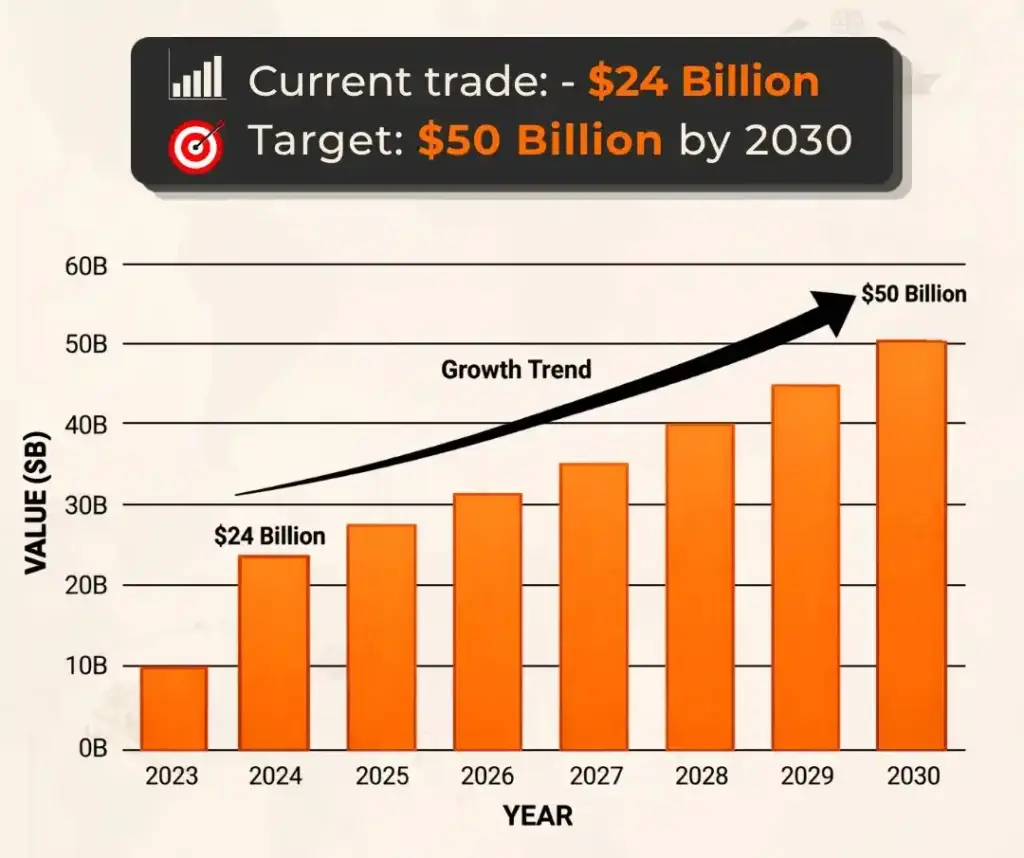
The bilateral trade baseline remains modest, while the target is to get that up to $50 billion by 2030. That target is ambitious but not implausible if the agreement is concluded quickly and if sector-specific barriers are addressed with discipline. The key is to treat the relationship not as a symbolic gesture of reconciliation, but as a strategic economic partnership grounded in comparative advantage and mutual demand.
Sectoral Complementarity and Mutual Gains
The strongest case for the relationship lies in the fact that the gains are spread across multiple sectors and are mutually reinforcing. In energy and critical minerals, Canada is well placed to support India’s transition needs through supplies of uranium and key battery-related minerals, while India offers Canada a large and durable market for long-term resource partnerships. For India, such access strengthens energy security, supports the expansion of nuclear and clean energy capacity, and underpins industrial ambitions in batteries and electric mobility. For Canada, it opens a major downstream market and creates room for its mining and energy firms, as well as pension funds, to participate in India’s infrastructure and green transition story.
Agriculture and agri-food offer another area where both economies stand to gain because their trade baskets are more complementary than confrontational. Canada has competitive strength in pulses, edible oils, feed products and agri-technology, while India can expand exports of processed foods, marine products, spices and niche consumer items into Canadian retail and diaspora markets. A deeper trade framework could reduce friction around standards and food regulation, helping Canada secure stable demand in a vast food market while enabling Indian producers to move up the value chain. The result would not simply be more trade in raw agricultural goods, but a broader agri-processing relationship with room for logistics, packaging and food technology collaboration.
Technology and digital services may prove even more consequential over time. Carney himself identified tech as one of the sectors where opportunities ahead are substantial, and that reflects a deeper reality: Canada has innovation capacity, capital and research ecosystems, while India has scale, engineering talent and globally competitive digital services. A stronger economic relationship could therefore support Indian IT, AI and business services firms seeking greater access to Canadian markets, even as Canadian companies benefit from partnerships in software, digital transformation and innovation services. In practical terms, this gives India more export space in high-value services and gives Canada cost-effective access to talent and execution capacity.
Education is often treated as a soft issue in bilateral ties, but in this relationship it is a real economic sector. Canada benefits from Indian student mobility not only through tuition revenue, but through talent retention, labour market support and long-term innovation linkages. India, for its part, benefits from educational partnerships, research collaboration, skills development and global exposure for its students and professionals. Given that students were among the groups most affected during the diplomatic chill, the normalization of this channel has both economic and symbolic value.
Advanced manufacturing and industrial cooperation also deserve closer attention. India’s push to build stronger manufacturing capacity in electric vehicles, machinery, components and industrial systems aligns with Canada’s strengths in clean technology, engineering-intensive production and industrial inputs. If CEPA is negotiated with a serious investment chapter, Canadian firms could see India not only as an end market, but also as a production base for regional and global supply chains. India, meanwhile, would benefit from technology transfer, joint ventures and deeper integration into advanced manufacturing networks.
The Road Ahead
Still, the reset will succeed only if political will is translated into negotiated outcomes. The rhetoric from recent engagements is encouraging, and the target of $50 billion in trade by 2030 is ambitious but attainable if the agreement is concluded quickly and if sector-specific barriers are addressed with discipline. Yet the obstacles are familiar: non-tariff barriers, regulatory divergence, domestic sensitivities in protected sectors and the lingering mistrust left by the 2023 crisis. The relationship is improving, but it is not yet insulated from politics.
The most constructive reading of the current moment is neither triumphalist nor cynical. Carney’s India outreach, reinforced by Goyal’s subsequent engagement in Canada, has created the most serious opening in years for rebuilding the bilateral relationship on commercially durable foundations. If both governments stay focused on energy, agri-food, technology, education, investment and industrial cooperation, India and Canada can turn a diplomatic recovery into a strategic economic partnership that is genuinely beneficial for both countries.