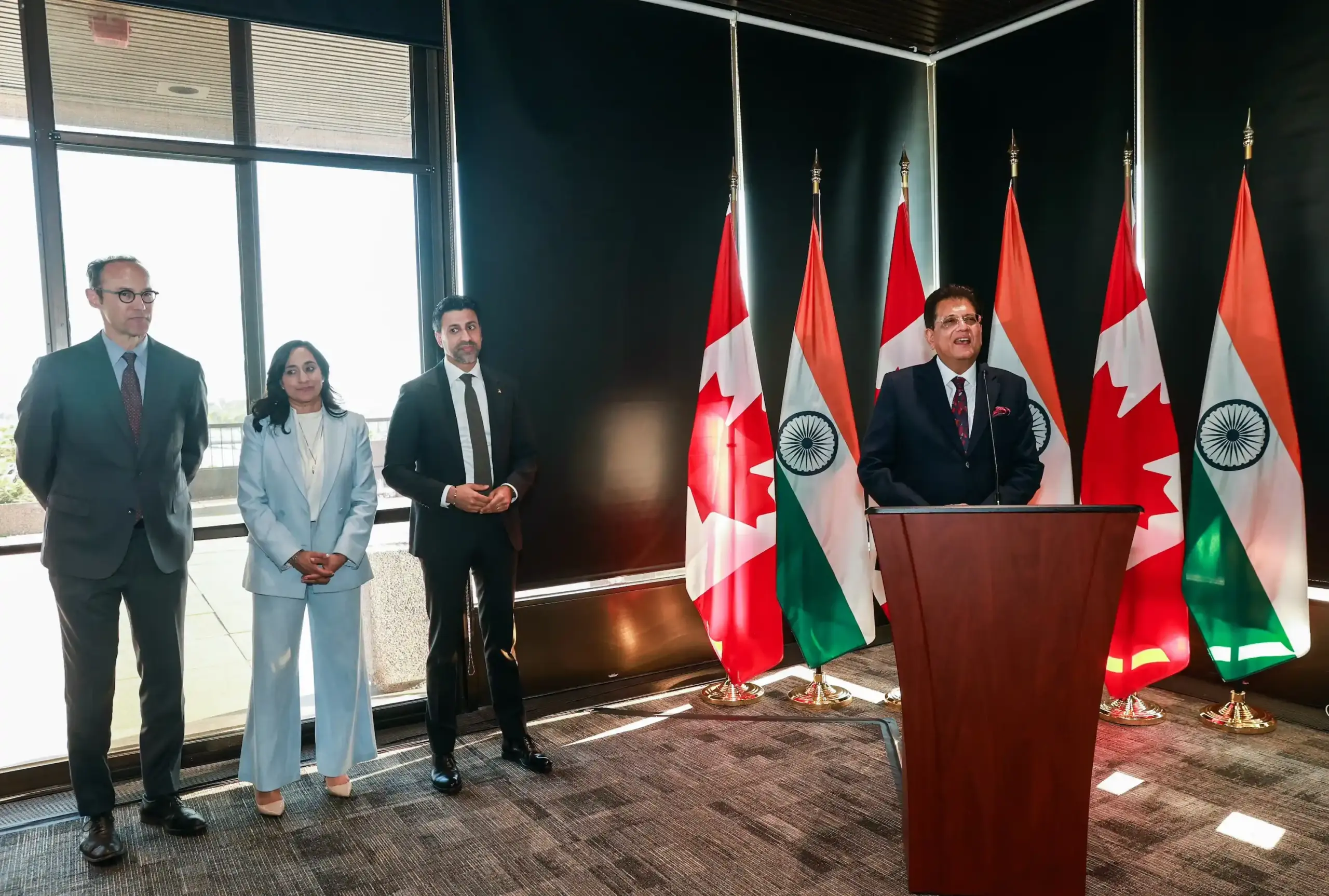
Commerce and Industry Minister Piyush Goyal’s visit to Canada, which concluded on 27 May, was more than a routine ministerial stopover. In many ways, it was the first real commercial test of the India-Canada reset that began during Prime Minister Mark Carney’s March 2026 visit to India. That visit had produced a visible attempt to stabilise the relationship: institutional dialogue was revived, the CEO Forum was relaunched, and both sides signed the Terms of Reference for negotiations on a Comprehensive Economic Partnership Agreement (CEPA). The broader message was clear enough. After a prolonged period of political strain, New Delhi and Ottawa were trying to move the relationship back toward a more structured economic footing.
Goyal’s meetings in Ottawa and Toronto reflected that effort. He met Prime Minister Carney, International Trade Minister Maninder Sidhu, Foreign Minister Anita Anand and Agriculture Minister Heath MacDonald, while also engaging investors, business associations and corporate leaders. CEPA was clearly at the centre of the visit. Both governments used the occasion to reiterate their intention to conclude the agreement by the end of the year.
The scale of the accompanying Indian business delegation was itself significant. Indian officials described it as the largest-ever Indian commercial delegation to Canada, with participation from more than 100 companies across sectors ranging from energy and mining to pharmaceuticals, artificial intelligence, textiles and agriculture. That matters because trade diplomacy ultimately succeeds only when businesses see commercial value in political engagement. Governments can reopen channels. Sustained economic relationships require industry confidence.
The business side of the visit was therefore not ceremonial. Goyal addressed the Canada-India Building Bridges event in Toronto, hosted by Global Affairs Canada along with CII and ASSOCHAM, and co-chaired a Canada-India Investment Roundtable with Maninder Sidhu. He also met representatives of Canadian pension funds, institutional investors and business councils. The objective appeared straightforward: to reconnect trade negotiations with long-term capital flows and investor confidence.
There was also direct outreach to major Canadian companies. Reports from the visit noted meetings with Fairfax Financial’s Prem Watsa, Manulife’s Philip Witherington, Sun Life’s Kevin Strain, TD Bank Group’s Raymond Chun, Neo Performance Materials’ Rahim Suleman and McCain Foods’ Max Koeune. The sectors discussed included financial services, food processing, critical minerals, clean technology and supply chains, closely mirror the areas both governments now identify as commercially promising.
What makes the current moment different is the broader international economic climate in which this engagement is taking place. Both India and Canada are operating in a world where supply chains are being reorganised, economic security concerns are rising, and countries are seeking more dependable trade and investment partners. Critical minerals, clean energy technologies, resilient supply chains and trusted digital ecosystems are no longer niche policy subjects; they are now central to national economic strategy. In that environment, India and Canada possess complementarities that are difficult to ignore. Canada brings capital, resources, technology and energy capacity. India brings scale, manufacturing ambition, market growth and talent.
There is also a geopolitical dimension that quietly strengthens the logic of closer economic engagement. Middle powers across the world are increasingly trying to diversify their strategic and commercial partnerships amid growing uncertainty in the global order. India’s rise as a major economic actor and Canada’s search for more resilient Indo-Pacific engagement create an opening that did not exist in quite the same way a decade ago. Neither side is likely to describe CEPA in geopolitical terms publicly. Yet the strategic context is impossible to miss.
Still, the real importance of the visit lies less in symbolism and more in whether this renewed engagement can avoid the fate of earlier negotiations.
India and Canada first launched CEPA negotiations in 2010. The talks continued for years but never reached conclusion. The problem was not the absence of economic complementarity. In fact, the two economies fit together reasonably well in areas such as energy, agriculture, education, technology and investment. The larger problem was that the negotiations gradually became too broad, too ambitious and too politically vulnerable.
Trade negotiations often lose momentum when their scope expands faster than political or administrative capacity. India and Canada learned that lesson the hard way.
That experience also explains why the distinction between CEPA and the proposed Early Progress Trade Agreement (EPTA) became important. EPTA was conceived as a narrower, early-harvest arrangement that could deliver quicker gains in commercially ready sectors while leaving more contentious issues for later negotiations. But even that process stalled in 2023 amid the sharp diplomatic tensions that followed allegations made by Ottawa regarding the killing of a Canada-based Khalistani extremist designated as a terrorist by India.
That history should temper expectations. Political resets are relatively easy to announce. Durable trade agreements are much harder to negotiate.
At the same time, the current moment does offer a more realistic basis for progress than earlier attempts. Both sides now appear more conscious of the costs of overloading negotiations with too many objectives at once. There also seems to be greater recognition that a commercially meaningful agreement, even if limited in scope initially, would be preferable to another sprawling framework that never reaches implementation.
That is really the core issue. India does not necessarily need a perfect CEPA with Canada. It needs a workable one.
There is no shortage of sectors where practical cooperation is possible. Energy, critical minerals, agri-tech, clean technology, education, digital infrastructure and long-term investment all offer obvious opportunities. Official briefings before Goyal’s visit repeatedly highlighted areas such as clean energy, food processing, technology and critical minerals. The large business delegation accompanying him was important for the same reason. Its success will ultimately be measured not by optics, but by whether it generates actual investment pipelines, partnerships and follow-up projects.
Mobility and education could also emerge as stabilising pillars of the relationship if handled sensibly. Canada has long been an important destination for Indian students and skilled professionals, while India’s expanding technology and innovation sectors increasingly matter to Canadian firms looking for talent and scale. A carefully structured economic partnership that includes predictable mobility arrangements could therefore generate benefits extending well beyond trade statistics alone.
None of this means the political difficulties have disappeared. The India-Canada relationship remains vulnerable to diplomatic friction, market-access disputes and security concerns. India’s long-standing concerns over a small fringe of Canada-based Khalistani extremists continue to cast a shadow over the relationship. Agricultural sensitivities and tariff disputes have also complicated trade discussions in the past.
But allowing every political disagreement to freeze economic engagement would be a strategic mistake for both countries. Mature relationships compartmentalise when necessary. Trade diplomacy rarely moves in straight lines.
The symbolic elements of Goyal’s visit also carried some significance. His visit to the Kanishka Memorial at Humber Bay Park, where he paid tribute to the victims of the Air India Flight 182 bombing, acknowledged one of the darkest chapters in India-Canada relations. His outreach to members of the Indian diaspora in Brampton reflected another enduring reality: the Indian-origin community remains an important bridge between the two countries, commercially as well as socially.
The Canadian side, too, signalled that this process is intended to continue beyond a single ministerial visit. Maninder Sidhu announced a Team Canada Trade Mission to India in November 2026 focused on sectors such as artificial intelligence, critical minerals, renewable energy, semiconductors, digital infrastructure and advanced manufacturing. That announcement may prove more consequential than it initially appears because it suggests a move toward sustained reciprocal engagement rather than isolated diplomatic signalling.
The real test now lies ahead. The Terms of Reference signed earlier this year have given the negotiations structure and political backing. Business interest has clearly revived. But negotiations of this kind tend to become unwieldy when governments try to resolve every difficult issue simultaneously.
India should therefore continue to push for a CEPA that is balanced, realistic and achievable. The best trade agreements are rarely the most ambitious on paper. They are the ones that can actually be concluded, implemented and expanded over time.
Goyal’s visit demonstrated that the political appetite and commercial interest for such an outcome still exist. Whether that momentum survives the next phase of negotiations is another matter entirely.