

India’s latest economic report card offers a reason for optimism. The unemployment rate eased to 4.9% in February — the lowest in over two years — surprising analysts who expected only modest improvement. For a country still rebounding from the twin shocks of the pandemic and global volatility, this figure feels like a milestone. It suggests that India’s growth story is not just alive, but gathering pace.
Behind the number lies an encouraging shift in the rhythm of hiring. Employment creation is no longer locked within a handful of urban hubs or select industries. February’s gains were spread across manufacturing, construction, retail, logistics, and agriculture — a sign that recovery is broad‑based and reaching both rural and urban India. Government capital spending, pre‑election infrastructure drive, and rebounding business confidence appear to be translating into tangible job opportunities.
Perhaps most heartening is the evidence of revival in rural employment, traditionally the backbone of India’s economy. The pickup in rural jobs, driven by infrastructure projects, small manufacturing clusters, and allied agricultural activities, indicates that the benefits of growth are filtering down to smaller towns and villages. This expansion helps stabilize household incomes and strengthens rural demand, creating a virtuous cycle of economic activity.
The manufacturing push under the “Make in India” and “Atmanirbhar Bharat” programs seems to be showing results. PLI (Production Linked Incentive) schemes are attracting global investments in sectors such as electronics, automobiles, and renewable energy. These industries not only create direct factory jobs but also spawn ancillary employment in logistics, component manufacturing, and services. The growing trend of global companies choosing India as a production base has made job creation increasingly resilient to seasonal slowdowns.
Youth employment, often seen as India’s biggest challenge, is also witnessing green shoots. The technology and digital services industries continue to thrive, employing millions in software, data analytics, and cloud solutions. More recently, India’s robust startup ecosystem — from fintech and e‑commerce to green energy — has become a magnet for young talent. The government’s continued focus on skilling through programs like PM Kaushal Vikas Yojana ensures that a generation of youth is better prepared for the changing job landscape.
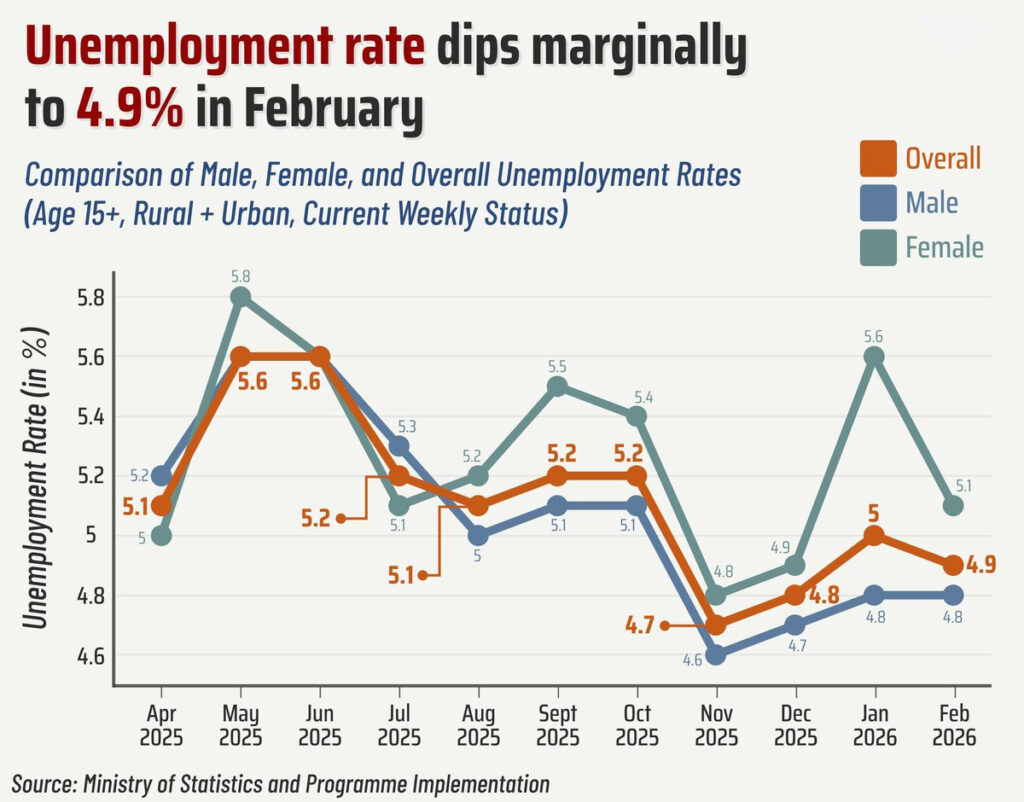
While much of the recent improvement stems from cyclical recovery, deeper structural trends are also playing out. India’s labor force participation rate, particularly among women, has begun moving upward after years of stagnation. More women entering the workforce — in healthcare, education, micro‑entrepreneurship, and digital services — indicates a gradual but meaningful transformation in the nature of India’s employment base. As digital connectivity expands, new flexible models of work, including remote and part‑time opportunities, are unlocking economic potential for millions who were previously excluded.
Skeptics might caution that many new roles still lie within the informal or gig sectors. Yet even here, India’s trajectory offers reasons for optimism. Digital platforms are helping organize informal workers, allowing them access to credit, insurance, and training. The rise of app‑based gig work and the steady formalization of small enterprises through GST and digital payments are slowly bridging the gap between informal and formal economies. Such changes may not immediately reflect in statistics, but they form the groundwork for more sustainable job creation.
Policy continuity has also played an under‑appreciated role. From steady capital outlay in infrastructure to incentives for manufacturing and housing, the government has maintained a pro‑investment stance that is beginning to bear fruit. India’s focus on renewable energy and green mobility, for example, is not only helping the environment but also creating thousands of high‑tech jobs in solar, storage, and electric vehicle manufacturing. These are precisely the sectors expected to drive employment growth in the next decade.
The 4.9% unemployment rate is therefore more than just a flattering number — it is an indicator of momentum. It shows that the economy is capable of generating jobs even amid global uncertainty, and that domestic demand remains robust. It also validates the strategic bet policymakers placed on infrastructure and manufacturing as twin engines of inclusive growth.
Of course, challenges remain: underemployment, skill mismatches, and regional disparities still persist. But the current trend suggests that India now has both the macroeconomic stability and the institutional strength to address them. The focus should shift toward sustaining this progress — by boosting vocational training, supporting small businesses, and encouraging greater female participation in the workforce.
Every economy experiences ups and downs. What defines resilience is the ability to emerge stronger from disruptions — and India appears to be doing just that. February’s unemployment numbers reflect the collective effort of entrepreneurs, workers, and policymakers who adapted, innovated, and endured. If the momentum continues through the year, India may well be on the cusp of a new employment cycle — one marked not just by growth in numbers but by growth in confidence.
The 4.9% figure should thus be read not as an endpoint, but as a beginning. It captures a nation rediscovering its economic rhythm, powered by aspiration, technology, and enterprise. For India, this is more than a statistical achievement — it is a sign that the promise of shared prosperity is moving closer to reality.

