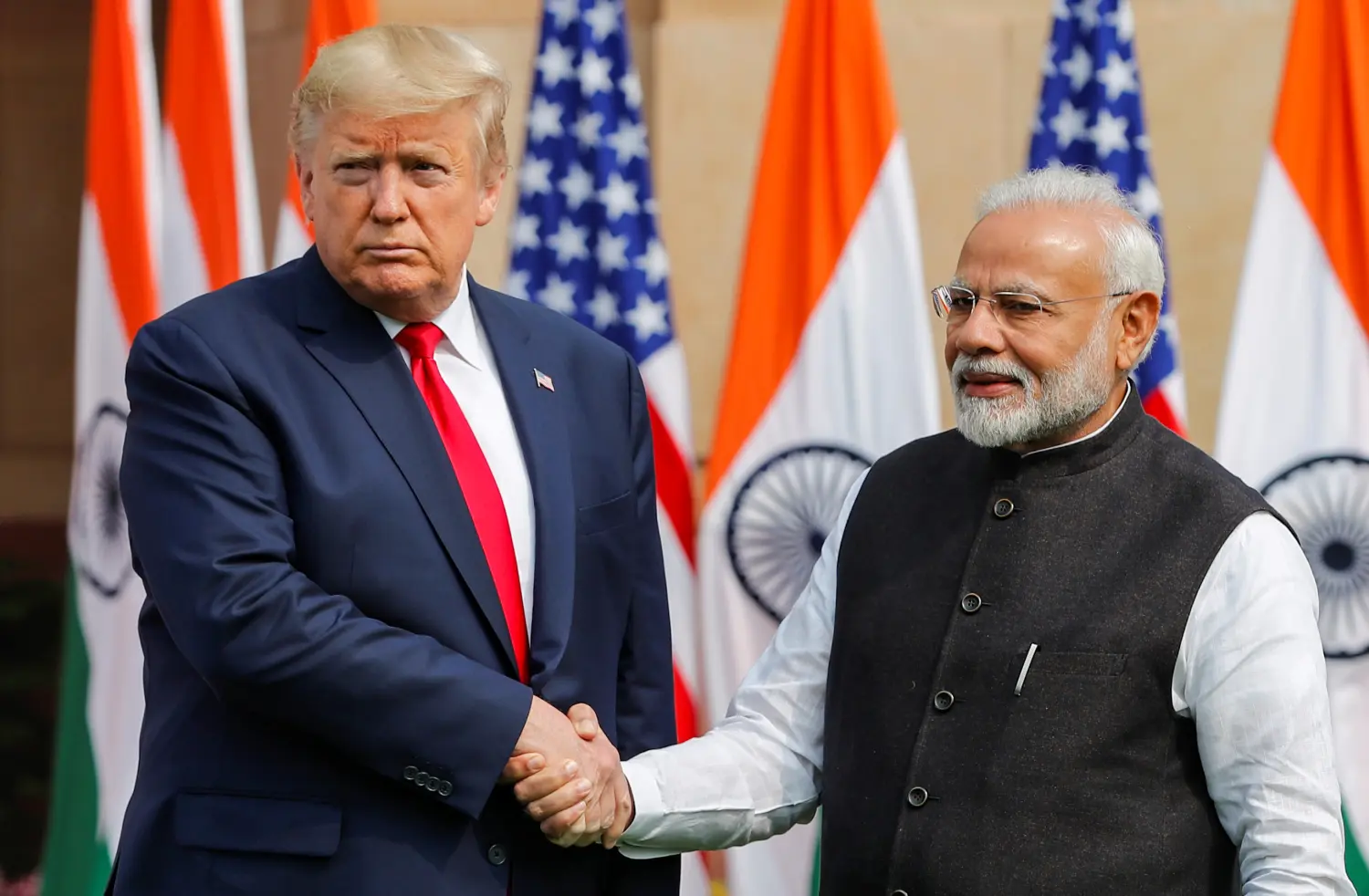
The recent India-US trade deal, announced on February 2, 2026, by President Donald Trump following talks with Prime Minister Narendra Modi, slashes US tariffs on Indian goods from an effective 50% (including a 25% punitive levy) to 18%. In exchange, India commits to reducing its tariffs and non-tariff barriers toward zero on US products, halting Russian oil imports, and purchasing over $500 billion in US energy, technology, agriculture, and defense goods. This pact resolves months of tensions and signals deeper bilateral alignment amid geopolitical flux.
Deal Essentials
At its core, the agreement lowers the US reciprocal tariff from 25% to 18%, eliminating the additional 25% penalty imposed in August 2025 over India’s Russian oil buys, affecting over 55% of India’s $87 billion annual exports to the US (exempting pharma, semiconductors, and energy). India pledges “Buy American” expansions, including ramped-up imports of US oil, coal, aircraft, and arms, while protecting sensitive sectors like agriculture. Bilateral trade, currently at $191 billion with a $500 billion target by 2030, gains momentum through this diplomatic breakthrough, complementing India’s pacts with the UK, EU, Oman, and New Zealand.
It is a step toward a comprehensive Bilateral Trade Agreement (BTA), addressing market access and supply chains. Immediate effects include boosted Indian exports in textiles, engineering goods, chemicals, gems, and jewelry.
Gains for India
For India, the tariff cut removes a “hanging sword” over exports, restoring predictability and unlocking investments in manufacturing under initiatives like Make in India and PLI schemes. Exports to the US, which dipped amid prior tariffs, now stand to rise, supporting GDP growth, job creation in export-linked sectors, and equity market rallies (e.g., GIFT Nifty surged 600 points post-announcement). The China+1 strategy benefits as firms reassess sourcing, with improved access for processed foods and tech collaboration.
Geopolitically, shifting from discounted Russian oil (down to 1.2 million bpd in January 2026) to US/Venezuelan supplies aligns India with Western energy security, though it raises costs short-term; long-term, it bolsters Indo-Pacific ties via Quad and reduces China-Russia axis leverage. PM Modi’s “delighted” response underscores diplomatic wins, positioning India as a diversified trade hub.
Benefits for the United States
The US secures massive purchase commitments—$500 billion across energy, ag, tech, and defense—addressing Trump’s trade deficit concerns and echoing “America First” by exporting coal, oil, and arms to India’s growing market. India’s zero-tariff trajectory on US industrial goods (from 13.5%) opens doors for Boeing aircraft, petroleum, and machinery, balancing the $131 billion bilateral flow.
Strategically, curbing India’s Russian oil imports (a Ukraine war flashpoint) advances US sanctions enforcement and weakens Moscow’s revenues, while deepening iCET tech ties in semiconductors counters China. Domestically, it creates US jobs in export sectors, with analysts like the US-India Strategic Partnership Forum hailing it as a BTA precursor for resilient supply chains.
Global Ripples
Globally, the deal accelerates deglobalization trends, fortifying US-India as a counterweight to China’s dominance; India’s tariffs now undercut neighbors like Pakistan and China, luring FDI via China+1. Energy markets shift as Russian oil loses a top buyer, potentially aiding Ukraine peace efforts and stabilizing prices, though Venezuela’s role adds volatility.
In the Indo-Pacific, it reinforces Quad maritime security and economic resilience against Beijing’s assertiveness, spilling into India’s EU pact for “two biggest capital blocks.” Risks persist: incomplete details on non-tariff barriers or farm protections could spark disputes, and Trump’s unpredictability tempers optimism. Yet, it exemplifies pragmatic bilateralism in a fragmented world.
A Win-Win; With Caveats
This pact exemplifies strategic interdependence, blending economic pragmatism with geopolitics in Trump’s second term. India’s deft diplomacy—leveraging EU/UK deals—extracted concessions without full capitulation, safeguarding farmers while advancing Atmanirbhar Bharat. For the US, it monetizes alliance-building, exporting surpluses amid domestic protectionism.
Critically, over-reliance on US markets risks India’s diversification; Russian oil halt hikes import bills (potentially 20-30% costlier), straining CAD unless offset by export booms. Globally, it marginalizes WTO multilateralism, favoring power blocs—beneficial for minilaterals like Quad but eroding rules-based trade.
Ultimately, success hinges on implementation: a full BTA could double trade by 2030, cementing US-India as the century’s defining partnership. For the world, it heralds a multipolar order where economic pacts double as security hedges, urging others to adapt or lag.