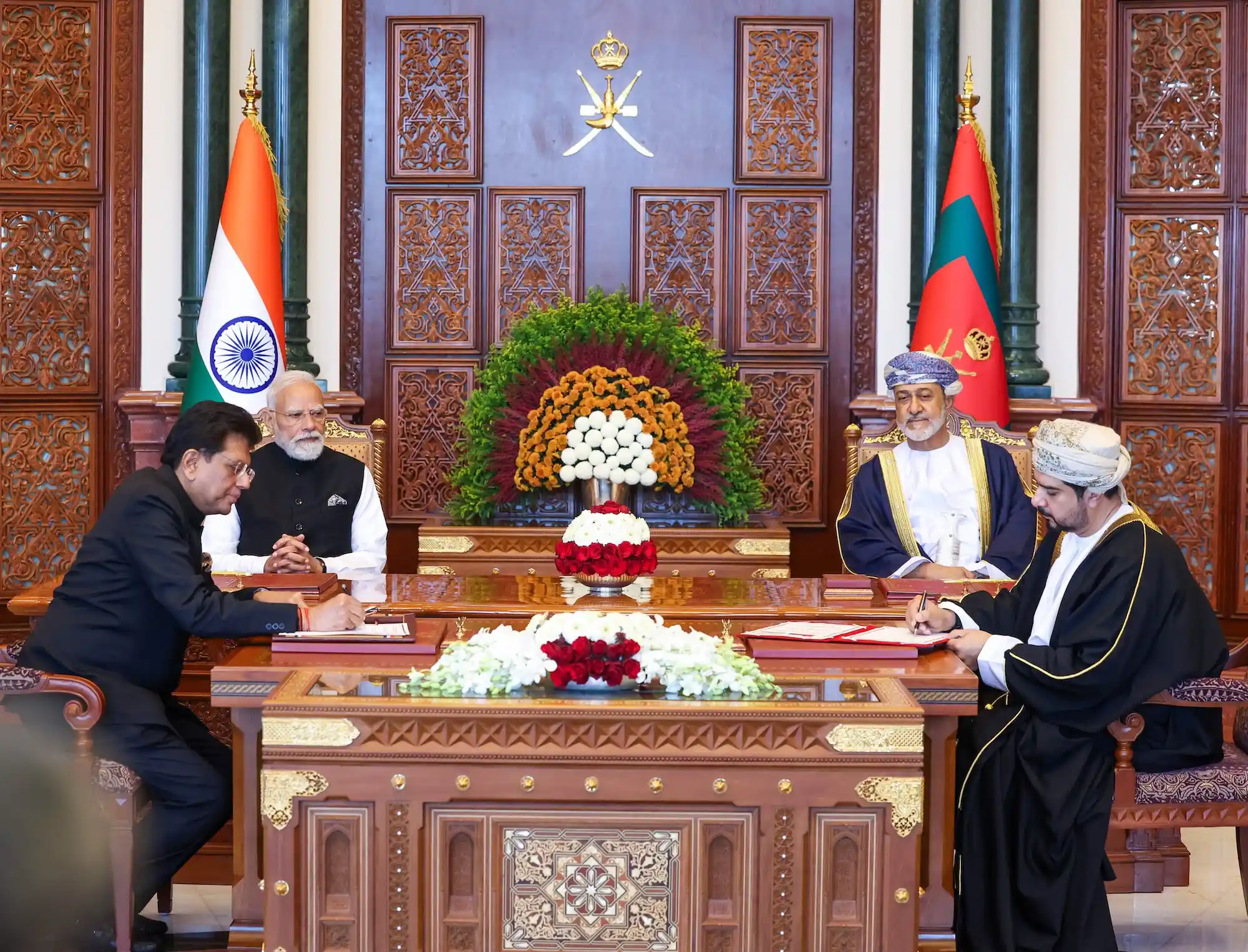
The India–Oman Comprehensive Economic Partnership Agreement (CEPA) represents a significant milestone in India’s expanding network of deep trade agreements. Unlike traditional free trade agreements that focus narrowly on tariff reductions, this agreement is designed as a broad-based economic framework covering goods, services, investment, professional mobility, and regulatory cooperation. Its objective is to create predictable, long-term conditions for trade and investment while safeguarding sensitive domestic sectors.
Expanding Bilateral Economic Engagement
India and Oman have steadily deepened their economic ties over the past decade, creating the foundation for a comprehensive partnership. Bilateral trade reached USD 10.61 billion in FY 2024–25, up from USD 8.94 billion in FY 2023–24, highlighting the rapid expansion of commercial relations. Trade during April–October 2025 alone amounted to USD 6.48 billion, indicating sustained momentum.
India’s merchandise exports to Oman stood at USD 4.06 billion in FY 2024–25, while imports from Oman were valued at USD 6.55 billion, reflecting Oman’s importance as a supplier of energy and mineral-based products. In services, India has maintained a strong surplus: exports increased from USD 397 million in 2020 to USD 617 million in 2023, driven by telecommunications, IT, transport, and other business services.
This expanding engagement in both goods and services provided the economic rationale for moving toward a comprehensive agreement that goes beyond incremental tariff concessions and supports deeper economic integration.
Market Access Gains for Indian Exports
A central feature of the CEPA is near-universal duty-free access for Indian goods. India secures 100 per cent duty-free market access across 98.08 per cent of Oman’s tariff lines, covering 99.38 per cent of India’s export value. All concessions apply from the first day of the agreement’s entry into force, providing immediate certainty to exporters.
This marks a sharp improvement over the earlier regime, where only 15.33 per cent of India’s export value entered Oman at zero duty under MFN terms. Indian exports worth around USD 3.64 billion, which previously faced tariffs of up to 5 per cent, are expected to benefit from enhanced price competitiveness.
With access to Oman’s import market of over USD 28 billion, and supported by streamlined regulatory procedures and faster market entry, Indian exporters are well positioned to expand their presence across a wide range of product categories, including engineering goods, pharmaceuticals, agriculture and processed food, marine products, textiles, chemicals, electronics, plastics, and gems and jewellery.
India’s Calibrated Liberalisation and Safeguards
While Oman has offered near-complete tariff elimination, India has adopted a calibrated approach to market access. India’s tariff liberalisation offer covers 77.79 per cent of tariff lines, accounting for 94.81 per cent of import value from Oman. At the same time, an exclusion list has been maintained to protect sensitive domestic sectors.
Excluded items include key agricultural products such as dairy, cereals, fruits, vegetables, edible oils, and oilseeds, as well as sensitive manufacturing sectors including textiles, leather, footwear, petroleum products, and select chemicals and transport equipment. This approach balances export growth with the need to safeguard farmer interests, MSMEs, and domestic manufacturing competitiveness.
Sectoral Impact: Goods Trade
Engineering Goods
Engineering exports to Oman reached USD 875.83 million in FY 2024–25, covering machinery, electrical equipment, automobiles, iron and steel, and non-ferrous metals. Under the CEPA, all engineering products receive zero-duty access, replacing MFN tariffs of up to 5 per cent. Exports are projected to rise to USD 1.3–1.6 billion by 2030, driven by demand from infrastructure, industrial diversification, and logistics sectors.
Key gains are expected in iron and steel products, industrial and electrical machinery, motor vehicles, and copper products. The agreement is particularly beneficial for MSMEs, enabling scale-up and deeper integration into Oman’s industrial and infrastructure supply chains while offering market diversification amid rising global protectionism.
Pharmaceuticals
Oman’s pharmaceutical market was valued at USD 302.84 million in 2024 and is projected to reach USD 473.71 million by 2031, growing at a CAGR of 6.6 per cent. The market is heavily import-dependent, creating sustained opportunities for Indian suppliers.
The CEPA provides binding zero-duty access for finished medicines, vaccines, and key active pharmaceutical ingredients. It also introduces regulatory fast-tracking for products approved by recognised stringent authorities, allowing marketing authorisations within 90 days in eligible cases. Acceptance of GMP certificates and streamlined stability requirements significantly reduce compliance costs and approval timelines.
Marine Products
Oman imported USD 118.91 million worth of marine products during 2022–24, while imports from India stood at only USD 7.75 million, indicating substantial untapped potential. Immediate duty-free access improves competitiveness for Indian seafood exports such as shrimp and fish.
Given the labour-intensive nature of the marine sector, expanded exports are expected to support employment generation in coastal regions and associated processing activities.
Agriculture and Processed Food
Oman’s agricultural imports increased from USD 4.51 billion in 2020 to USD 5.97 billion in 2024, recording strong growth. India emerged as the second-largest supplier with a 10.24 per cent market share. India’s agricultural exports to Oman rose to USD 556.34 million, growing at a CAGR of over 11 per cent.
Duty-free access strengthens India’s position in products such as boneless bovine meat, eggs, sweet biscuits, butter, honey, and mixed condiments. At the same time, phased tariff elimination and exclusions protect sensitive agricultural interests and food security concerns.
Textiles, Chemicals, Plastics, and Gems & Jewellery
Labour-intensive sectors gain significantly under the CEPA. Indian textile exports now enjoy zero-duty access in a USD 597.9 million Omani market, strengthening India’s competitive position against major suppliers. Chemicals and plastics benefit from the removal of tariffs of up to 5 per cent, improving margins and encouraging industrial cooperation.
In gems and jewellery, India’s exports stood at USD 35 million in 2024 against Oman’s total imports of over USD 1 billion. Duty-free access is expected to support export growth of up to USD 150 million over the next three years, benefiting skilled and employment-intensive jewellery clusters across India.
Services, Investment, and Professional Mobility
Services form a key pillar of the CEPA. In 2024, bilateral services trade stood at USD 863 million, with India recording a surplus of USD 447 million. Oman has undertaken deep market access commitments across 127 services sub-sectors, covering professional services, IT, healthcare, education, tourism, R&D, and business services.
The agreement raises the intra-corporate transferee ceiling from 20 per cent to 50 per cent, enabling Indian firms to deploy more managerial and specialist staff. For the first time, Oman has undertaken commitments for defined categories of professionals, including those in accounting, engineering, medical, IT, education, construction, and consulting services.
Provisions supporting nearly 6,000 India–Oman joint ventures and allowing 100 per cent foreign direct investment by Indian companies in major services sectors are expected to deepen long-term commercial presence and support regional expansion.
Regulatory Cooperation and Trade Facilitation
Dedicated provisions on technical barriers to trade and sanitary and phytosanitary measures promote transparency, use of international standards, and consultation mechanisms. Mandatory acceptance of recognised inspection and certification systems reduces duplication of testing and inspection at ports of entry.
Special cooperation frameworks cover pharmaceuticals, halal products, and organic goods, including recognition of India’s organic certification system, facilitating smoother and faster market access.
The India–Oman CEPA establishes a comprehensive and balanced framework covering trade in goods and services, investment, professional mobility, and regulatory cooperation. By providing near-universal zero-duty market access, deep services commitments, and strong safeguards for sensitive sectors, the agreement is expected to boost exports, generate employment, strengthen supply chains, and support deeper and more sustained economic engagement between India and Oman.