
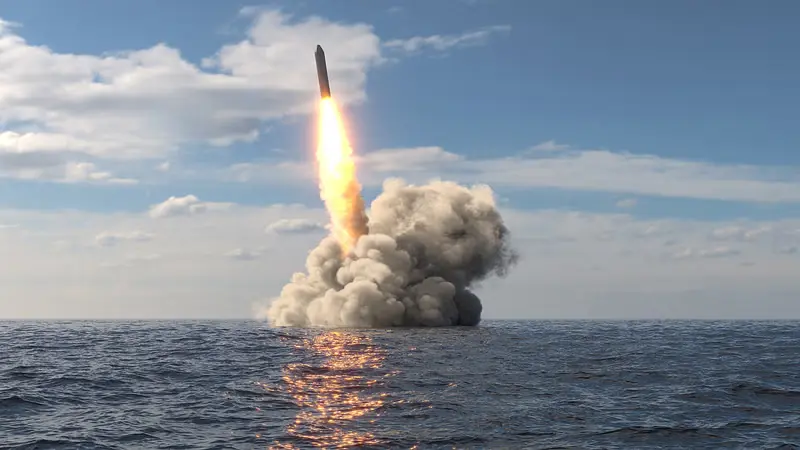
India’s K-4 submarine-launched ballistic missile (SLBM) does not create the nuclear triad from scratch; rather, it is the technology that finally makes India’s triad credible, survivable and regionally consequential. The K-4 allows Indian ballistic missile submarines to hold both Pakistan and key Chinese targets at risk from relatively safe patrol areas, transforming the sea-based leg from a symbolic capability into a genuine second-strike force.
The K-4 is a nuclear‑capable, two‑stage, solid‑fuel SLBM with an estimated range of about 3,500 km, designed to be launched from Arihant‑class nuclear‑powered ballistic missile submarines (SSBNs). It carries a payload of roughly 1 tonne and is optimised for underwater launch, providing higher accuracy (reported circular error probability around 100 m) and better penetration of missile defences than the shorter‑range K‑15.
- Range: ~3,500 km, placing most of Pakistan and large parts of China within reach from the northern and central Indian Ocean.
- Platform: Integrated on INS Arihant and INS Arighaat, which can reportedly carry four K‑4s each (or twelve K‑15s when configured for shorter‑range deterrence).
- Role: Forms the core of India’s sea‑based nuclear deterrent, intended for assured second‑strike rather than first use.
How India’s nuclear triad evolved
India’s nuclear triad refers to the ability to deliver nuclear weapons from land, air and sea, a capability currently possessed by only a handful of states. The triad has evolved incrementally: land‑based Agni series missiles and nuclear‑capable aircraft came first, with the sea‑based leg maturing last through Arihant‑class SSBNs and K‑series SLBMs.
- Land leg: Agni‑I to Agni‑V ballistic missiles, with ranges from 700 km to over 5,000 km, give India the ability to strike targets deep inside Pakistan and China from secure inland bases.
- Air leg: Nuclear‑capable aircraft like modified Mirage‑2000 and Su‑30 MKI, and potentially Rafale, provide flexible but more vulnerable delivery options.
- Sea leg: Began to take shape with INS Arihant’s commissioning in 2016, technically “completing” the triad but with only 750‑km K‑15 missiles, limiting reach and survivability.
INS Arihant’s induction meant India could in theory launch nuclear weapons from undersea, but the K‑15’s 750‑km range forced SSBNs to patrol dangerously close to adversary coastlines, undermining stealth and resilience. Strategists therefore treated the triad as incomplete in practice until a longer‑range SLBM like K‑4 became operational.
Why the K-4 changes the game
The K-4 fundamentally alters the geometry of deterrence by allowing Indian SSBNs to stay in safer bastions in the Bay of Bengal or central Arabian Sea while still holding high‑value targets at risk. With 3,500 km range, K‑4s can cover all of Pakistan and key Chinese cities and bases without SSBNs leaving relatively secure patrol areas under Indian naval and air cover.
- Survivable second strike: Longer range reduces the need to “hug” enemy coasts, making Indian SSBNs much harder to track and target, which is the core logic of sea‑based deterrence.
- Credible no‑first‑use posture: India’s declared no‑first‑use policy relies on the ability to absorb an initial strike and retaliate; survivable K‑4‑armed SSBNs provide that insurance even if land and air assets are degraded.
- Regional reach: Analysts note that while K‑15 could only cover parts of Pakistan, K‑4 extends coverage to the whole of Pakistan and large swathes of China, enhancing bargaining power and crisis stability.
Several assessments explicitly argue that the K‑4 makes India’s nuclear triad “credible” for the first time, because a short‑range SLBM alone did not offer a convincing sea‑based deterrent against China. This shift has implications beyond numbers, reshaping adversary calculations about pre‑emptive strikes and escalation ladders.
Recent tests and operational status
In late 2025, India conducted a high‑profile test of the K‑4 from the nuclear‑powered SSBN INS Arighaat in the Bay of Bengal, reportedly for its full operational range of around 3,500 km. The test followed earlier firings from underwater pontoons and at least one prior launch from an Arihant‑class submarine, marking the transition from development trials to user validation.
- Media and defence sources state that the December 23, 2025 test was carried out by the tri‑service Strategic Forces Command, signalling that the missile is moving towards full operational induction.
- Reports also note that while a few more launches may be required before formal induction, the test effectively validates the sea‑based leg as a usable deterrent rather than a technology demonstrator.
Once fully operational, INS Arihant and INS Arighaat are expected to sail with a mix of K‑4 and K‑15 missiles, allowing mission planners to tailor loadouts for near‑sea patrols or extended‑range deterrence missions. This flexible load‑out concept mirrors practices of more established nuclear navies, underscoring India’s transition into a mature sea‑based deterrent power.
Strategic and geopolitical significance
For New Delhi, a credible K‑4‑armed SSBN force is more than a technical milestone; it is a political signal of great‑power ambitions and a hedge against a deteriorating Asian security environment. It comes amid China’s naval expansion into the Indian Ocean and Pakistan’s deepening strategic alignment with Beijing, both of which have sharpened India’s focus on survivable deterrence.
- Narrow nuclear club: India joins a small group—primarily the US, Russia, China, France and the UK—with operational SLBMs on SSBNs, enhancing its status and bargaining leverage in global nuclear norm‑setting.
- Crisis stability: By reducing incentives for a disarming first strike, a survivable sea‑based deterrent can dampen nuclear brinkmanship, even as it may spur counter‑measures like improved anti‑submarine warfare by rivals.
- Technological signalling: The K‑4 and Arihant‑class programmes showcase indigenous R&D and industrial capacity under a nuclear‑powered and nuclear‑armed platform, reinforcing India’s narrative of strategic autonomy.
In that sense, the K‑4 does not just “complete” the nuclear triad in a mechanical, three‑legged sense; it turns India’s triad into a credible and survivable deterrent aligned with its no‑first‑use doctrine and great‑power aspirations in a turbulent Indo‑Pacific.

