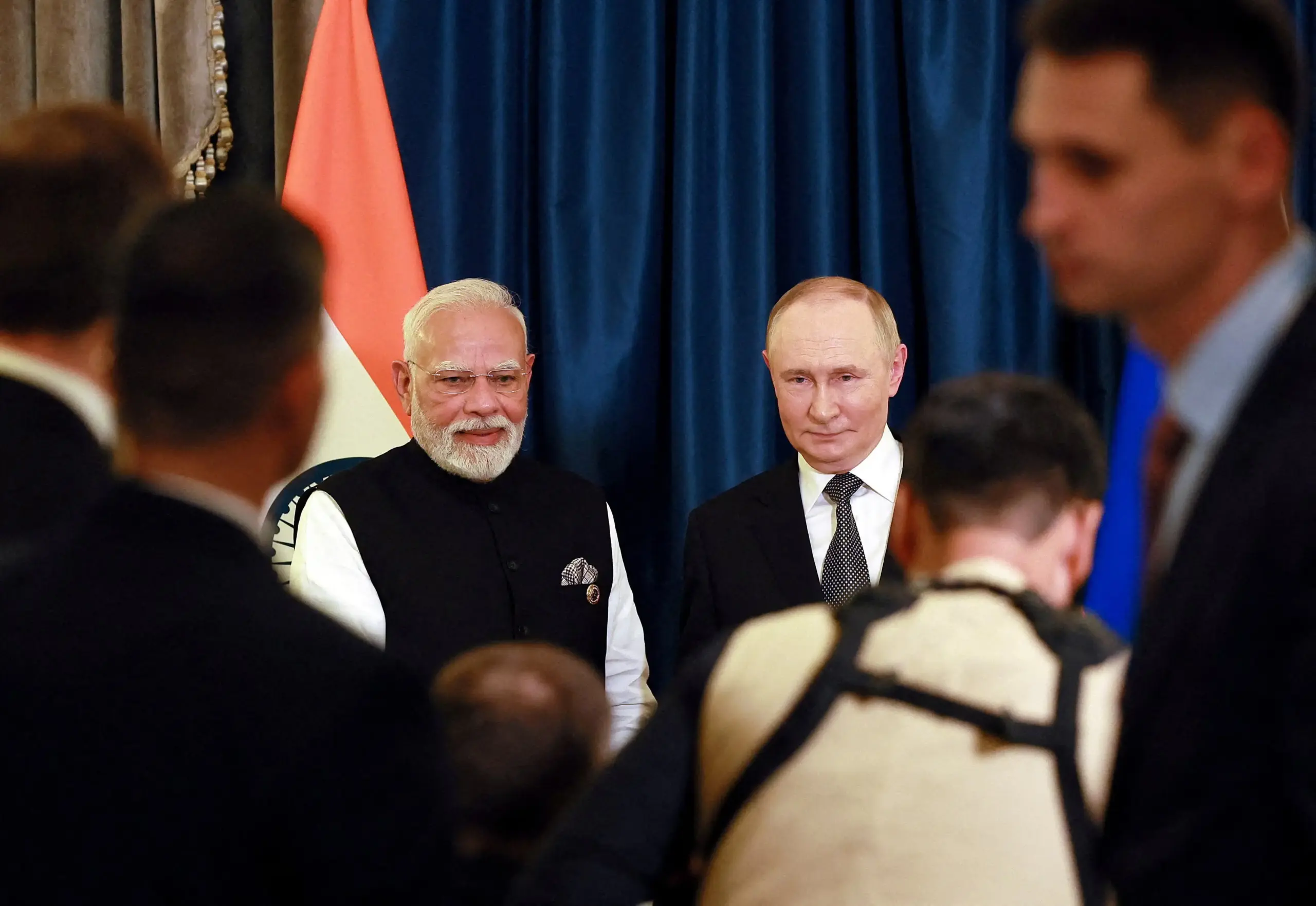
Russian President Vladimir Putin’s state visit to India is essential for many reasons. At the bilateral level, it reiterates the importance both sides attach to their mutual ties. For India, this relationship has proved its value over the last seven decades or so. It has been a steady relationship and has served India’s interests in vital areas. If nothing else, pragmatism demands that we continue to invest in a relationship that has endured so well.
Russia may be a relatively diminished power after the collapse of the Soviet Union, but, besides being the world’s largest country and possessing enormous natural resources that give it a great degree of self-sufficiency, it remains a formidable military, nuclear, and space power. As a permanent member of the UN Security Council, it exercises considerable international influence.
How many countries have such attributes? It is therefore surprising that some even in India talk of Russia’s diminished importance to us. Yes, our ties with the US have significantly expanded, and in many ways that relationship has become our most important one, but this does not mean we have to view our ties with the US and Russia in an either-or or in a renewed Cold War mode. Both relationships have their own importance in the matrix of our foreign policy.
With India’s rise and its increasing weight at the global level, the equation between India and Russia has also changed, with Russia now acknowledging that its partnership with India has become more critical at a time when Russia is under great pressure from the West, and it needs to expand and consolidate its openings towards Asia beyond China.
Putin’s several public statements acknowledging India’s rising stature as a global player and appreciating the independence of its foreign policy underline Russia’s new thinking and approach towards India. Modi and Putin have engaged each other very cordially, including at the SCO summit in China. That Putin has received our External Affairs Minister and the National Security Adviser more than once in recent months shows how much ease in levels of communication has occurred and how much the protocol element has undergone a change from the past.
Putin has been hampered in his foreign travels because of his indictment as a war criminal by the International Criminal Court (ICC). This makes his travel to India important in the international context. India is not a member of the ICC and is unbothered by this engineered judgment. The West has tried to isolate Russia internationally. It has put pressure on India to distance itself from Russia and demanded that it reduce its defence and energy ties with it. We have received moral lectures from the West on our refusal to condemn Russia for its military intervention in Ukraine. This went to the absurd length of accusing us of funding Russia’s Ukraine war by continuing to buy discounted Russian oil. Trump went to the extreme of imposing an additional penalty tariff of 25% on India’s exports to the US because of our oil purchases from Russia. This penalty has not been removed even after Trump gave a red carpet treatment to Putin in Alaska, and the exploration of potential economic cooperation with it is driving him to promote a solution to the Ukraine conflict.
It is in this general background that Putin’s visit is taking place. At the bilateral level, it is a vote of confidence by both sides in the inherent value of their close ties and a signal of their determination to nurture them despite unfavourable conditions created by the West. For India, it is an assertion of our strategic autonomy. This is not being petulant or defiant for the sake of defiance. It simply means that we cannot allow the US or Europe to exercise control of foreign policy choices that we make responsibly in our enduring and vital national interest.
On the oil front, we do face a problem because of the sanctions imposed by Trump on two major Russian oil companies supplying oil to India. Our private sector and government-owned oil refineries will willy-nilly reduce their purchases of oil from sanctioned Russian companies to avoid US secondary sanctions, which could damage their larger business and financial interests by loss of access to the US-dominated financial system. That these sanctions are illegal is neither here nor there. India has much less resilience than Russia in dealing with these sanctions because of the size of our economic, investment, financial, and technology ties with the US.
This would mean that the overall India-Russia trade figures will come down drastically. Some Russian oil will flow into India, but in much smaller quantities. To raise trade levels to $100 billion by 2030, the target announced by the Kremlin spokesperson Dmitri Peskov, would require Russia to buy much more from India, as Indian exports to Russia, at less than $5 billion, are pitiably small. Russia is now willing to look at its regulatory and registration processes to facilitate the import of Indian products. India and Russia have organised a giant business conclave on the occasion of Putin’s visit. There are serious possibilities of India exporting electronic products, pharmaceuticals, textiles, agricultural and fishery products to Russia, besides cooperation in the IT sector. With the Western sanctions on Russia, payment systems have been disrupted. We seem to have found some ways to go around them, with Peskov stating that our bilateral trade is now being conducted in national currencies. Even if that is the case, the breakdown in payment mechanisms does hinder trade.
In the defence area, no major acquisition announcement is expected to be made during Putin’s visit. However, Defence Minister Rajnath Singh has already stated publicly that India would wish to acquire additional S-400 air defence systems if Russia can provide them. Talk of acquiring S-500S seems a little premature, as Russia has still to complete the earlier contract for S-400S. Russia is offering its latest Su-57 aircraft with complete technology transfer. India will have to weigh this offer in the light of its ambition to be self-reliant and its own AMCA programme. India could usefully explore how it can benefit from weaponry and other capabilities Russia has demonstrated during the Ukraine conflict in countering NATO’s advanced weaponry supplied to Ukraine and the new modes of modern warfare it has faced. The Russian parliament has ratified a Logistics Agreement with India.
Russia has offered a no-limits partnership with India, according to the Kremlin spokesperson. It is willing to go ahead with India as far as India wants. This is an important message, as it means that Russia sees its relationship with India as crucial as with China. This is a message directed at China, too. The intention is to reassure India that its ties with us are independent of Russia’s ties with China. It is to dispel any concern that the very close Russia-China strategic ties will come at the cost of ties with India, and that India can no longer rely on Russia as before. This “no limits partnership” phrase will cause some disquiet in the West as it will fuel concerns there about a potential Russia-India-China nexus developing at the cost of the West, especially if the phrase gets reflected in any official document. Even a trilateral Modi-Putin-Xi holding of hands in Tianjin causes a lot of flutter in the West.