
India’s economy grew by 8.2 per cent in the July-September quarter, the fastest in six quarters, even as Donald Trump’s tariffs battered its exports. This is no mere statistic. It signals a profound shift: India, long lectured by Washington on trade imbalances and strategic fealty, has forged a resilience that tariffs alone cannot shatter.
The Numbers That Defied Expectation
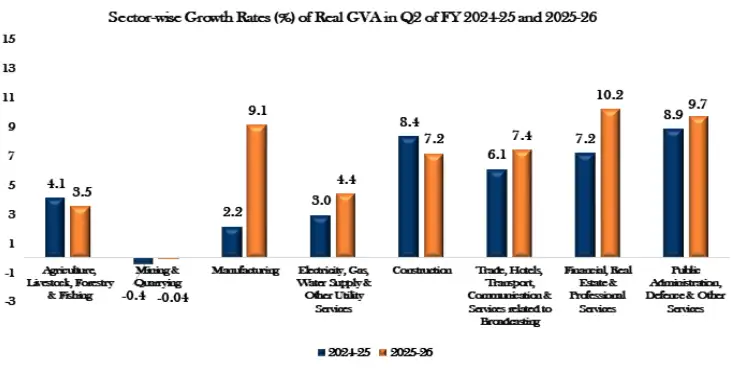
The Ministry of Statistics and Programme Implementation released the figures on Thursday, pegging real G.D.P. growth at 8.2 per cent for the second quarter of the 2025-26 fiscal year—above the 7.9 per cent economists had forecast and a sharp rebound from last year’s 5.6 per cent. Nominal growth, the raw measure that matters to budgets and balance sheets, hit nearly 9 per cent, buoyed by cooling inflation. Manufacturing surged past 9 per cent, construction topped 7 per cent, and services like finance and real estate expanded by double digits. Agriculture grew modestly, in the mid-single digits, underscoring that this boom sprang from factories and urban demand, not the whims of the monsoon.
Tariffs as the Unseen Spectre
President Trump, inaugurated anew in January, wasted little time. By late August, his administration had layered tariffs reaching 50 per cent on most Indian goods—a cocktail of baseline duties, “reciprocal” measures, and punitive add-ons. The casus belli? India’s purchases of discounted Russian oil, its push within BRICS, and a perceived tilt away from American priorities. The United States absorbs a fifth of India’s exports; a sudden duty hike should have cratered shipments, idled plants, and dented growth. Exports to America did slump, by double digits in key months. Yet total merchandise and services exports rose 5 to 6 per cent in the quarter, cushioned by surges to the Gulf, Europe, Africa, and East Asia.
Diversification, the Quiet Revolution
India did not stumble into this fortitude. Over a decade, it methodically rewired its economy. Export destinations proliferated: shipments to the U.A.E., South Korea, Germany, Vietnam, Mexico, and Nigeria grew even as America faltered, these markets now claiming more than half of total outflows. The goods mix evolved, too. Electronics—smartphones, components—jumped 25 to 40 per cent year on year through August, finding takers not just in the West but in Dubai, London, and Shenzhen. Fiscal 2024-25 closed with exports at a record $825 billion, up 6 per cent, tilting toward high-value manufactures over raw commodities.
Domestic engines roared louder still. Private consumption climbed almost 8 per cent, from 6 per cent a year earlier, as households propelled factories. Public investment in highways, ports, rail corridors, and renewables crowded in private capital, from data centres to electric vehicles.
Policies That Bent History’s Arc
These trends trace to choices that once seemed quixotic. Production-linked incentives lured assembly lines for phones, drugs, and solar panels, transforming India from importer to exporter. Factories, once tethered to American buyers, pivoted seamlessly to new shores. Infrastructure spending—roads doubling in length, airports tripling—slashed logistics costs, letting firms compete post-tariff. Fiscal prudence trimmed deficits without gutting capex, steadying rates and drawing foreign funds amid global flux.
Consider the vignette of a Foxconn plant in Tamil Nadu, churning iPhones for global chains. Tariffs bit U.S.-bound units, but orders from Europe and the Middle East filled the gap. Or Tata’s semiconductor foray, backed by incentives, now supplying chips to domestic autos and exports alike. These are not abstractions; they are the sinews of 8.2 per cent growth.
Leverage Rebalanced
Trump’s tariffs aimed to cow New Delhi into alignment—curb Russian oil, rethink BRICS, buy more American arms. They miscalculated. India’s model, once U.S.-reliant, now decouples enough to endure. Exporters in garments or gems ache, jobs wobble in vulnerable niches. But with consumption resilient and manufacturing ascendant, India negotiates from strength—on digital taxes, trade pacts, even defence.
New Delhi eyes a trade deal by year’s end, officials say, but on its terms. This is the new calculus: an 8-per-cent grower, with $4 trillion in output and rising, is no supplicant. Trump may tariff anew, but India’s trajectory—forged in diversification, demand, and deliberate policy—suggests the era of economic hectoring has waned. In its place emerges a power that bends, rather than breaks, under pressure.

