
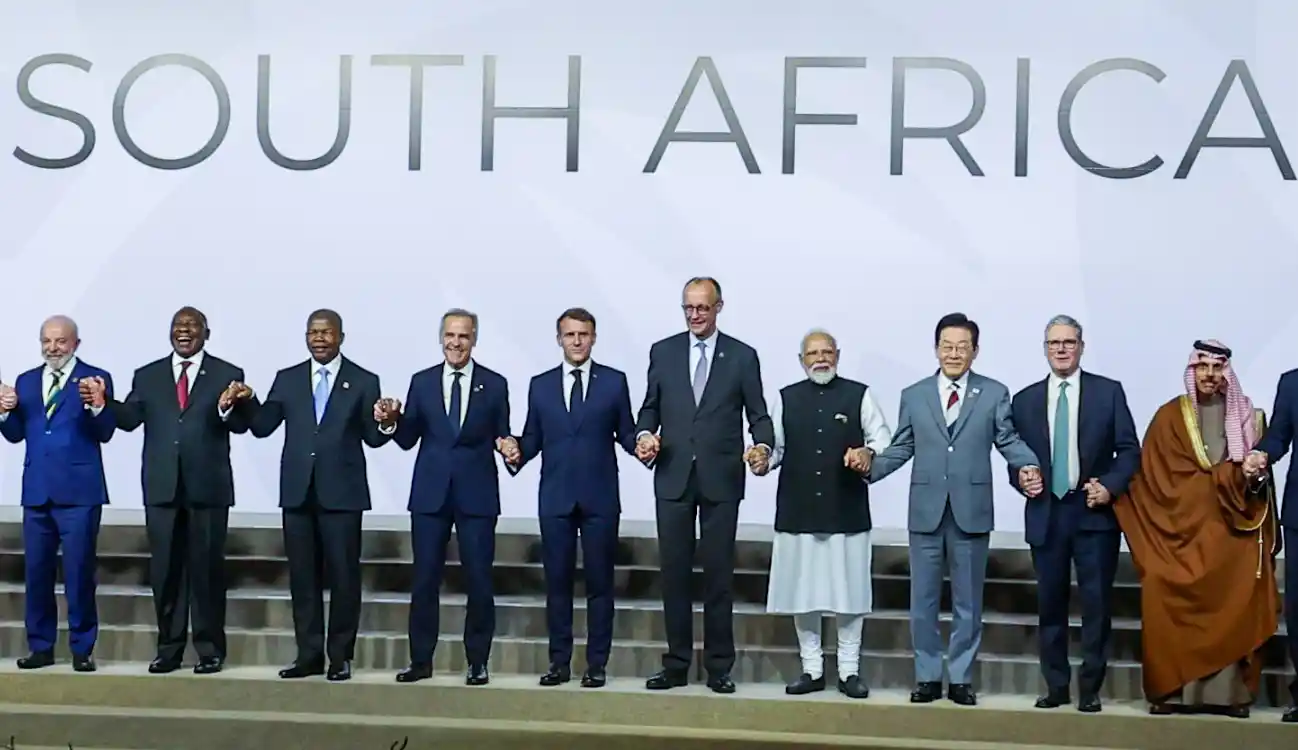
For the first time in its quarter-century existence, the G20 convened on African soil, a fact that in another era might have felt like a footnote and now reads more like a thesis statement. The summit arrived with an earnestness of ambition—“Solidarity, Equality and Sustainability”—and an almost theatrical sense of timing. A few leaders skipped the Johannesburg G20 summit, most notably US President Trump and Chinese President Xi.
And yet, in the strange lull created by these absences, a different presence asserted itself with unusual clarity. India was no longer merely one seat at a crowded table; it positioned itself as the animating consciousness of what we have come to call the Global South, a phrase that has always sounded geographical and has now begun to read as philosophical. Indian Prime Minister Narendra Modi’s address in Johannesburg did not so much seek applause as establish a vocabulary. It was, in tone and ambition, less a speech than a proposal for how the twenty-first century might come to understand itself.
Upon reaching the G20 Summit venue in Johannesburg earlier today, thanked President Ramaphosa for the warm welcome and for organising this important Summit.@PresidencyZA@CyrilRamaphosa pic.twitter.com/sERipwK2jm
— Narendra Modi (@narendramodi) November 22, 2025
Opening with a reference to Integral Humanism, an Indian philosophical tradition that insists development must harmonize the needs of the individual, the community, and the natural world, India set the stage. It is an idea that, in another context, might have been dismissed as moral ornamentation. Here, it served as the scaffolding for a six-point agenda that married idealism with almost technocratic precision.
The first proposal—the G20-Africa Skills Multiplier Initiative—imagines a decade-long effort to train one million certified trainers across Africa, drawing on India’s own extensive skilling infrastructure. It is tempting to read this as benevolence, but the underlying logic is harder-edged and more compelling: Africa’s demographic youth bulge represents not a crisis to be managed but the world’s most promising reserve of talent. In this vision, a skilled continent is not a dependent one but an equal, and equality is redefined not as charity but as strategy.
The second initiative, a G20 Global Healthcare Response Team, bore the imprint of recent memory. India’s evacuation of citizens from dozens of nations during the pandemic, alongside its vast vaccine distribution, had already rewritten its reputation from regional actor to global responder. The proposed rapid-deployment medical force—assembled across member states and activated in times of crisis—suggested a future in which emergency response is not a chaotic scramble but an organized choreography of preparedness.
Then came a turn toward the past, though of a most modern variety. The Global Traditional Knowledge Repository seeks to digitize and legitimize ancient practices—agricultural wisdom, ecological stewardship, herbal medicine—so often dismissed as folklore by Western technocrats. By anchoring the initiative in its own Traditional Knowledge Digital Library, India reframed the narrative: the Global South is not merely waiting for innovation; it has been quietly preserving it for centuries.
The fourth proposal struck a darker, more urgent note. PM Modi described the narcotics trade as “terrorism with a business model,” linking distant poppy fields to the corrosion of urban youth and the destabilization of entire regions. In calling for a unified G20 offensive against the drug-terror nexus, he confronted a problem often euphemized in diplomatic language and named it with a blunt moral clarity that few leaders dare attempt.
Critical minerals formed the fifth pillar of India’s agenda. The world’s rush toward green technology, with its insatiable appetite for lithium, cobalt, and rare earths, threatens to reproduce the inequities of the oil age. India’s proposal for a G20 Critical Minerals Circularity Initiative—centered on recycling, urban mining, and second-life batteries—was an attempt to imagine a future in which developing nations are not condemned to the role of perpetual suppliers of raw material for someone else’s prosperity.
Taken together, these proposals cohere into something more than a list of initiatives. They articulate a worldview in which the Sanskrit aphorism Vasudeva Kutumbakam—the world is one family—is not decorative spirituality but operational doctrine. If this sounds grand, even utopian, it is worth remembering that utopias often serve as blueprints for realities yet to be built.
Beyond the plenary sessions, India’s diplomacy unfolded with a kind of studied elegance. A trilateral partnership—the Australia-Canada-India Technology and Innovation initiative—signaled an intention to shape the governance of artificial intelligence and the architecture of future supply chains. Meetings with leaders from Europe, Asia, Latin America, and Africa yielded commitments in defense co-production, renewable energy corridors, and skilling exchanges. It was less a flurry than a quiet orchestration of ambition.
Australia, Canada and India have just agreed on a new trilateral partnership. 🇦🇺 🇨🇦 🇮🇳
— Anthony Albanese (@AlboMP) November 22, 2025
Together we will find new ways to cooperate on technology, and innovation in areas like clean energy, critical minerals and Ai.
I look forward to working with you, for the mutual benefit of… pic.twitter.com/Dfr34g3l8Q
Perhaps the most consequential achievement, however, was already part of the architecture of the summit itself. The African Union’s elevation to permanent G20 membership—a result of India’s advocacy during its own presidency—meant that Africa was no longer a subject at the margins but a stakeholder at the center. The Johannesburg Declaration, adopted in record time, echoed themes of debt sustainability, equitable energy transitions, and disaster resilience, each of them a reflection of priorities India had championed years before.
India’s references to the Deccan Principles on Food Security and the Coalition for Disaster Resilient Infrastructure carried particular resonance on African soil. Its own domestic experiments—massive food distribution programs, expansive health insurance coverage, and sweeping financial inclusion—were not presented as triumphalism but as exportable templates, proof that scale and empathy need not be mutually exclusive.
In a summit defined as much by who was absent as by who was present, India occupied the silence not with bombast but with architecture. It offered a narrative in which the Global South is not a cartographic convenience but an ethical proposition: development that is human-centered, climate-conscious, and unashamedly equitable.

