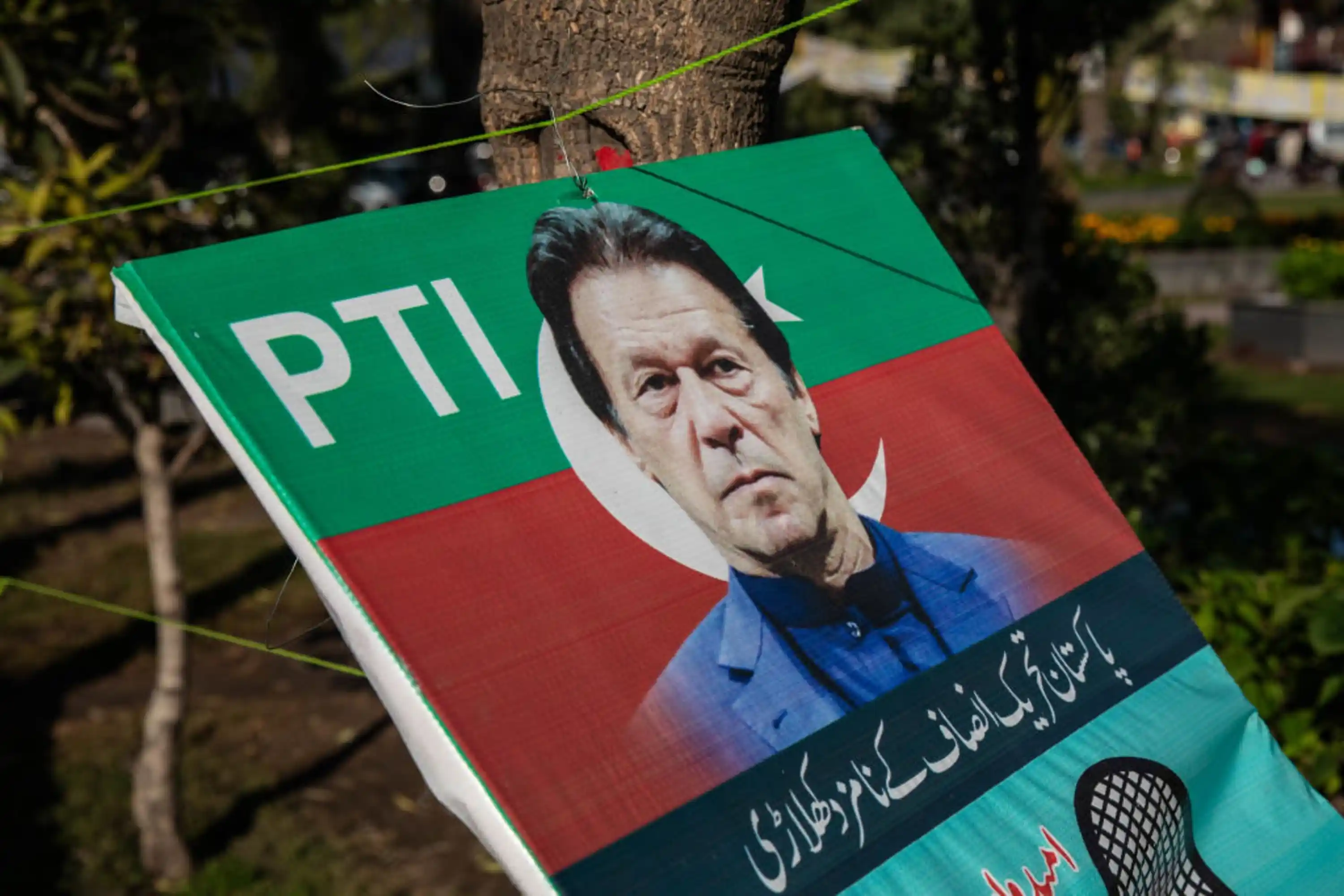
On 17–18 May 2026, Drop Site News published Cable I-0678 in full — the classified Pakistani diplomatic cipher that Imran Khan had cited since April 2022 as evidence of American involvement in his removal. The document demands to be read in its structural and historical context.
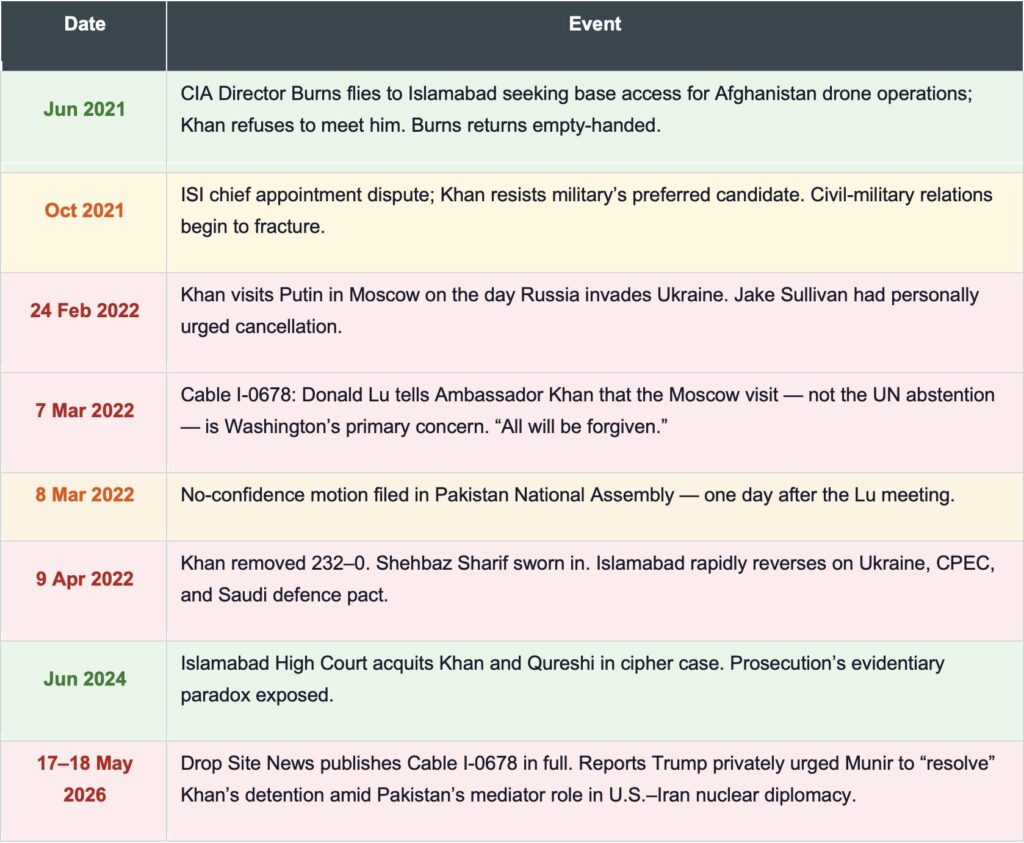
On 9 April 2022, Imran Khan became the first Pakistani Prime Minister removed through a parliamentary no-confidence vote — 232 to zero. What the Drop Site News investigation, published 17–18 May 2026, adds to the public record is not merely the full text of Cable I-0678, but a documented sequence: CIA Director William Burns flew to Islamabad in June 2021 to request base access for post-withdrawal drone operations and left without either a meeting with Khan or a concession; Khan visited Moscow on 24 February 2022, the day of Russia’s invasion; U.S. Assistant Secretary Donald Lu met Ambassador Asad Majeed Khan on 7 March 2022; and the no-confidence motion was filed on 8 March 2022 — the following day. Sequence is not causation. But the compression of these events within a ten-month window is analytically significant.
Cable I-0678 — stamped “secret,” marked “no circulation,” dated 7 March 2022 — records Lu telling the Ambassador that Washington’s primary concern was not Pakistan’s UN abstention on Russia but Khan’s Moscow visit itself, and that “all will be forgiven in Washington” should the no-confidence vote succeed. The U.S. State Department has denied operational involvement. Pakistan’s 38th NSC under Shehbaz Sharif found “no evidence of foreign conspiracy”; the 37th NSC under Khan had characterised the same meeting as “blatant interference.” The Islamabad High Court acquitted Khan and former Foreign Minister Shah Mahmood Qureshi in the cipher prosecution in June 2024, exposing the evidentiary paradox at the heart of the case. Khan remains imprisoned as of May 2026; Drop Site News additionally reports that President Trump privately urged Field Marshal Asim Munir to “resolve” Khan’s detention — transactionalism, not principle, operating on both ends.
“I think if the no confidence vote against the Prime Minister succeeds, all will be forgiven in Washington because the Russia visit is being looked at as a decision by the Prime Minister.”
— Donald Lu, U.S. Assistant Secretary of State, to Ambassador Asad Majeed Khan · Cable I-0678 · 7 March 2022 (Drop Site News, May 2026)
Table 1 — Key Event Timeline: The Cipher Sequence (2021–2026)
Sources: Drop Site News (May 2026); The Intercept (Aug 2023); WION News; American Bazaar; SIASAT Daily; Islamabad High Court
The cipher does not stand alone. It stands within a documented architecture of American political intervention across the Global South that is confirmed — not alleged — through CIA declassified histories, National Security Archive files, FRUS volumes, and Church Committee testimony. From Iran in 1953 and Guatemala in 1954 to Indonesia in 1965 and Chile in 1973, the pattern is consistent: a government pursuing economic nationalism or an independent foreign policy; a domestic military constituency whose interests align with Washington’s; and instruments deployed simultaneously across economic, media, and political domains. Three structural conditions are consistently present across all documented cases — and all three are present in Pakistan’s case. What has not been established is the third-order element: operational direction. Expressing a diplomatic preference for regime change, as the cipher records, is qualitatively different from funding it.
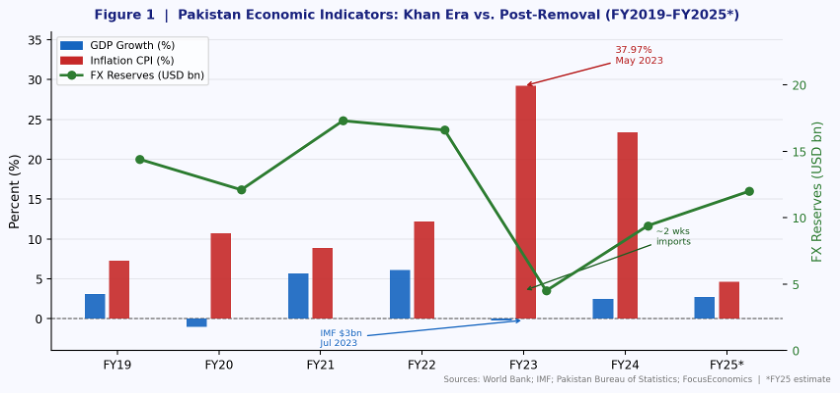
Figure 1 documents why structural leverage matters in this case. Inflation peaked at 37.97% in May 2023 — Pakistan’s highest in three decades — while foreign exchange reserves collapsed to approximately USD 4.5 billion, barely two weeks of import cover. The USD 3 billion IMF Stand-By Arrangement of July 2023 averted sovereign default. By Q4 2025, Pakistan’s total external debt had reached USD 138 billion (Trading Economics), with a debt-to-GDP ratio of 70–80% and approximately USD 30 billion in repayments falling due in FY2025–26. The USD 7 billion IMF Extended Fund Facility, signed September 2024, conditions Pakistan’s fiscal policy for at least three years. This is not the balance sheet of a state capable of absorbing great-power displeasure without consequence.
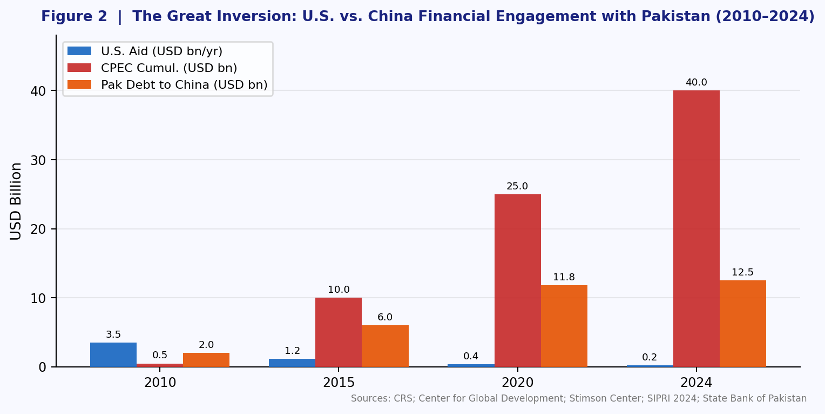
Table 2 — U.S. vs. China Financial Engagement: Key Metrics (2010–2024)
Sources: CRS; CGD; Stimson Center; SIPRI 2024; State Bank of Pakistan
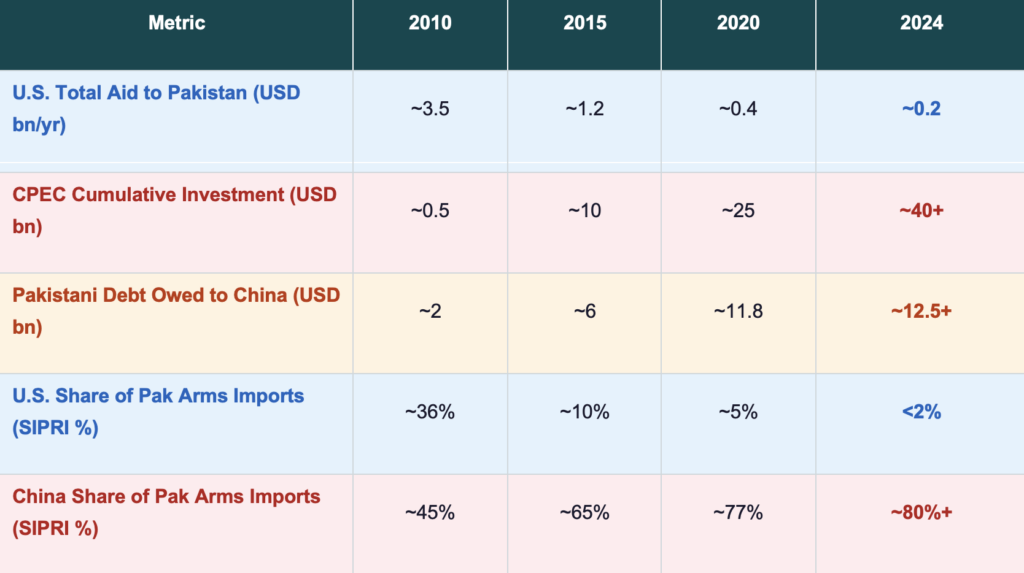
Figure 2 and Table 2 document what may be the most consequential shift in Pakistani geopolitics since the post-9/11 alignment with Washington. U.S. financial leverage, which peaked above USD 3.5 billion annually in Coalition Support Funds, had fallen below USD 200 million annually by 2024 (Congressional Research Service). Chinese cumulative investment through CPEC reached over USD 40 billion; Pakistan’s debt to Beijing stands at approximately USD 12.5 billion — roughly one-third of total external debt at the time of Khan’s removal. Between 2020 and 2024, China supplied over 80% of Pakistani arms imports, replacing the United States as primary military supplier entirely (SIPRI 2024). This structural inversion matters analytically: by 2022, Washington could no longer compel through financial inducement, intensifying incentives to apply diplomatic pressure through channels precisely like the one Cable I-0678 records.
The analytical verdict must remain provisional. Civil-military fractures within Pakistan — the ISI appointment dispute, the military establishment’s withdrawal of confidence from Khan on governance grounds — provide a sufficient domestic explanation for his removal that does not require foreign orchestration. What the Drop Site investigation establishes is a subtler finding: American preferences were expressed through diplomatic channels and absorbed by Pakistan’s military in ways that served the military’s own institutional interests. Whether this constitutes covert intervention in the tradition of the documented historical cases, or a coincidence of preferences and autonomous decision-making, is the central question the available evidence does not yet resolve. The structural conditions that make such a question permanently plausible — IMF dependency, civil-military fragmentation, collapsing U.S. financial leverage, and CPEC debt — are not disputed. Those conditions are the analysis, whatever the evidentiary verdict on April 2022 ultimately proves to be.
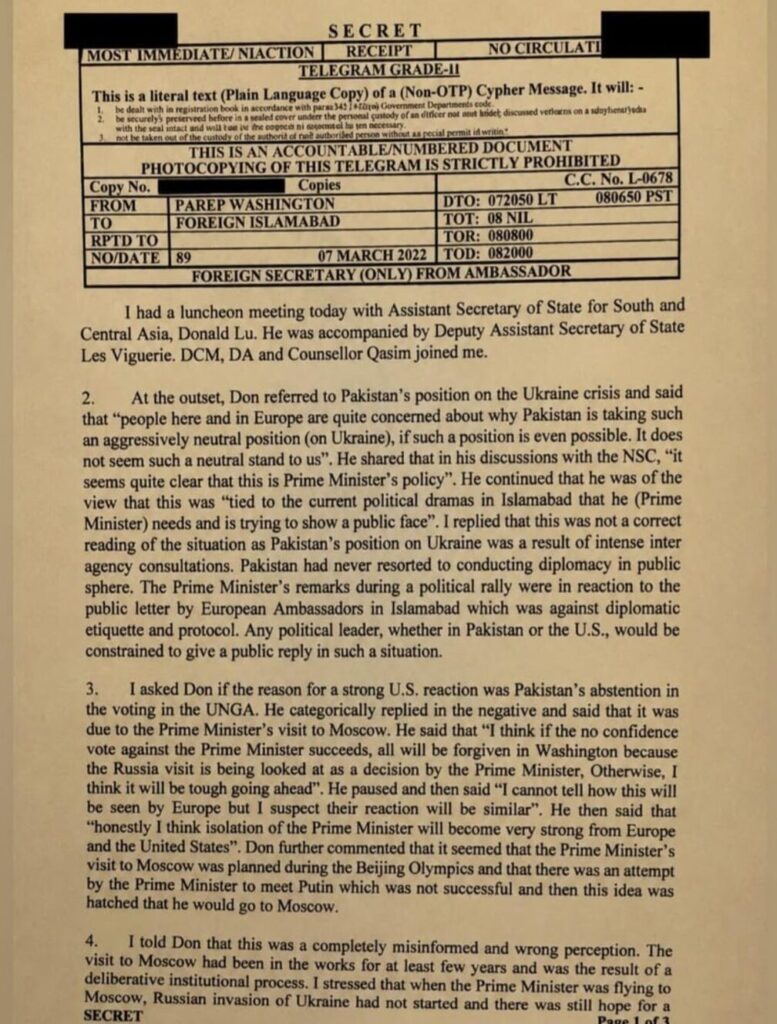
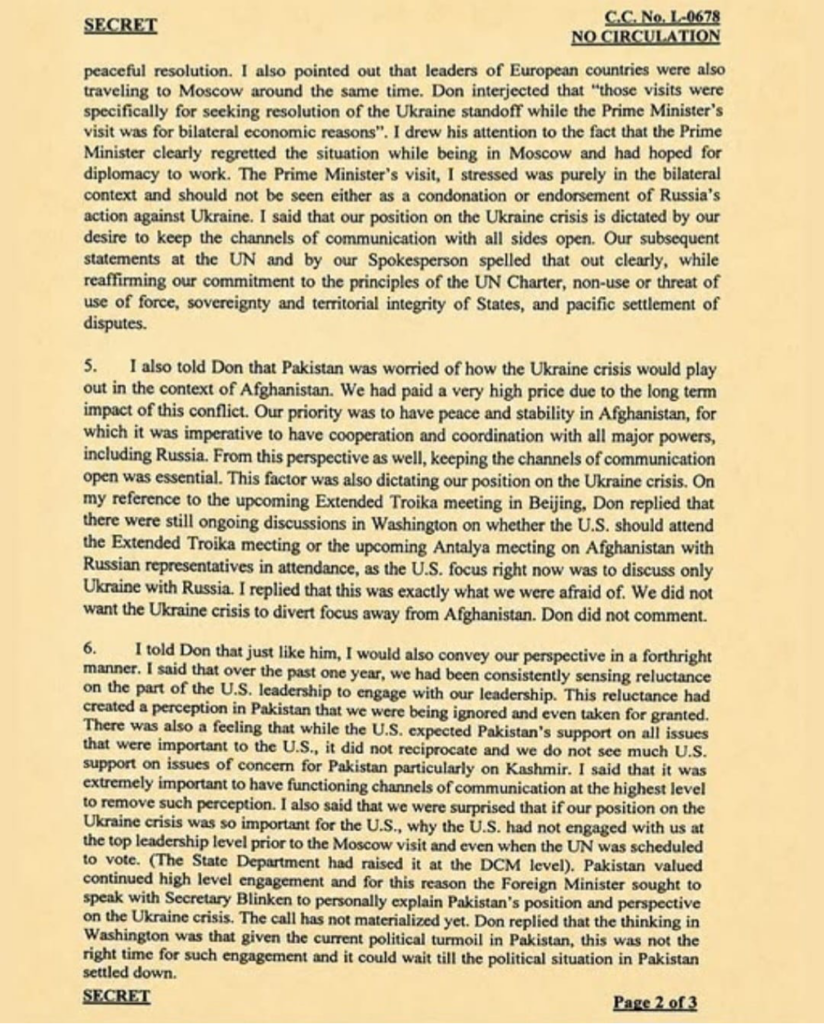
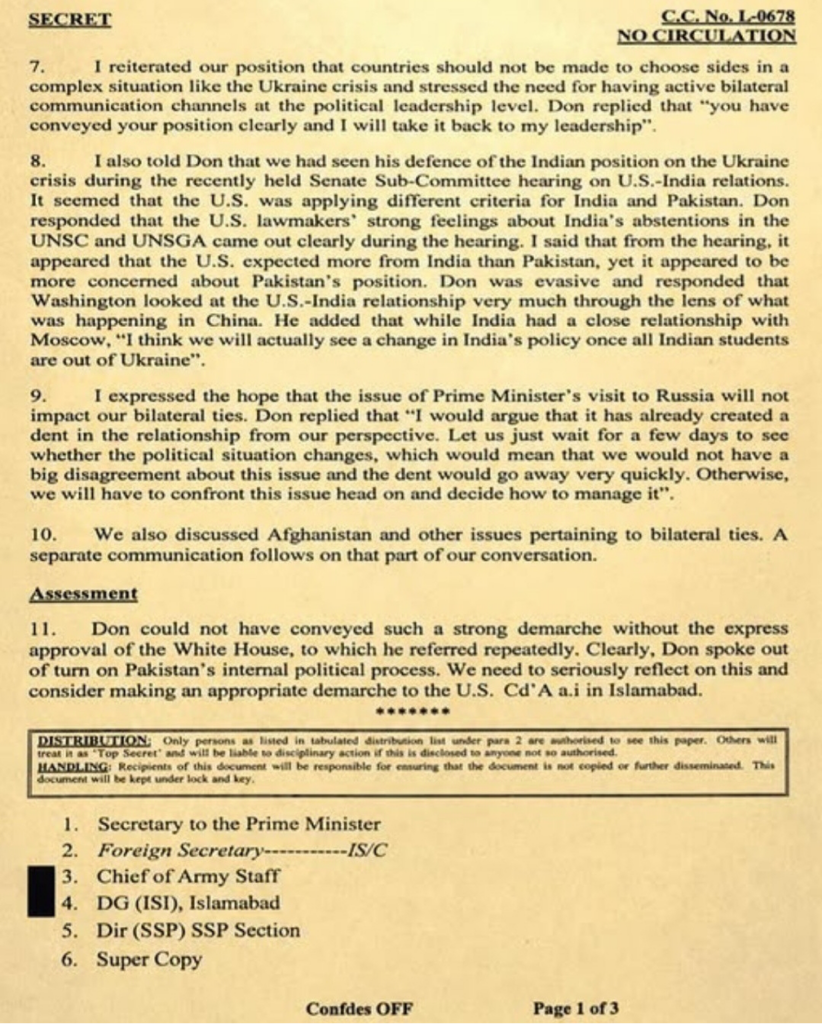
Above Screenshots from The Truth India (@thetruthin), X post dated 18 May 2026, citing leaked Pakistani diplomatic cable published by Drop Site News
Selected Sources
Bevins, V. (2020). The Jakarta Method. PublicAffairs.
Church Committee (1975–76). Final Report. U.S. Senate Select Committee to Study Governmental Operations with Respect to Intelligence Activities.
Congressional Research Service (2023). Pakistan and U.S.-Pakistan Relations (R47565). Library of Congress.
Drop Site News (2026, May 17–18). “From Mutual Suspicion to Political Embrace.” dropsitenews.com — publishes Cable I-0678 in full.
The Intercept (2023, August 9). “Secret Pakistan Cable Documents U.S. Pressure to Remove Imran Khan.”
The Truth India (@thetruthin). “EXPLOSIVE: For the FIRST TIME, the original Pakistan Cable has been LEAKED…” X, May 18, 2026. https://x.com/thetruthin/status/2056265919887032584
IMF (2024, September). Pakistan: Extended Fund Facility Arrangement ($7 billion). Washington, DC.
Kinzer, S. (2006). Overthrow: America’s Century of Regime Change. Times Books.
SIPRI (2024). SIPRI Yearbook 2024: Armaments, Disarmament and International Security. Stockholm.
SIASAT Daily (2026, May 18). “Secret cable shows US sought ouster of Imran Khan as Pakistan PM.”
Trading Economics (2026). Pakistan Total External Debt: $138 billion (Q4 2025). tradingeconomics.com.
Weiner, T. (2007). Legacy of Ashes: The History of the CIA. Doubleday.
World Bank (2025). Pakistan Economic Monitor. South Asia Development Report.