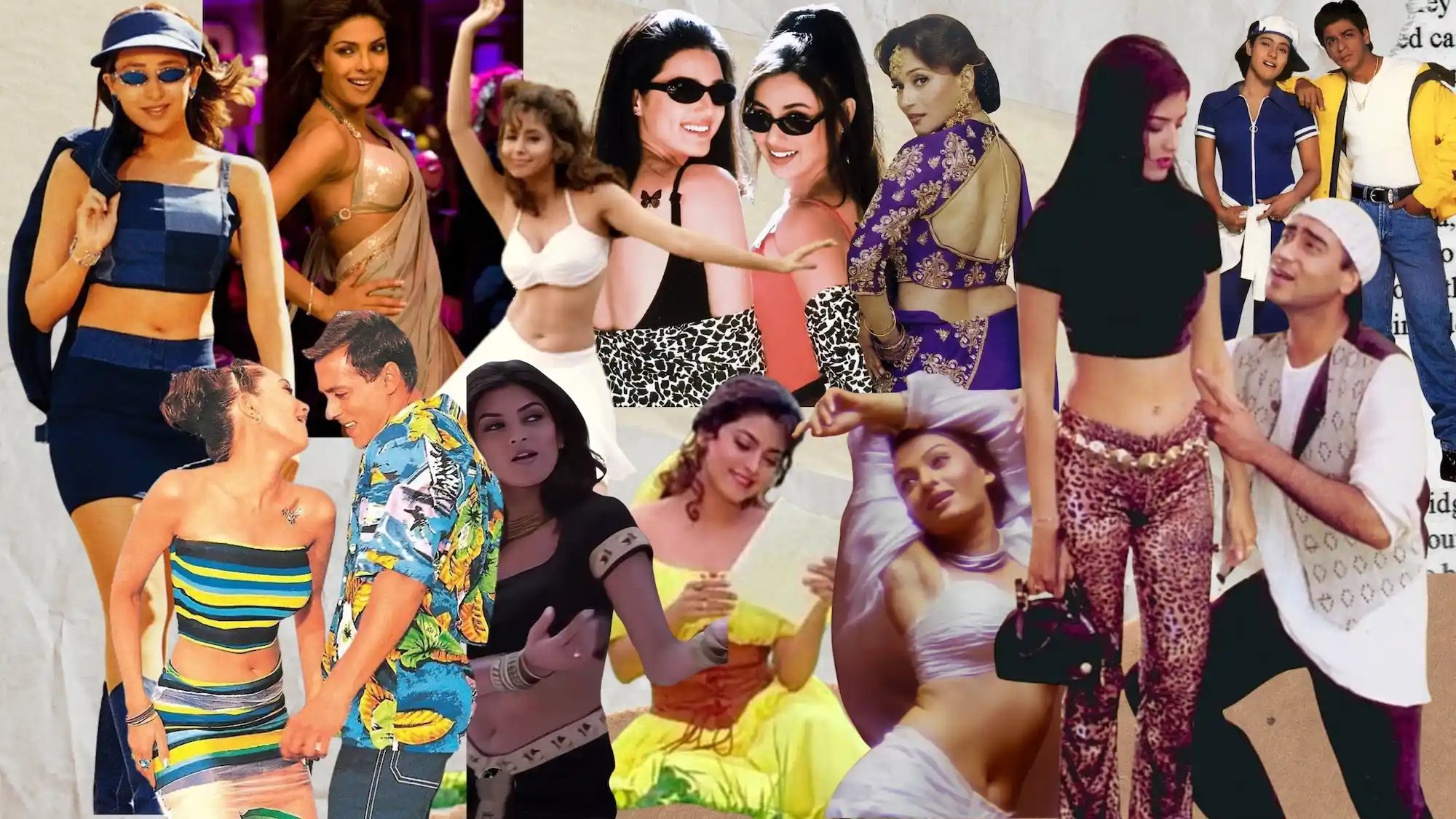
In the 1990s, India didn’t have Instagram moodboards, celebrity stylists on speed dial, or global fast fashion feeding trends every quarter. What it had was cinema, and, more specifically, a silver screen that doubled as the country’s most powerful runway. Before “influencer culture” existed, it was Bollywood that made audiences walk into stores asking for “Rangeela tops,” “Kajol lehengas,” or “Shah Rukh T-shirts.”
Cinema wasn’t just aspirational entertainment; it was the public’s style textbook.
When Manish Malhotra changed the script
Every conversation about film-led fashion in India starts, rightly, with Rangeela (1995). Manish Malhotra’s styling for Urmila Matondkar redefined the purpose of a film costume. It wasn’t just about character; it was about cool. The knotted shirts, cropped tops, and high-waisted denims in Rangeela were instantly decoded and duplicated by tailors across cities. It’s not an exaggeration to say that the movie made “styling” a mainstream word in Bollywood. “What really came out of Rangeela was something minimal and effective wear. And I was always a fan of colour, and colour to me is a core element of fashion. So, for example, that tangerine dress in ‘Tanha Tanha’ to the red chiffon sari when she is dancing in the sand dunes, to the athleisure in the title song, to the peplum cut outfit… overall, we saw a lot of smart casuals that were very trendsetting at that time, and it looked really glamorous.” – Manish Malhotra
For the first time, cinema wardrobes weren’t costumes to be admired from a distance; they were accessible blueprints for everyday dressing. Urban youth suddenly saw themselves mirrored on screen, and they wanted that mirror in their closet.
The wedding that re-dressed a nation
Just a year earlier, Hum Aapke Hain Koun..!(1994) had turned the Indian wedding into a costume department dream. Madhuri Dixit’s purple saree, adorned with sequins and rich in colour, effectively wrote the 1990s bridal rulebook. What was shown on screen quickly spilled into the streets, boutiques and tailors received endless requests for “Madhuri-style” sarees, and wedding trousseaus began to borrow cinema’s candy-coloured optimism.
The phenomenon was proof that film wardrobes could drive an entire economy of fabric and imitation, right down to local markets in Tier-2 towns.
Kajol, chiffon, and a London meadow
Then came Dilwale Dulhania Le Jayenge (1995), and with it, the legend of Kajol’s green lehenga. In one sweeping song sequence, the garment became emblematic of modern Indian femininity, traditional but not timid. To this day, the “Simran look” is referenced in bridal collections and festive campaigns, a reminder of how cinematic costuming can slip seamlessly into cultural identity.
Dilwale Dulhania Le Jayenge (DDLJ) transcended mere trend-chasing; it was a cinematic phenomenon that meticulously codified the visual language of romance for an entire generation. The film’s iconic aesthetic, epitomized by chiffon sarees and gold borders, became synonymous with aspirational love, not just in fashion but in the collective imagination of India. It wasn’t about fleeting styles, but about crafting a timeless image of courtship and devotion that resonated deeply with audiences. DDLJ’s influence extended far beyond the silver screen, permeating bridal wear, celebratory attire, and even everyday fashion, solidifying its place as a sartorial touchstone in Bollywood history.
Youth culture, scripted by Karan Johar
By 1998, Kuch Kuch Hota Hai had turned the Indian college campus into a global brand playground. Hoodies, baseball caps, headbands, and bright graphic tees, suddenly, these were not just imports seen in catalogues but must-haves from local street stalls. The film’s costuming by Manish Malhotra made casual wear aspirational, signalling a shift in how the urban Indian dressed for leisure.
The film totally nailed the athleisure look, showcasing it in Indian pop culture for the first time. And guess what? It wasn’t just a passing trend; it’s been around ever since! This big screen moment really put athleisure on the map in India, inspiring designers and shoppers for years to come. Why’s it so popular? Well, it’s that perfect mix of comfy and stylish, which is exactly what today’s crowd wants in their clothes: versatility and practicality without sacrificing good looks.
Men get their moment: The Suniel Shetty silhouette
If the 90s were dominated by female costume icons, Suniel Shetty gave men their first brush with cinematic fashion identity. His loose printed shirts, open collars, and rugged denim looks, especially in films like Gopi Kishan and Rakshak, defined the “action hero off-duty” template.
Retrospectives of 90s menswear repeatedly namecheck Shetty and, might I add, Jackie Shroff too, for bringing a kind of effortless, tropical machismo to the screen. Their wardrobe wasn’t couture, but it was relatable: the kind of clothes that a Bandra bachelor could actually wear to a party.
And in Haseena Maan Jaayegi (1999), Pooja Batra’s cropped tees and capris, often remembered by fans as the “pedal pusher” moment, supposedly kicked off a wave of short-pant replicas in college fashion. I remember the cassette cover of the movie and how I had shown it to my mother. On her next work trip to Kolkata, she made sure she got it for me. While archival evidence for that exact cause-and-effect remains elusive, the memory itself says something important: viewers believed that movies could launch trends, even if the paper trail doesn’t exist. Anecdote or not, it shows how deeply Bollywood wardrobes were woven into the cultural psyche.
From silver screen to mall window
Through the 2000s, as multiplex culture exploded, so did the feedback loop between films and retail. Dostana (2008) made its Miami-inflected wardrobes: linen shorts, halters, beach shirts, the new definition of vacation chic. Suddenly, every college farewell party had a “Dostana look.” Karan Johar’s productions in this period were less about couture and more about translating aspirational modernity into wearable silhouettes.
By the 2010s, stylists had become public figures, and their cinematic wardrobes routinely crossed over into fast-fashion collections. Aisha (2010), with Sonam Kapoor’s Dior-heavy ensembles, blurred the line between costume and editorial styling. The fashion industry had finally caught up with what Rangeela had hinted at fifteen years earlier: that style on screen could be the first draft of a nationwide moodboard.
The new era: from theatre to thumbnail
If earlier generations shopped for what they saw on 35 mm, today’s audience screenshots what they see on Netflix. Yet the underlying phenomenon hasn’t changed; film continues to dictate fashion tempo.
In 2023, Rocky Aur Rani Kii Prem Kahaani proved the formula still works. Alia Bhatt’s chiffon sarees, equal parts nostalgia and glamour, went viral within hours of release. Within weeks, boutique Instagram pages were offering “Rocky Aur Rani sarees,” tagged with reels of real-life weddings. The cycle that began with Hum Aapke Hain Koun..! has now simply accelerated to fit social-media speed.
Similarly, Gangubai Kathiawadi (2022) revived white cotton sarees and oxidised jewellery as symbols of power and poise, a look quickly adopted in fashion editorials and influencer shoots. Even background dancers in big-budget song sequences today are styled with precision, their wardrobes spawning entire micro-trends online.
Anecdotes, archives, and influence
When people recall “Pooja Batra’s capris” or “Shah Rukh’s logo tees,” they’re not misremembering trends; they’re recalling an era when Bollywood was the style press. The printed-shirt hero and the pedal-pusher heroine belonged to a time before the internet catalogued everything, when fashion travelled by word of mouth and VCR replay.
That’s why even anecdotes, however unverified, deserve a footnote in the story. They show how democratic fashion once was: born not in ateliers but in cinema halls.
From costume to consciousness
Three decades on, the relationship between Indian film and fashion has matured but not diminished. The scale may have shifted, from costume designer’s sewing machines to the same “fashion designer’s” Instagram, yet the equation remains the same. When a garment lights up a 70 mm screen, it instantly acquires the charge of desire, nostalgia, and mass influence.
Fashion in India didn’t begin with magazines or luxury houses. It began with dialogue, song, and movement, with Kajol’s lehenga fluttering in a mustard field, with Urmila’s crop top in a rain dance, with Suniel’s printed shirt on a Goan beach.
Cinema didn’t just reflect style. It created it; and it still does, one frame at a time.