
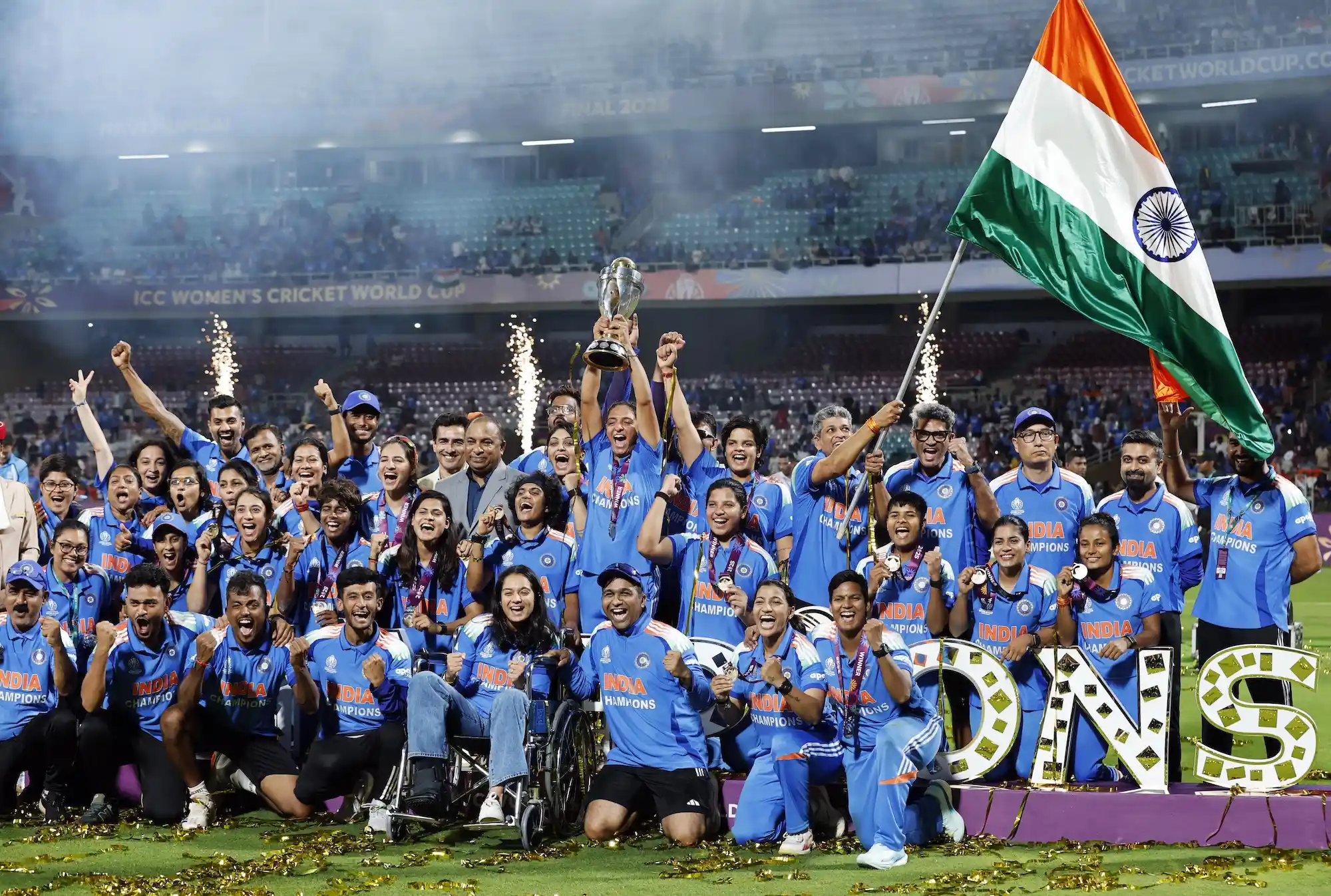
It started like a thousand other nights in Indian cricket, with rain falling harder than the dreams it threatened to drown. Navi Mumbai’s DY Patil Stadium, usually more familiar with the polished rhythms of domestic footfall, was instead stirring with the restless thrum of something entirely different—a nation on the cusp of history. Women’s World Cup final. India vs South Africa. A stage set not just for sport, but for transformation.
By the time the clock grazed midnight, the aisles had already become dancefloors. The thunder wasn’t only in the clouds anymore—it was rising from the throats of tens of thousands, who had waited not just two rain-marred hours for a start, but decades for this moment. For a moment like Amanjot Kaur’s juggling catch on the deep mid-wicket fence, or the hush that followed an inside-out chip from Nadine de Klerk’s bat. The kind of hush you hear only right before an explosion.
And oh, what an explosion it was.
When that final wicket fell, the roar was something else. A sound born not just of victory, but of vindication. The kind of sound you’ll hear replayed in the minds of those who stood there soaked to the bone, chanting names that once barely made headlines. It was the roar of the billion. The roar of the champions.
More Than a Win—A Rewriting of Futures
We sometimes talk about sport as a proxy for progress. That it has the power to heal, to bind, to inspire. But seldom do we witness that so quickly, so purely, as we did that night. Here was Harmanpreet Kaur, finally lifting the World Cup that had eluded her for so long. Smriti Mandhana, at the tail-end of the greatest year of batting in the format, beaming as though she had just rewritten her own legacy. Deepti Sharma, who once bowled a no-ball that cost India dearly, now delivering vengeance dressed in self-belief.
1983 inspired an entire generation to dream big and chase those dreams. 🏏
— Sachin Tendulkar (@sachin_rt) November 2, 2025
Today, our Women’s Cricket Team has done something truly special. They have inspired countless young girls across the country to pick up a bat and ball, take the field and believe that they too can lift… pic.twitter.com/YiFeqpRipc
And how do you sum up Shafali Verma? Fresh off a domestic T20 tournament a few days prior, she walked into the final as though she’d choreographed the script. No nerves. No shadows. Just raw genius, with both bat and ball. That Pratika Rawal—who got injured to make way for Shafali—had herself almost carried India to the semis through her own brilliance says everything you need to know: this wasn’t one hero’s tale. It was a chorus, made richer by every rise, every fall, every fight-back.
Add to that the freshness of Richa Ghosh and Shree Charani—two young meteors who now blaze across a sky they were once told wasn’t meant for them—and you begin to understand the scale of what happened. India not only won a title; they declared an era.
The New India: Champions in Every Sense
Let’s be clear: dominance isn’t guaranteed. Nothing in sport ever is. But that’s not the point. The point is belief. The belief that a young girl in Ranchi or Rohtak, holding on to a battered bat or a borrowed ball, now has a new mirror in which to see her future. Not as a dreamer on the periphery, but as a doer in the main arena.
This triumph is not the end of a journey, as captain Harmanpreet rightly said—it is the beginning. The beginning of a world where young women don’t just enter stadiums to watch, but stride in to own them. Where the Indian jersey, stitched over with sweat, soil, and story, belongs just as much to them.
And let’s not diminish the ripple effect. Sport, though often derided as escapism, is one of the most powerful unifiers we have. It was evident in the crowd that night—the teeming mass of strangers who sang together, held breath together, wept together. They came for a match. They left with a movement.
A Win for the Team, a Win for the People
When history is written, let this moment shine not just in the annals of cricketing glory, but in the quiet revolutions it sparked. Because somewhere in the stands sat a mother who will no longer hesitate when her daughter asks for a cricket bat. Somewhere at home, a father will loosen the ties of tradition just enough for ambition to slip through. Somewhere, a girl will watch this team and whisper to herself, “Why not me?”
And that’s the real victory. Not the trophy that rests now in the hands of eleven warriors, but the fire they’ve lit in millions more.
In the end, what the world saw was India’s first women’s World Cup crown. But what India felt… what India breathed… was a new chapter in its sporting soul. A catharsis long overdue. A night that—fifty years from now—may be seen as the point where the needle didn’t just move; it spiked.
So yes, as the dust settles and the rain finally lets up, we can all agree: this wasn’t just a win for the Indian women’s cricket team. This was a win for a nation learning, one glorious innings at a time, how to roar with its whole heart.
And this time, it was the roar of the billion.

