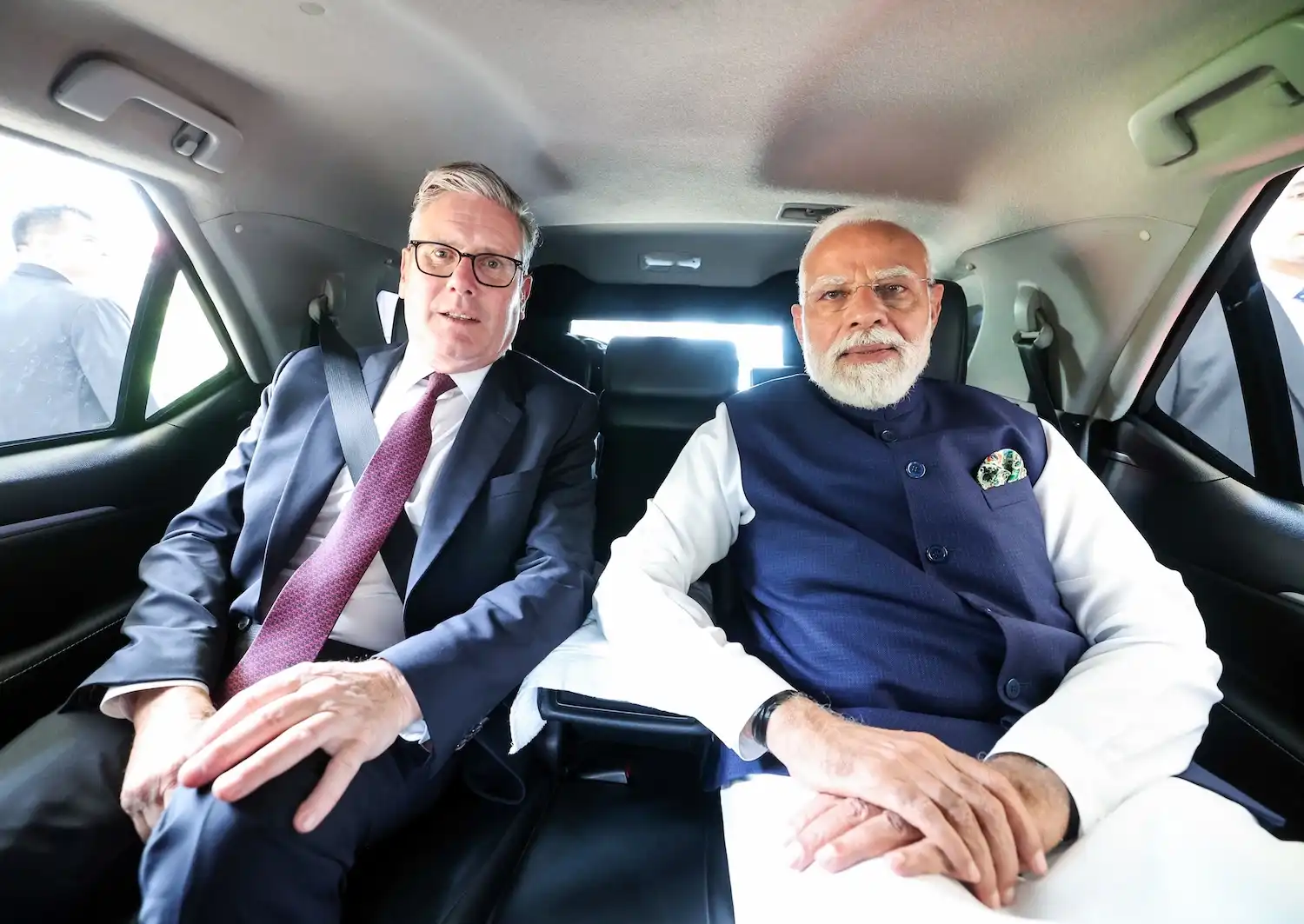
UK Prime Minister Keir Starmer’s recent visit to India marks a turning point in the trajectory of India-UK relations, reinforcing the strategic and economic partnership between the two countries. This is Starmer’s first official visit to India as the UK’s Prime Minister and follows closely on the heels of the historic India–UK Comprehensive Economic and Trade Agreement (CETA) signed in July 2025. The high-level engagement over two packed days in Mumbai has seen the two nations not only reaffirm earlier commitments but also chart new pathways for cooperation across business, technology, defence, and people-to-people ties.
Starmer arrived in Mumbai on October 8, leading one of the UK’s largest-ever business delegations to India. The entourage included the Secretary of State for Business and Trade, the Secretary of State for Scotland, the Minister for Investment, and a group of 125 CEOs, entrepreneurs, vice-chancellors, and cultural leaders. This robust representation underscores the significance the new UK government assigns to Indo-British relations, projecting confidence in India’s economic ascent and the UK’s desire to anchor itself as a preferential partner.
Trade and Economic Cooperation
The centrepiece of the visit is the implementation and expansion of CETA, the India–UK free trade agreement signed in July. CETA is expected to substantially lower tariffs and increase market access for a broad range of goods and services, including textiles, whisky, automobiles, and spices, making trade between the two countries quicker, cheaper, and more beneficial for businesses and consumers in both nations. Both nations have set an ambitious goal of doubling bilateral trade to $100 billion by 2030, with trade already witnessing a £6 billion uptick since July’s agreement.
During their addresses at the India–UK CEO Forum and the Global Fintech Fest, both Prime Ministers used emphatic language—Starmer called the trade deal a “launchpad for future economic cooperation,” while Modi highlighted four new dimensions to broaden CETA’s scope, including MSMEs, youth employment, and technology transfer.
New Announcements and Sectoral Investments
Several significant announcements marked the visit:
- A connectivity and innovation center and a joint AI center were unveiled, signaling a commitment to advanced digital and technological collaboration.
- A critical minerals industry guild was launched to strengthen supply chains and foster the green energy transition.
- Indian companies committed £1.3 billion of fresh investment into the UK, promising close to 7,000 new jobs for the British economy.
- Major deals in defence and strategic sectors—highlighted by a £350 million defence contract—were showcased as a testament to deepening mutual trust.
The strategic aspect of the relationship has also expanded, with the partnership now encompassing maritime security, advanced missile technology, and zero tolerance to terrorism—including against Khalistani extremism. Modi’s government also used the opportunity to announce the opening up of India’s nuclear power sector to private players, hinting at future joint ventures in civil nuclear energy.
Digital India Inspiration
A notable theme in Starmer’s visit was the UK’s renewed interest in India’s digital ID system (Aadhaar), which now covers over 1.3 billion residents. Starmer openly praised the Indian system as a “remarkable success” and sought lessons to apply to the UK’s planned digital ID framework (the “Brit Card”), which he argues will enhance security and regulate labor practices in the UK.
In Mumbai, Starmer met Nandan Nilekani, Infosys co-founder and chief architect of Aadhaar, to engage with the technology’s architects. His public endorsement of India’s digital governance model is being closely watched in both countries, given privacy concerns in the UK.
Cultural and Academic Linkages
The delegation’s makeup—featuring vice-chancellors and cultural figures—highlights the growing importance of education, research, and the creative sectors in India–UK ties. The India–UK CEO Forum, one of the largest business summits in bilateral history, provided a platform for direct interaction between leaders of industry, academia, and government.
At cultural events, Starmer and his team highlighted the contribution of the Indian diaspora to the UK, and celebrated shared democratic values and multiculturalism as drivers of future cooperation.
What’s Next for the Partnership
The visit concluded with both leaders expressing satisfaction with the progress achieved and optimism for the future, emphasizing that the energy, market size, and dynamism of India, when combined with British expertise and global reach, present a unique synergy.
Forward-looking frameworks, such as the India-UK Vision 2035 and Defence Industrial Roadmap, adopted at this and previous summits, are expected to provide structure for strategic collaboration spanning economic growth, security, green technologies, and knowledge exchange over the next decade.
Keir Starmer’s 2025 India visit has consolidated an expansive partnership based on commerce, shared democratic values, strategic trust, and mutual aspirations for global leadership. As implementation of CETA unfolds, the world will watch closely how this “modern partnership for a modern era” translates into tangible economic and strategic benefits for both India and the UK.