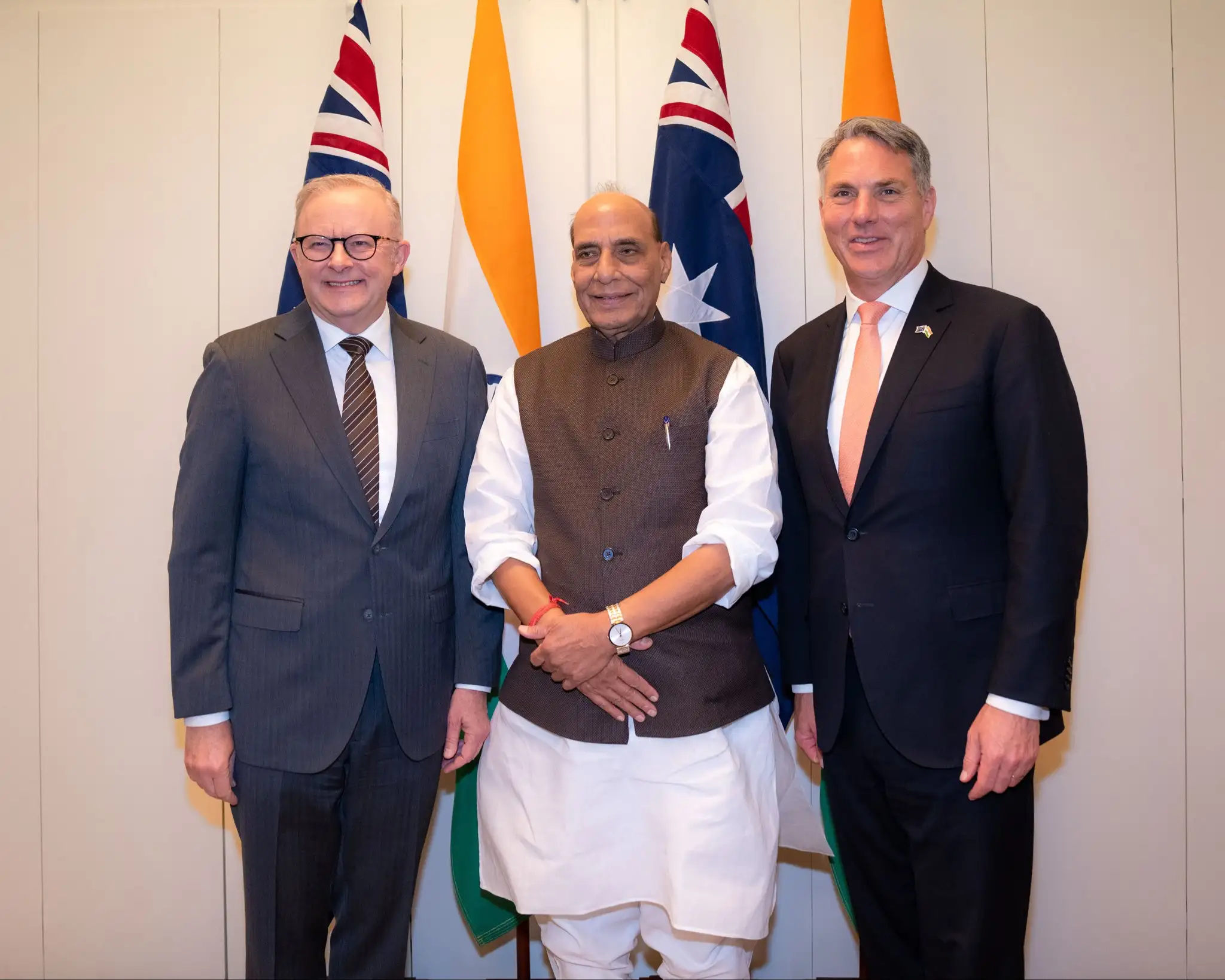
India and Australia have significantly deepened their maritime security ties with the signing of a new mutual maritime security framework during Defence Minister Rajnath Singh’s visit to Australia on October 9, 2025. This move is aimed at fostering cooperation for a “free, open, and resilient Indo-Pacific,” reinforcing the two nations’ strategic partnership amid rising geopolitical challenges in the region. The discussions and agreements come at a moment when India and Australia, as key Indo-Pacific players and part of the Quad grouping with the US and Japan, seek to counterbalance China’s maritime assertiveness and ensure a rules-based regional order.
Strategic Context and Importance
The phrase “free and open Indo-Pacific” signals a strategic effort by India and Australia, along with other Quad countries, to uphold maritime freedom and security against China’s attempts to alter the status quo in the South China Sea. Australia’s Deputy Prime Minister and Defence Minister Richard Marles highlighted the significance of this visit, the first by an Indian Defence Minister to Australia in 12 years, describing it as a step that elevated their “Comprehensive Strategic Partnership” to a top-tier security relationship. Both countries are committed to boosting dialogue, operational cooperation, and the complexity of joint and multilateral military exercises across all service branches.
The escalation of strategic competition in the Indo-Pacific, characterized by China’s expanding naval presence and grey-zone contestations, underscores this collaboration’s urgency. Both countries are moving beyond symbolic alignment to practical, operational maritime cooperation, which also aims at reassuring regional partners like Southeast Asian nations by contributing to maritime domain awareness and crisis response.
Key Agreements and Areas of Cooperation
During his two-day visit, Rajnath Singh and Richard Marles reviewed the full spectrum of defence cooperation, including the defence industry, cyber defence, maritime security, and broader regional challenges. They signed three key defence agreements: intelligence sharing, enhanced maritime security, and a framework for joint military activities. These agreements are designed to institutionalize operational cooperation, making collaboration more efficient in terms of data sharing, coordinated presence in maritime domains, and industry partnerships.
The maritime security framework particularly aims to increase situational awareness of the sea lanes critical to both countries and their partners, enabling coordinated patrols and quicker joint responses to regional threats. This is supported by advances such as the 2020 Mutual Logistics Support Arrangement (MLSA), which provides reciprocal access to military bases for logistics support, including refuelling and maintenance. This logistical integration is vital for combined naval operations and strategic reach across the Indo-Pacific.
Defence Industry and Technology Collaboration
Singh emphasized the rapid growth of India’s defence industry and its emergence as a credible global source of advanced defence technologies. Discussions during the visit highlighted prospects for deeper defence industry partnerships, including cooperation on cutting-edge technologies in cyber defence, Command, Control, Communications, Computers, Cyber-defence, Intelligence, Surveillance, and Reconnaissance (C5ISR) systems, and autonomous maritime surveillance platforms. Australian firms are exploring collaborations with Indian entities, particularly small and medium enterprises, for shipbuilding and maintenance facilities, reflecting a shared technological and industrial vision.
Military Exercises and Operational Integration
Joint military exercises form a cornerstone of India-Australia defence ties. The two countries regularly participate in AUSINDEX naval exercises, and India has increasingly engaged in other multinational drills like Talisman Sabre 2025, hosted by Australia, which included over 35,000 troops from 19 nations. These exercises enhance interoperability, especially in anti-submarine warfare and air defence, increasing the complexity and scope of combined operations. The visit also included demonstrations such as Rajnath Singh witnessing the refuelling of Australian F-35 aircraft, symbolizing deepening operational ties.
Political and Diplomatic Significance
The visit and agreements come amid the fifth anniversary of the India-Australia Comprehensive Strategic Partnership, marking a milestone in bilateral relations. Rajnath Singh’s ceremonial welcome at the Australian Parliament and high-level meetings with key leaders, including Prime Minister Anthony Albanese, further cement the diplomatic weight of the visit. The partnership’s security pillar has grown robust, with over 30 defence-related joint activities conducted in 2024 alone, illustrating sustained momentum.
India expressed gratitude for Australia’s steadfast support on cross-border terrorism and shared regional stability, reaffirming mutual interests in counterterrorism and ensuring peace in the region. The signed agreements and the ongoing high-level dialogue underscore a shared vision of resilient regional architecture, anchored in trust, operational readiness, and a commitment to multilateralism without bloc politics.