On July 31, 1995, India’s first-ever mobile phone call was made between Delhi and Kolkata. What seemed like a modest technological milestone would ignite a communications revolution that reshaped how 1.4 billion Indians live, work, and connect.
Three decades later, the mobile phone has evolved from a luxury into an indispensable tool of empowerment. It is now India’s bank, classroom, and television — the centerpiece of its digital transformation.
According to the Comprehensive Modular Survey: Telecom (January–March 2025), nearly 97% of Indians aged 15–29—both in rural and urban areas—use mobile phones daily. In rural India, mobile-enabled platforms like the mKisan Portal, National Pest Surveillance System (NPSS), and Digital Crop Survey empower farmers with real-time information on weather, pest threats, and market prices.
This pervasive adoption reflects how mobile connectivity has democratized access to opportunity. As Prime Minister Narendra Modi remarked, “India has become a key hub for mobile phone manufacturing, with exports now reaching global markets.”
The Smartphone Surge: From Imports to Global Export Powerhouse
A decade ago, India’s mobile market was 78% import-dependent. In 2014–15, nearly three-quarters of all phones sold domestically were imported. Today, that figure is just 0.02% — a transformation unprecedented among developing economies.
Between FY2014–15 and FY2024–25, mobile phone production rose from ₹18,000 crore to ₹5.45 lakh crore, marking a 28-fold increase. Exports grew an astonishing 127 times, from ₹1,500 crore to ₹2,00,000 crore.
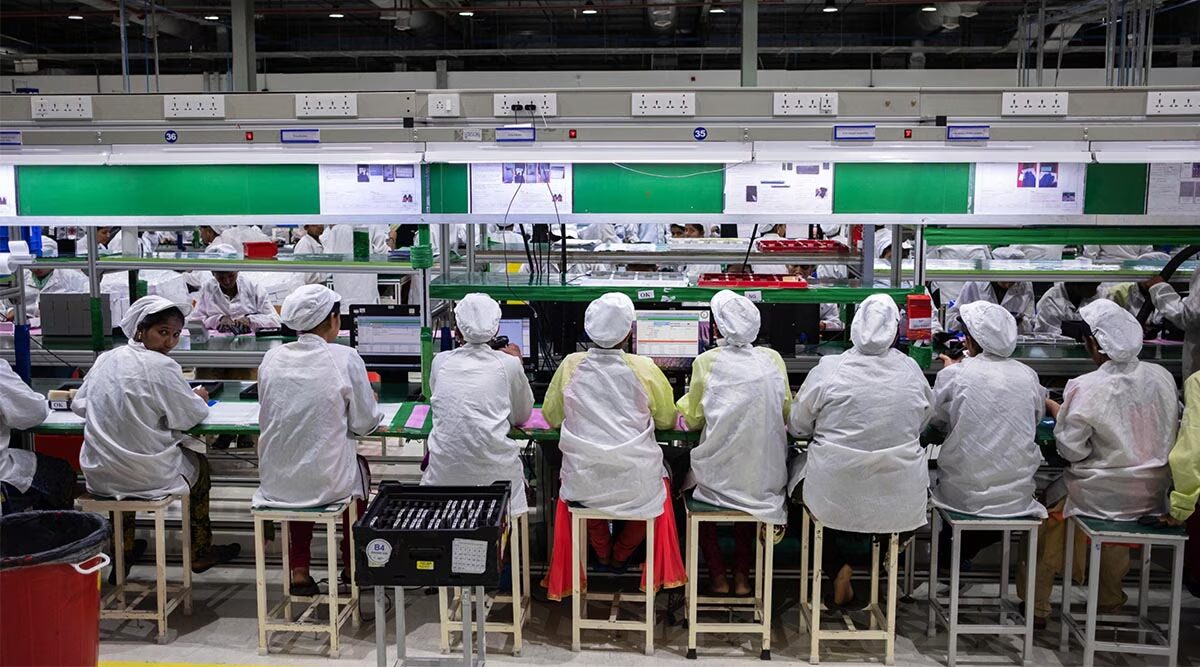
In 2025, India overtook China to become the top smartphone exporter to the United States, with exports crossing ₹1 lakh crore in just the first five months of FY2025–26 — a 55% year-on-year surge. Today, India is the world’s second-largest mobile phone manufacturer, with over 300 production facilities, up from only two in 2014.
Key Growth Drivers
- The Production Linked Incentive (PLI) Scheme (2020) – provided performance-based financial incentives for domestic production.
- Make in India (2014) – encouraged global manufacturers like Apple and Samsung to shift production to India.
- Phased Manufacturing Programme (2017) – promoted local component assembly, reducing import dependency.
- Electronics Components Manufacturing Scheme (ECMS, 2025) – boosted domestic value addition with ₹22,919 crore in funding and targets of ₹4,56,500 crore in output.
Together, these initiatives transformed India from a consumer to a producer — from importing mobile phones to exporting premium devices to the world.
Digital India and the New Economic Architecture
The Digital India programme, launched in 2015, became the backbone of India’s inclusive technological growth. It transformed how governance, education, and entrepreneurship interact with technology.
The Numbers Behind the Revolution
- Internet users: 251 million (2014) → 969 million (2024), a 285% surge.
- 4G coverage: 100% by 2016.
- 5G rollout: Launched in October 2022, covering 99.6% of districts by mid-2024.
- Digital economy contribution: 11.7% of GDP in 2022–23 → projected 20% by 2030.
This infrastructure has laid the groundwork for what economists call “the digital multiplier effect” — every rupee invested in digital infrastructure yields multiple rupees in GDP growth.
By 2029–30, India’s digital economy is projected to outpace the overall economy, contributing nearly one-fifth of national income. Within this framework, mobile phones are the most visible driver — the tool through which citizens engage in commerce, access government services, and participate in the global information ecosystem.
Manufacturing Momentum: India’s Global Positioning
The Rise of a Manufacturing Ecosystem
India’s electronics sector has evolved through three distinct phases:
- Assembly Stage (2014–2017): Focused on finished product imports and basic assembly.
- Sub-Assembly Stage (2017–2022): Expansion of domestic supply chains and local part manufacturing.
- Component Manufacturing (2022–present): Deep localization of core components such as semiconductors, displays, and batteries.
This progression signifies a move from “Make in India” to “Design and Manufacture in India.” Total electronics production surged from ₹1.9 lakh crore (2014–15) to ₹11.3 lakh crore (2024–25).
Apple, Samsung, and the New Global Hub
India’s integration into the global smartphone value chain is exemplified by leading manufacturers:
- Apple: Exported ₹1,10,989 crore (US$12.8 billion) in 2024, a 42% YoY growth.
- Foxconn: Plans to double iPhone output by end-2025 to 25–30 million units annually.
- Samsung (Noida facility): Helped push exports to US$20.4 billion in 2024, up 44% from 2023.
These milestones are not isolated events but part of a structural shift known as the “China + 1” strategy, where global firms diversify away from China to reduce geopolitical and supply chain risks. India, with its scale, skilled workforce, and policy stability, has emerged as the leading beneficiary.
Economic Impact: Jobs, Exports, and Inclusive Growth
Employment and Skill Development
Over the past decade, India’s mobile manufacturing sector has generated over 12 lakh jobs — both direct and indirect — contributing to socio-economic mobility, especially among youth and women in industrial clusters like Tamil Nadu, Uttar Pradesh, and Telangana.
The proliferation of electronics manufacturing clusters (EMCs) has deepened regional development. Tamil Nadu alone hosts 47 electronics units, many under the Ministry of Electronics and Information Technology’s support schemes.
Trade Transformation
The mobile phone industry now sits among India’s top five export categories, alongside petroleum, gems and jewelry, and machinery. Smartphones have become India’s fourth largest export item, representing the nation’s shift toward high-value manufacturing.
This is reflected in the broader export portfolio — electronics is now the fastest-growing segment among India’s top 30 export categories. In FY2025–26, total smartphone exports are expected to surpass last year’s record levels, despite global tariff pressures.
India in the Global League of Mobile Makers
Globally, China and Vietnam have long dominated electronics exports — with electronics contributing 27% and 40% of their total exports respectively. Yet, India is rapidly catching up.
In 2023–24 alone, China’s mobile exports fell by $3.8 billion and Vietnam’s by $5.6 billion, while India’s increased by $4.5 billion, capturing nearly half the market loss from those two nations.
India’s share in global mobile phone exports, once negligible, is now approaching 5%, and it is projected to reach 10% by 2030, driven by expanded domestic production capacity and favorable trade agreements.
The rise of India as a smartphone export hub is, therefore, not merely an economic story but a geopolitical one. It represents the global realignment of supply chains and the decentralization of technology manufacturing — with India emerging as a strategic counterbalance in the global digital economy.
Socio-Economic Implications: Smartphones as Equalizers
Mobile technology’s impact extends beyond economics. As UNGA President Dennis Francis observed in 2024, “India has lifted 800 million people out of poverty in the last 5–6 years through the use of smartphones.”
This transformation is visible across sectors:
- Education: Mobile-enabled e-learning platforms reached rural students during the pandemic, mitigating learning losses.
- Finance: UPI and mobile banking have revolutionized financial inclusion — 80% of adults now have access to digital payments.
- Agriculture: Mobile applications empower farmers with data-driven decision-making.
- Healthcare: Telemedicine apps bridge urban-rural health divides.
India’s mobile revolution, therefore, is as much a social movement as a technological one. It connects the unconnected and empowers citizens to participate in a digital-first economy.
Outlook: Toward a $300 Billion Electronics Powerhouse
Looking ahead, India’s digital economy is projected to expand twice as fast as the overall economy, with electronics manufacturing — led by mobile phones — at its core.
By 2026, India targets US$300 billion in electronics production, and by 2030, it aims to contribute 4–5% of global electronics exports. The synergy of Digital India, Make in India, and PLI schemes is expected to sustain this momentum, supported by emerging investments in semiconductor fabrication and 6G technologies.
As PM Modi noted, “We’re rapidly moving towards being No. 1 in mobile phones manufacturing.”
The trajectory is clear: India’s mobile phone success story is not just about devices. It is about resilience, policy foresight, and the belief that technology can bridge divides — economic, social, and geographic.
The Smartphone as the Symbol of a New India
From the first phone call in 1995 to becoming the world’s second-largest mobile manufacturer, India’s journey encapsulates its broader digital rise. The smartphone embodies the nation’s progress — a tool that empowers citizens, drives exports, and anchors India’s global economic ascent.
As India approaches its 2030 vision of a $7 trillion economy, mobile manufacturing and exports will remain the pillars of this transformation — turning connectivity into capability, and innovation into inclusion.