
India closed the 20th Asian Games in Aichi-Nagoya in fourth place, with 21 gold, 27 silver and 37 bronze — 85 medals in all. It is the country’s second-largest haul in Asian Games history, behind only the record 107 medals (28 gold, 38 silver, 41 bronze) at Hangzhou in 2023, and it came on the back of a late surge that lifted India from outside the top ten, with barely ten golds, into the medals table’s first four. China finished a distant first with 169 gold and 341 medals; hosts Japan were second with 83 gold and 269; South Korea third with 39 gold and 150. Uzbekistan matched India’s 21 golds but finished fifth on the silver count. Fourth place, twice in succession, is no longer an accident.
The shape of the 85 is the more interesting fact. Athletics supplied the volume, 24 medals (1 gold, 9 silver, 14 bronze). Shooting added 15 (3-8-4). Archery was the gold engine, with five of India’s 21 titles and nine medals overall. Boxing and wrestling produced six each; squash five; sailing three. Cricket, hockey and kabaddi each delivered a men’s and a women’s gold. Golf, weightlifting and wushu added the rest of the silvers; badminton, kurash, mixed martial arts, rowing, sepaktakraw, soft tennis and table tennis each returned a bronze. Twenty sports, nine of them producing gold. That spread did not exist a generation ago.
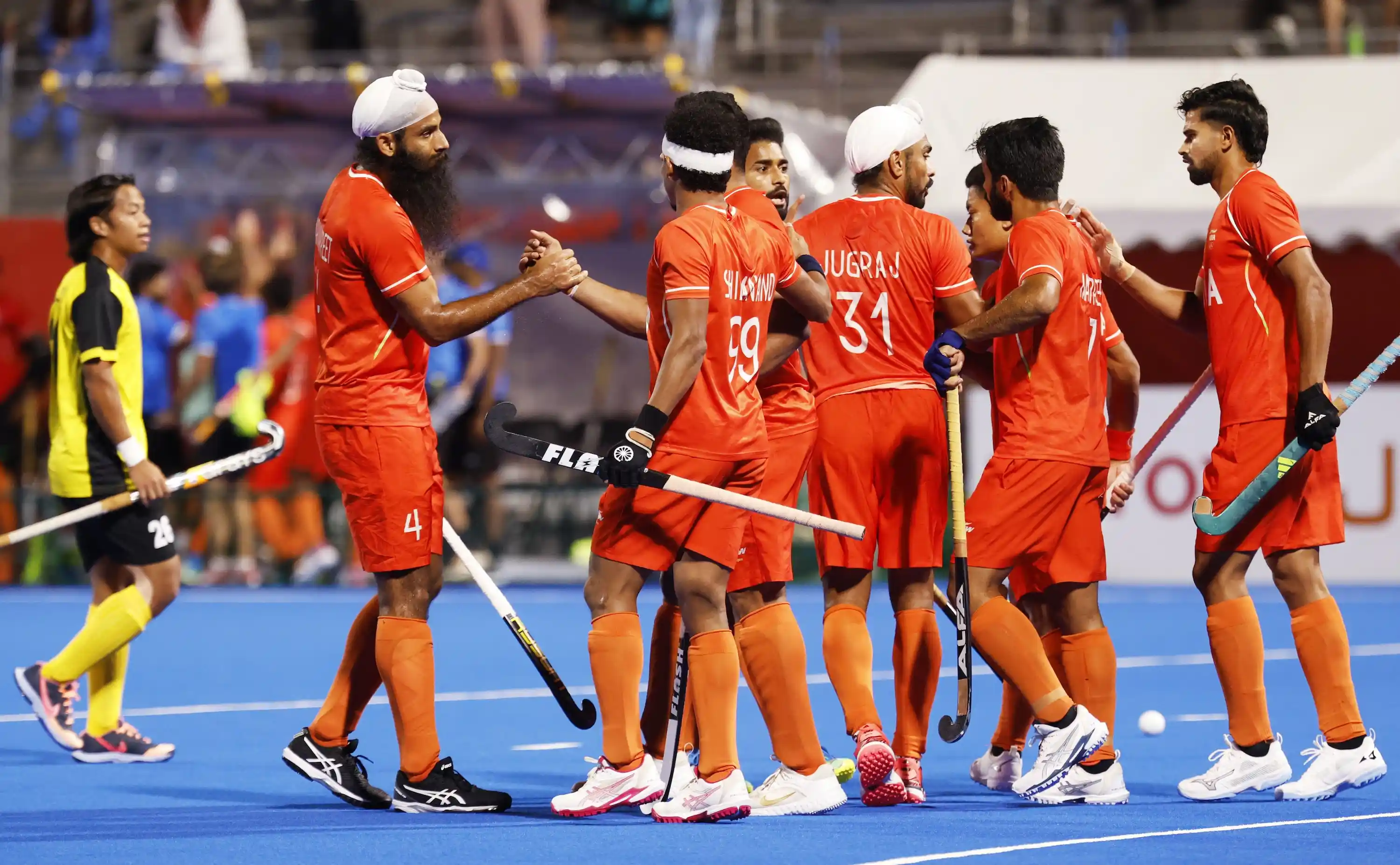
The gold list is worth reading in full, because several of these titles are firsts rather than repeats. In archery, the women’s compound team of Jyothi Surekha Vennam, Prithika Pradeep and Chikitha Taniparthi; the mixed compound pair of Taniparthi and Sahil Jadhav; the men’s compound team of Jadhav, Kushal Dalal and T. G. Mani Ratnam; the women’s recurve team of Ankita Bhakat, Kirti and 17-year-old Kumkum Anil Mohod, which ended a 28-year South Korean hold on the event; and Mohod herself in the individual recurve, the first Indian woman to win that title, and an Olympic quota with it. In shooting, Kamaljeet and Suruchi Singh in the mixed 10m air pistol; Neeru Dhanda in the women’s trap, India’s first individual trap gold since Randhir Singh in 1978; and Dhanda with Kynan Chenai in the mixed trap, a first for India and an Asian record. Kabaddi’s men and women both beat Iran to retain gold. The women’s hockey team won its first Asian Games title since the home Games of 1982; the men, under Harmanpreet Singh, beat Malaysia 5-1 to defend theirs — the first successful men’s defence — and both sides sealed places at Los Angeles 2028. The women’s and men’s cricket teams both won. Boxing produced three golds, India’s best such return: Lovlina Borgohain at 75kg, only the second Indian woman after Mary Kom to win an Asiad boxing title; Parveen Hooda at 65kg; Ankush Panghal in the men’s middleweight. Wrestling’s Aman Sehrawat took the men’s 57kg, a first for India in that class, and Sujeet Kalkal the 65kg — two freestyle golds in one Games for the first time since 1978. Pranavi Urs won the women’s individual golf, India’s first gold in the event; the women’s golf team took silver. Athletics’ lone gold was the women’s 4x400m of Kiran Pahal, M. R. Poovamma, Prachi Choudhary and Vithya Ramraj.
The silvers fill in the depth. Elavenil Valarivan (individual and team 10m air rifle), Himanshu Dhillon, Rudrankksh Patil and the rifle teams; Esha Singh in the 25m pistol; the women’s trap team; Mirabai Chanu’s 49kg silver, India’s first weightlifting medal at the Games since Karnam Malleswari in 1998; Roshibina Devi in wushu; Antim Panghal and Nitesh Siwach in wrestling; Anahat Singh and Abhay Singh in squash singles, the former the first Indian woman to reach an Asiad singles final; Sreeshankar Murali, Gulveer Singh (twice), Sawan Barwal’s marathon silver — a 44-year wait, and the first such medal away from home — Tajinderpal Singh Toor, Sarvesh Kushare, Ancy Sojan, Yashvir Singh and the mixed 4x400m in athletics; the men’s skiff in sailing; the men’s recurve and mixed recurve teams in archery.
The comparison with earlier editions is unambiguous. Guangzhou 2010 produced 65 medals and 14 gold, for sixth. Incheon 2014 slipped to 57 medals and 11 gold, eighth. Jakarta-Palembang 2018 was then a record: 70 medals, 16 gold, still eighth. Hangzhou 2023 broke the hundred-medal barrier and put India fourth. Aichi-Nagoya did not match that peak — 22 fewer medals, seven fewer golds — but it held fourth place and remained far above every pre-2023 edition. The drop is real, and athletics’ single gold against a pile of minor medals is a warning. The floor, though, has moved. India no longer treats 15 golds as a ceiling.
None of this is detachable from the system built underneath it. Khelo India, in its present form since 2017, has put more than a thousand district centres into operation and pushed talent identification out of the metros. Of 349 sanctioned sports infrastructure projects worth about ₹3,176 crore, 274 had been completed by the time these Games began. Preparation for Aichi-Nagoya itself was funded at scale: ₹702.86 crore under the Annual Calendar for Training and Competition, plus ₹97.84 crore under the Target Olympic Podium Scheme, roughly ₹800 crore in all, with the largest share going to international competition exposure, then domestic camps, equipment and coaching. In September 2026 the Union Cabinet approved a combined ₹36,441 crore for a revamped Khelo India and enhanced support to national federations through 2030–31, explicitly tying school and village pathways to National Centres of Excellence and to TOPS. Foreign coaches, sports science and equipment stipends — once exceptional — are now line items.
The gap that remains is the one that matters for 2028 and 2032. China still wins eight golds for every Indian one. Japan, on home soil, won four times as many. India’s golds still cluster in archery, combat sports and the team games it has long owned; the track, the pool and several Olympic weight classes remain thin. A fourth-place finish built on a frantic final weekend is better than an eighth-place finish built on nothing, but it is not yet a system that produces golds on demand. What Aichi-Nagoya does confirm is that the old complaint — no infrastructure, no pathway, no money — no longer explains the shortfall. The centres exist, the budget exists, and the medals, all 85 of them, are the return so far. The next test is whether that return compounds.

