After calling it the worst agreement in American history, Trump’s administration has rebuilt Obama’s Iran framework, just at a much higher price.
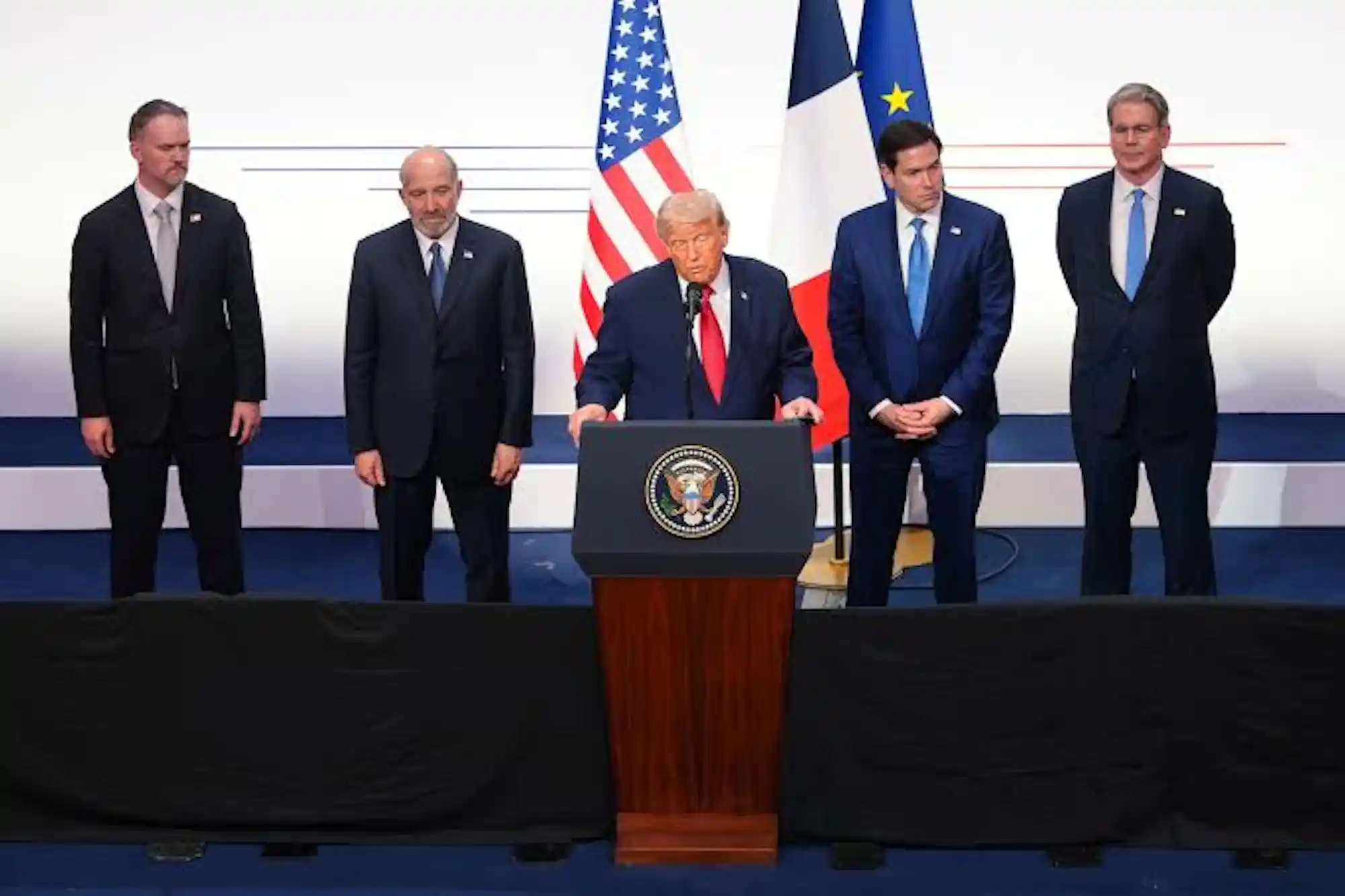
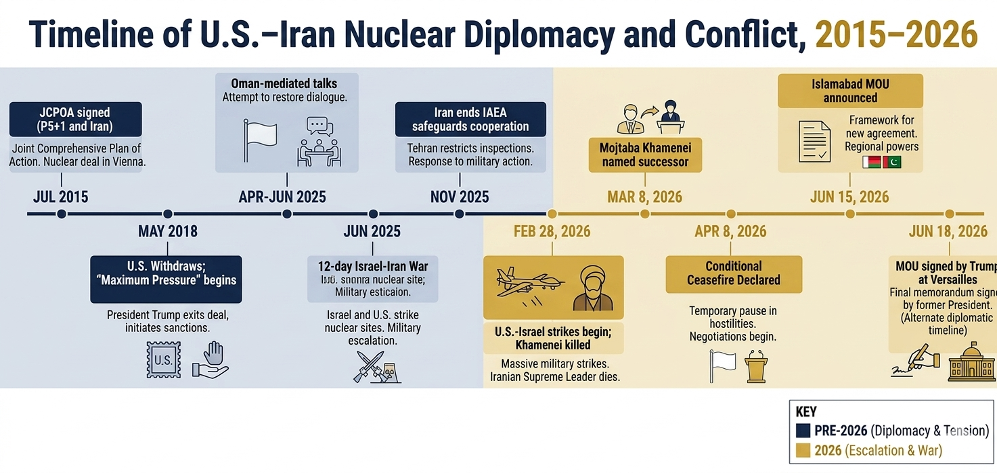
Three Indian sailors killed by American strikes in the Gulf of Oman were still being mourned in New Delhi when Donald Trump signed away the rationale for the war that killed them. At the G7 summit in Versailles on June 18, he put his name to the Islamabad Memorandum of Understanding with Iran, a 14-point agreement committing both sides to a permanent end to hostilities, the reopening of the Strait of Hormuz, and the dismantling of an economic siege that has run, with pauses and interruptions, since 1979. The architecture underneath it was familiar. Obama built it first.
In May 2018, Trump withdrew from Barack Obama’s Joint Comprehensive Plan of Action, calling it the worst agreement any country had ever negotiated. The objections were standard: some restrictions expired, ballistic missiles went untouched, and Iran’s regional proxies sat entirely outside the deal’s scope. Eight years of maximum pressure, a regional war, and the killing of a supreme leader later, Washington has returned to the same core bargain: nuclear restraint exchanged for economic relief, at a considerably steeper price.
The Original Bargain
Obama’s wager was that intrusive inspection could substitute for trust. Tehran agreed to cap enrichment at 3.67 percent, hold its stockpile to 300 kilograms, and accept the most rigorous IAEA monitoring ever applied to a non-weapons state, in exchange for phased relief starting in January 2016. Critics never disputed that this worked; they objected to the sunset clauses, the unaddressed missiles, and the regional proxies Obama left entirely untouched.
That account does not explain what happened next, though. Freed from the JCPOA’s ceiling, Iran’s enriched stockpile climbed for seven straight years instead of shrinking. By May 2025, IAEA safeguards reporting placed total enriched uranium at 9,247 kilograms across all levels, more than thirty times the JCPOA limit, with 440.9 kilograms at 60 percent enrichment. France’s delegate told the UN Security Council that material alone could yield roughly ten nuclear devices if pushed to weapons grade. Sanctions, including the snapback Britain, France, and Germany triggered in August 2025, slowed none of it.
The War That Did What Sanctions Could Not
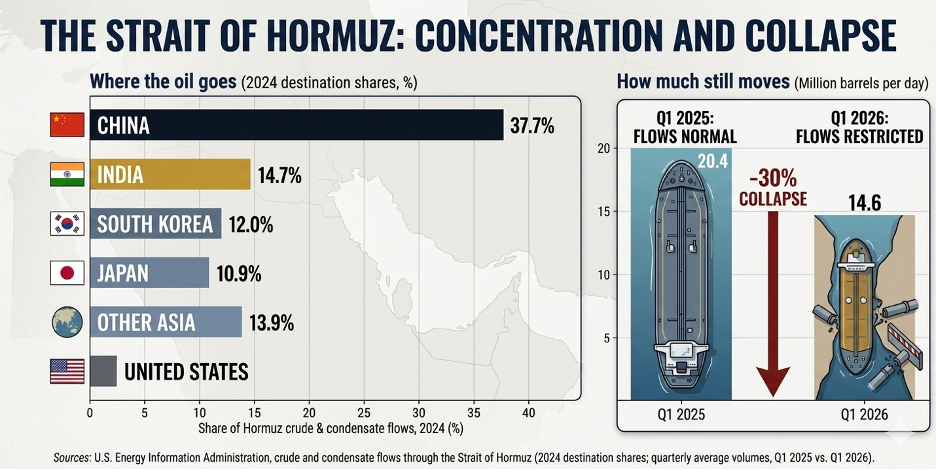
What finally stopped the growth was war, not pressure. Israeli and American strikes hit Iran’s enrichment sites in June 2025; a larger campaign beginning February 28, 2026, killed Khamenei within hours and installed his son Mojtaba as successor by early March. Iran answered by mining the Strait of Hormuz. A waterway that ordinarily carries a fifth of the world’s oil effectively closed. Hormuz flows fell nearly thirty percent, to 14.6 million barrels a day. Brent crude, trading near seventy dollars before the war, pushed past one hundred. War forced Iran back to the table. Eight years of sanctions had not.
The Islamabad Blueprint
The Islamabad MOU, mediated by Pakistan and signed digitally at Versailles on June 18, commits Iran to reaffirming that it will not acquire or develop nuclear weapons, down-blending its uranium stockpile under IAEA supervision, and allowing toll-free passage through Hormuz for a minimum of sixty days. The United States commits to ending its economic sanctions under a mutually agreed schedule, unfreezing Iranian assets, and developing alongside regional partners a $300 billion reconstruction package for Iran.
Set it beside the 2015 deal and the family resemblance is plain. Both trade nuclear restraint for economic relief; both establish international oversight of Iran’s program; both defer unresolved questions to follow-on talks. What is genuinely new is scope. Hormuz, Lebanon, and a $300 billion reconstruction package sit inside the 2026 text in ways nothing in Obama’s framework anticipated, because no comparable war had occurred to put them there. Iran’s lead negotiator has offered to dilute rather than surrender the uranium stockpile outright, a quiet admission that Tehran still controls that material, and the IAEA cannot yet confirm the current status of Iran’s enrichment sites after they were struck.
| Dimension | Obama’s JCPOA (2015) | Trump’s Framework (2026) |
| Strategic logic | Multilateral diplomacy negotiated without an active war; leverage built through sanctions and isolation. | Bilateral terms negotiated after a war that killed Iran’s Supreme Leader; mediated by Pakistan; leverage built through direct military force. |
| Verification | Enhanced IAEA inspections begin on day one; continuous monitoring of enrichment sites. | IAEA access severed since November 2025; down-blending of stockpile under IAEA supervision proposed, but monitoring architecture deferred to 60-day follow-on talks. |
| Nuclear restrictions | Numerically explicit: enrichment capped at 3.67%, stockpile capped at 300 kilograms. Sunset clauses attached. | Iran reaffirms it will not acquire nuclear weapons; uranium stockpile to be down-blended rather than removed; enrichment ceilings deferred to follow-on negotiations. |
| Economic terms | Phased multilateral sanctions relief tied to certified compliance, anchored in UNSCR 2231. | Full US sanctions lifted under a mutually agreed schedule; Iranian assets unfrozen; $300 billion reconstruction package committed by US and regional partners. |
| Strait of Hormuz | Not a subject of negotiation; the strait operated normally throughout the Vienna talks. | Central deliverable of the agreement: toll-free reopening for commercial vessels for 60 days minimum, with future administration to be negotiated with Oman. |
| Ballistic missiles | Excluded by design. Critics called this the deal’s central flaw. | Excluded again. Trump said at G7 Evian it would be ‘unfair’ to deny Iran missiles while Saudi Arabia and Qatar retain their own. |
Table 1. Two nuclear bargains with Iran, eleven years apart: what changed, what didn’t.
The Missiles Trump Couldn’t Touch
One of Trump’s original justifications for the war was eliminating Iran’s ballistic missile program. At the G7 in Evian, the day before he signed the MOU at Versailles, he abandoned that goal in a single sentence. Asked whether Iran should disarm its missiles, Trump said he found it a little bit unfair to demand that Tehran stand down while Saudi Arabia and Qatar retained their own. ‘If other countries have them,’ he told reporters, ‘in relative proportion, I think it’s okay.’ Reuters noted he had withdrawn at least one of his stated rationales for attacking Iran in the first place. Iran’s foreign minister had already declared missiles non-negotiable; Trump’s remark arrived as confirmation rather than concession. Israel, not a party to the agreement and still refusing to withdraw from southern Lebanon, was left to absorb the widening gap between Washington and Jerusalem.
War accomplished what eight years of sanctions could not.
India’s Bill
The deal came too late for the three sailors. India imports roughly nine-tenths of its crude, and within weeks of the war the petroleum ministry had rerouted seventy percent of those imports away from Hormuz, up from fifty-five percent before the conflict, drawing on forty countries instead. The Indian crude basket jumped to $113.57 a barrel by mid-March, prompting a cut to petrol excise duty and the elimination of diesel duty altogether. Nearly eighteen thousand Indian seafarers remain stranded across the Gulf. At the G7 in Evian, Prime Minister Modi raised the issue directly with Trump during their first bilateral in sixteen months. ‘Hundreds of thousands of Indian seafarers are working across global maritime trade routes, including the Strait of Hormuz,’ he said, ‘and their safety is of utmost importance to us.’ Trump acknowledged the casualties. ‘It’s a rough profession, no question about it,’ he replied. The exchange was not unfair. It was not policy either.
Saudi Arabia cautiously welcomed the agreement, but its foreign ministry was candid that trust with Tehran had been severely damaged by the conflict. That framing captures the MOU’s central unresolved problem: the deal ends the fighting; it defers to sixty days of follow-on talks the verification architecture that would make the peace durable. The IAEA still cannot confirm the status of Iran’s enrichment sites. The ballistic missiles remain. Lebanon is unsettled. The comparison with Obama’s bargain reads less like a contrast than a palimpsest.
Trump did not negotiate a different bargain from Obama’s. He negotiated a far costlier route back to a similar one, paid for in a dead supreme leader, a blockaded strait, three Indian sailors, and a ballistic missile concession his own administration had refused for eight years before making it in an off-the-cuff remark at a French summit. Whether the Islamabad MOU holds longer than the agreement it resembles depends on details still being negotiated, by the same parties, over the same questions, for the third time in a decade.
References:
Al Jazeera. “Iran Names Mojtaba Khamenei as New Supreme Leader after Father’s Killing.” March 8, 2026.
Arab Center Washington DC. “The United States Has Joined Israel in an All-Out War on the Islamic Republic of Iran.” March 2, 2026.
Associated Press. “Trump Appears to Undercut US Proposal to Iran, Declaring He Won’t Allow Any Uranium Enrichment.” May 30, 2025.
Bloomberg News. “Hormuz Oil Flows Fell Nearly 30% Last Quarter, EIA Says.” May 13, 2026.
CBS News. “14 Dead, Thousands Stranded: Inside the Plight of Mariners Trapped in the Strait of Hormuz.” June 17, 2026.
Center for Arms Control and Non-Proliferation. “Iran’s Stockpile of Highly Enriched Uranium: Worth Bargaining For?” March 2026.
Center for Strategic and International Studies. “The United States and Iran Announce a Deal to End the War.” State of Play, June 2026.
Congressional Research Service. Iran Conflict and the Strait of Hormuz: Impacts on Oil, Gas, and Other Commodities. R45281. Washington, DC: Library of Congress, 2026.
Congressional Research Service. Iran’s Nuclear Program and UN Sanctions Reimposition. IF11583. Washington, DC: Library of Congress, April 2026.
Food and Agriculture Organization of the United Nations. “Triple Squeeze: How the Strait of Hormuz Crisis Hit India’s Fuel, Fertilizer, and Agricultural Exports.” FAO in India, April 2026.
India Briefing. “Strait of Hormuz and India’s Oil Supply: Import Dependencies and Mitigation Measures.” April 2, 2026.
Institute for Energy Research. “New EIA Report Shows Extent of Hormuz Oil Disruptions.” May 2026.
International Atomic Energy Agency, Board of Governors. NPT Safeguards Agreement with the Islamic Republic of Iran. GOV/2025/24. Vienna: IAEA, May 2025.
International Atomic Energy Agency, Board of Governors. NPT Safeguards Agreement with the Islamic Republic of Iran. GOV/2026/8. Vienna: IAEA, February 27, 2026.
International Energy Agency. “Strait of Hormuz.” Energy Security and Emergency Response, 2025–2026.
Invasset Research. “$143 and Counting: Why India’s Crude Oil Basket Is Far More Expensive Than Brent.” March 25, 2026.
The Jerusalem Post. “Trump’s Nuclear Deal Could Be Critical for Israel on Iran, Hezbollah.” June 16, 2026.
NPR. “U.S. and Iran Announce an Initial Deal to End the War and Reopen the Strait of Hormuz.” June 15, 2026.
Observer Research Foundation. “The Strait That Shakes Prices: Impact of the Hormuz Disruption on Inflation in India.” May 15, 2026.
UK House of Commons Library. The E3 Triggers Snapback Sanctions against Iran, 2025. CBP-10330. London: House of Commons Library, 2025.
UK House of Commons Library. Israel/US–Iran Conflict 2026: Background and UK Response. London: House of Commons Library, 2026.
U.S. Department of State, Office of the Spokesperson. “Completion of UN Sanctions Snapback on Iran.” September 27, 2025.
U.S. Energy Information Administration. “Amid Regional Conflict, the Strait of Hormuz Remains Critical Oil Chokepoint.” Today in Energy, June 16, 2025.
United Nations Security Council. “Speakers Split over Iran’s Nuclear Ambitions, Merits of Snapback Sanctions as Security Council Considers Implementation of JCPOA.” SC/16263, December 2025.