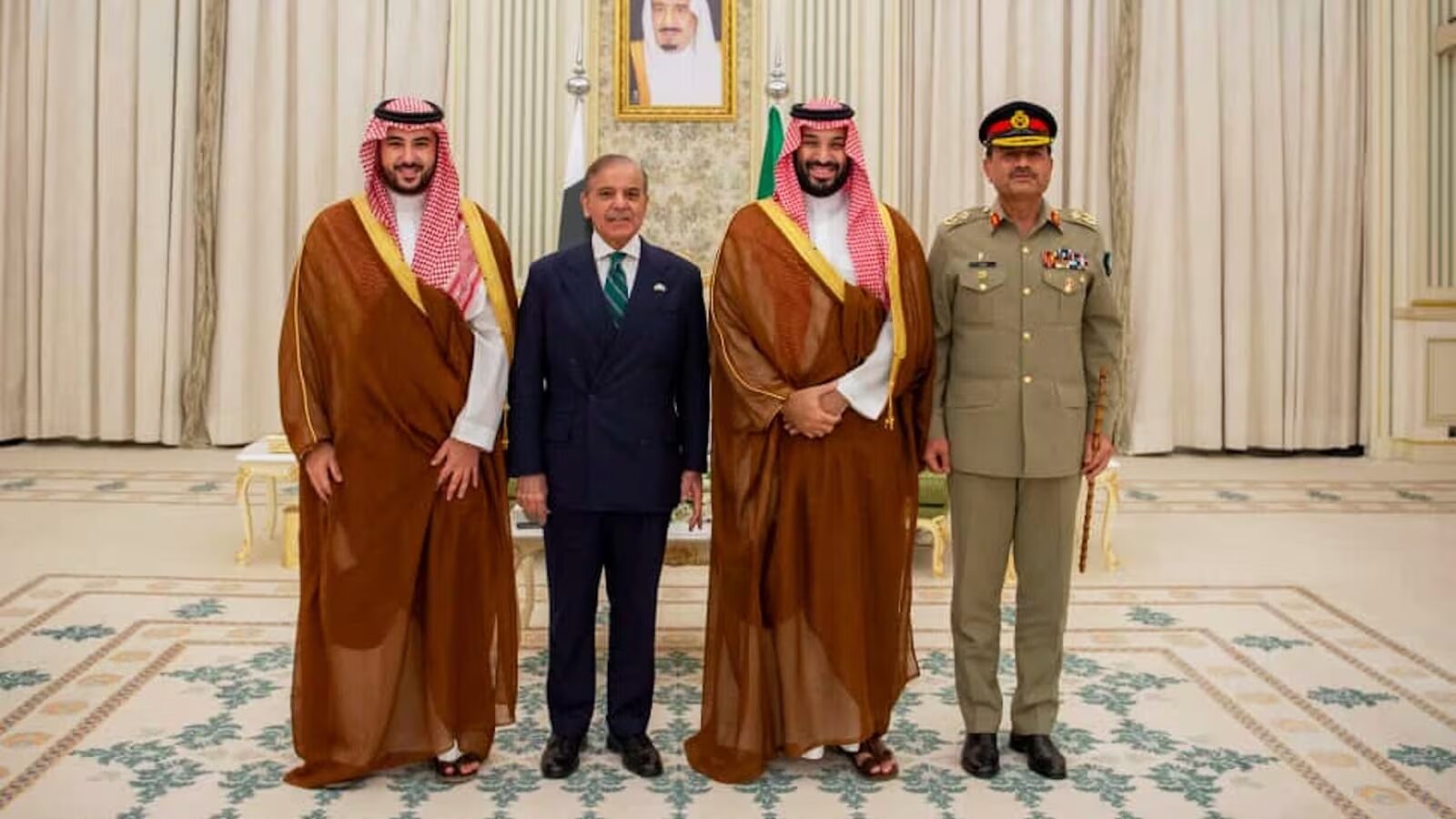
The announcement of a strategic defence pact between Saudi Arabia and Pakistan has many ramifications for us and for the region. India has reacted immediately, which means that we are seriously concerned and want to make our position known without delay.
We have frontally stated our serious concerns about the impact of this development on our national security as well as on regional and global stability. By underscoring in the context of this defence pact our commitment to protect our national interests and to ensure comprehensive national security in all domains, we have been unusually forthright.
Our saying that we were aware that this development, which formalises a long-standing arrangement between the two countries, has been under consideration would suggest that we were not caught completely off guard. But, if we have reacted so strongly, it is probably because of the clause in this pact, which has been highlighted in the Saudi statement, namely, that aggression against one country will be seen as aggression against the other.
Now, for Pakistan, the only country that can commit “aggression” against it is India. There is no other country from which Pakistan could fear an attack. Operation Sindoor is not yet over. If, therefore. If Pakistan sponsors another major terrorist attack and India reacts militarily, would Saudi Arabia consider it an attack on them too?
Saudi Arabia is aware of the reasons for the conflict between India and Pakistan. It is in no position to cleanse Pakistan of its jihadi outfits and end Pakistan’s long-standing policy of using terrorism as a tool against India. Pakistan has territorial claims on India, which it is determined to maintain. Its Army Chief is a diehard, India-baiting, and Hindu-baiting Islamist. The defence pact can, in fact, embolden the Pakistan military and the jihadi groups to target India.
In this situation, does Saudi Arabia want to be drawn directly into an India-Pakistan conflict in the future? If not, why then this clause that aggression against Pakistan will be considered as an aggression against Saudi Arabia too? The Saudi leader would know that India would construe this clause in the only way it has to be. Why has he allowed this concern to arise in India?
If he had anticipated this concern and clarified to us in advance the scope of this clause and the obligations on each side arising from this defence pact, our reaction would have probably been couched differently. Obviously, the Saudis did not seek to allay our concerns.
We do not, of course, expect Saudi Arabia to get directly involved in a military conflict with India. What we can expect as a result of this defence pact is Saudi financial aid to Pakistan to build its military capacities so that its security support to Saudi Arabia in the future becomes more robust.
In the recent conflict with India, Pakistan has suffered major damage to its air bases, and it would now be looking to fill the gaps in its air defences in particular. This would require a lot of money, which Pakistan can ill afford, given the state of its economy. Saudi Arabia can make financial resources available with soft loans, in addition to subsidised energy supplies.
Saudi Arabia can also become more active on the diplomatic front in favour of Pakistan. Even during Operation Sindoor, it had intervened diplomatically. After the defence pact, it could feel obliged to work in favour of Pakistan within the Islamic world and with the US.
President Trump has already expressed his desire to mediate between India and Pakistan on Kashmir, besides other signals he has given about strengthening ties with Pakistan. He has disregarded India’s concerns. He has engaged Pakistan’s Army Chief over the head of the country’s prime minister. He wants US companies to exploit Pakistan’s natural resources. In the past, the US and Saudi Arabia have collaborated against the Soviet Union in Afghanistan with Pakistan’s collaboration. That cooperative role can be revived in a different context, this time to ostensibly stabilise the situation in the sub-continent, more so if the Saudis are also investing in extracting minerals in Baluchistan.
Some commentators in India are arguing that this defence pact is directed at Israel and not India. The immediate trigger, it is being said, was the Israeli attack on Qatar. All these years, the Gulf countries, and Saudi Arabia in particular, with its massive oil resources, depended on the US for their security. Now they can no longer, as the US is fully backing Israel. Besides this, Trump’s political base is against the US getting involved in conflicts abroad and acting as the policeman of the world.
This dwindling confidence in the US as a guarantor of security in the region had already led Saudi Arabia to begin normalising its ties with Iran.
The fact remains that the US has major military bases in the region, in Qatar and in Bahrain. The US Navy is active in the region. The US has been protecting commercial shipping in the Red Sea and acting against Houthi threats. It has militarily attacked Iranian nuclear installations, something the US has never done before. The fact is also that the Gulf states are supportive of Israeli efforts to eliminate what are seen as Iranian proxies in the region, be it Hamas or Hezbollah. Despite Israel’s deadly military campaign against the Palestinians in Gaza and accusations against it of committing genocidal acts, the UAE, Bahrain, Sudan, and Morocco have not broken diplomatic ties with Israel.
Israel’s violation of Qatar’s sovereignty in conducting air strikes against Hamas leaders located on its territory seems to have precipitated the Saudi decision to sign the strategic defence pact with Pakistan. The “strategic” element in this is the nuclear weapon umbrella that Pakistan is providing to Saudi Arabia.
Bringing in this nuclear element into the equation would be unsettling for the region. On the one hand, Iran continues to be subject to intense pressure to prevent it from going nuclear, even though it disclaims any intention to do so, and its programme has been subject to IAEA inspections. It has been argued that if Iran went nuclear, Saudi Arabia would do so too in time. On the other hand, by accepting Pakistan’s nuclear umbrella, Saudi Arabia is now bringing in nuclear weapon deterrence in the Gulf. This could be seen as a nuclear challenge by Iran. This is bound to complicate the security issues in the Gulf region.
The assumption that Pakistan’s nuclear capacity will act as a deterrent to Israel in West Asia assumes that Israel could use nuclear weapons against the Gulf states. No Gulf state is powerful enough to threaten the existence of Israel, and Israel does not need to use nuclear weapons against Saudi Arabia. Israel has no reason to threaten the existence of Pakistan either. So, why is Pakistan’s nuclear arsenal being brought into the security arrangements in the Gulf?
India would feel perturbed by this development too. Pakistan acquired its nuclear capability clandestinely. It has been involved in proliferation activities. There has been concern in the US in particular about its nuclear weapons falling into the hands of Islamic extremists. The Pakistan Army Chief, talking to the Pakistani diaspora in the US, has been threatening to bring down half the world with the country’s nuclear weapons.
This strategic defence pact between Saudi Arabia and Pakistan rehabilitates Pakistan as a responsible state. It also politically legitimises Pakistan’s nuclear arsenal as a stabilising element regionally.
Significantly, the head of the US Central Command was in Riyadh when the defence pact with Pakistan was signed. (Oddly, Ali Larijani, head of Iran’s National Security Council, was in Riyadh too on the same day.) One can assume that the US is not against Pakistan playing a security role in the Gulf and taking the burden off the US, in the way the US wants Europe to share the security burden in Europe. This would be part of the Trump administration’s policy of strengthening ties with Pakistan and adding to strategic pressures on India, the latest being the decision to revoke the earlier waiver and impose sanctions on the Chabahar port project in Iran, in which India is participating. It is an important connectivity project that facilitates India’s access to Afghanistan and Central Asia.