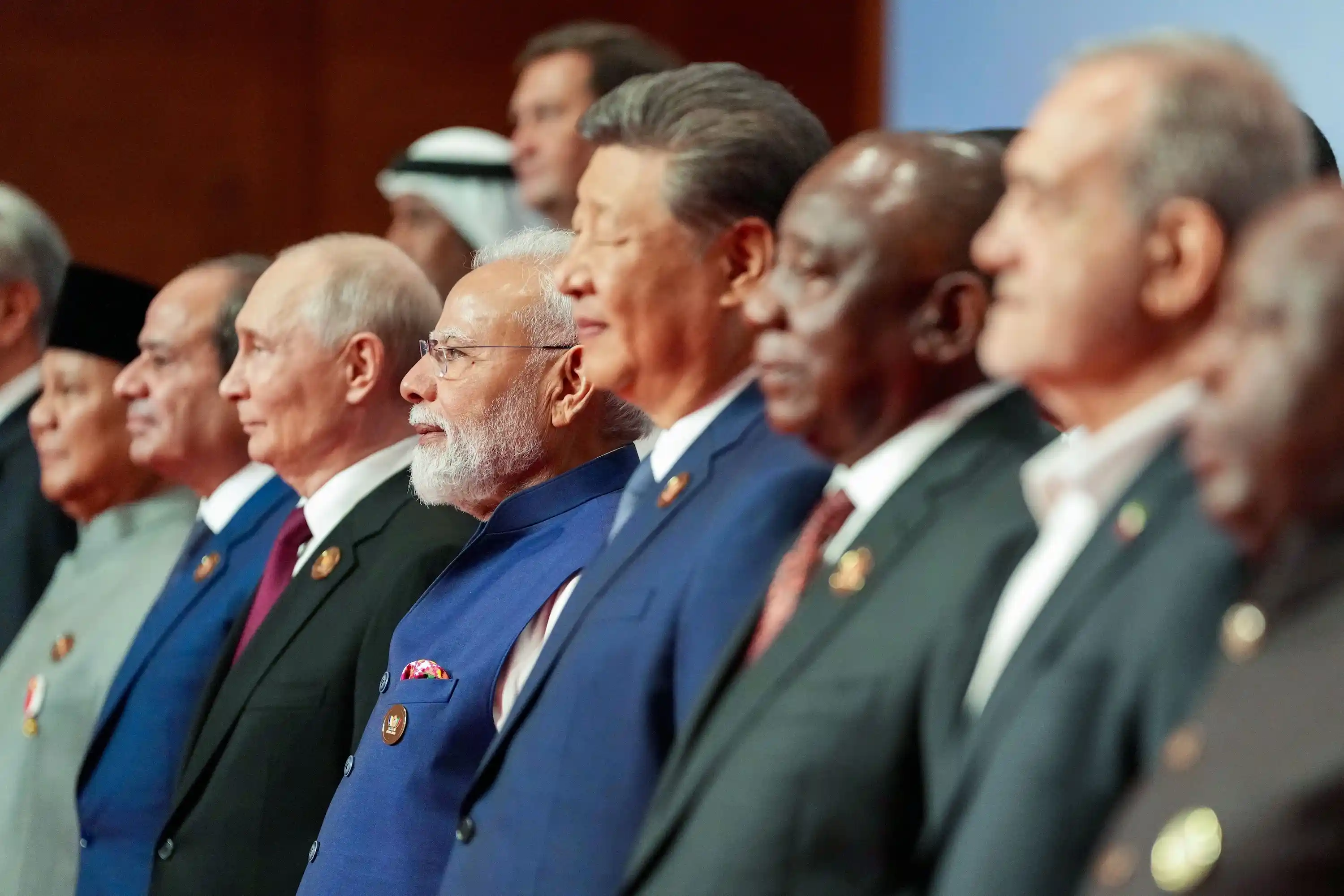
As eleven BRICS economies adopted the New Delhi Declaration this week, India’s chairship offered a test case for a diplomatic model built less on picking sides than on refusing to be reduced to one.
Key Findings
- BRICS (11 members) holds about 40% of global GDP at purchasing power parity against roughly 28% for the G7, but the G7 still commands close to 45% in nominal dollar terms.
- China overtook the United States as India’s largest trading partner in FY2025-26, on a $112 billion deficit, even as the boundary dispute remains unresolved.
- India’s Russian crude purchases rebounded past 50% of its import basket by mid-2026, months after Washington’s tariff pressure had pushed the share below a quarter.
- A concluded EU trade agreement and a de-escalated US tariff rate show deepening Western ties running concurrently with BRICS chairship, not instead of it.
- No common BRICS currency exists or is imminent; what is real is incremental local-currency settlement, alongside continued dollar-denominated NDB borrowing.
Xi Jinping shook Narendra Modi’s hand outside Bharat Mandapam on September 12, his first visit to India since 2019; Vladimir Putin arrived for his first in-person BRICS summit outside Russia since the war in Ukraine began (Spokesman-Review 2026; NewsBricks 2026). The image will circulate as shorthand for an anti-Western axis. It misreads what happened. The more interesting story isn’t that Modi hosted Xi and Putin. It’s that he hosted them the same week Washington and Brussels remained, by trade volume, among India’s largest partners, and neither fact cancelled out the other.
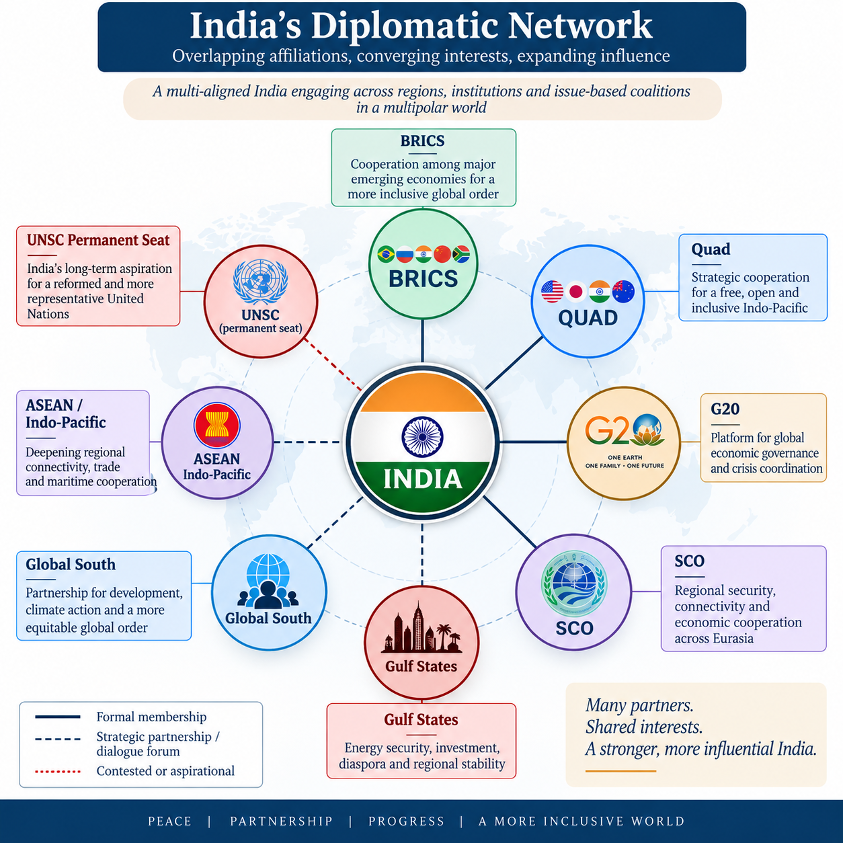
That simultaneity is the argument here. Modi’s most consequential diplomatic achievement isn’t an anti-Western bloc; BRICS has never become one, and its own May 2026 foreign ministers’ meeting collapsed without a joint statement over splits on West Asia (Forbes India 2026). It is India’s accumulating capacity to sit inside overlapping, often mutually suspicious systems at once: BRICS and the Quad, Moscow and Washington, Beijing and the Gulf, without treating any one membership as exclusive. Call it managed multi-alignment. It isn’t new to 2026, but the New Delhi summit, and the 140-paragraph declaration it produced, show it operating at a scale and under a strain earlier chairships never faced.
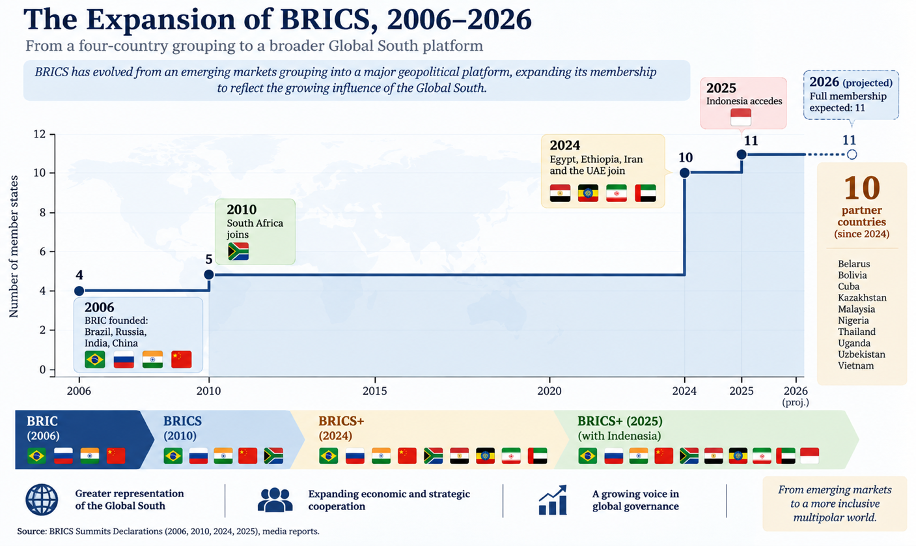
Start with the numbers, because BRICS diplomacy increasingly rests on them. The eleven-member grouping now accounts for roughly half the world’s population and forty percent of global GDP at purchasing power parity, against twenty-six percent of global trade (Vajiram & Ravi 2026; Forbes India 2026). The G7, by contrast, holds under thirty percent of PPP output, though it still commands something closer to forty-five percent in nominal dollar terms (Chaturvedi 2025). That gap between PPP and nominal weight isn’t a technicality. It is the entire argument for why BRICS matters economically while remaining, in hard-currency and financial-market terms, still the junior partner.
Table 1. G7, BRICS and India: Comparative Global Weight
| Indicator | G7 | BRICS (11 members) | India |
| Population, share of world (2026 est.) | ≈ 9–10% | ≈ 49–50% | ≈ 18% |
| GDP, purchasing power parity, share of world | ≈ 28–29% | ≈ 40–41% | 3rd largest (by this measure) |
| GDP, nominal (market exchange rates), share of world | ≈ 44–45% | not independently verified¹ | 6th largest ($3.92 trillion, 2025) |
| Share of global merchandise trade | not independently verified¹ | ≈ 26% | not independently verified¹ |
India’s own numbers carry a similar tension the government hasn’t always acknowledged cleanly. In May 2025, NITI Aayog announced India had become the world’s fourth-largest economy; the IMF’s April 2026 Outlook instead placed it sixth, behind Japan and the UK, the rupee’s slide from roughly 85 to 92 per dollar having done more to the ranking than any change in output (Business Standard 2026a; The Wire 2026). Measured in purchasing power, India remains third, behind only the US and China. Nominal GDP has grown by something like ninety percent since 2014, a genuinely rapid expansion, though not the tidy “doubling” figure the ruling party’s own social accounts prefer.
Nowhere is the multi-alignment thesis tested harder than with China. Five years after Galwan, the relationship runs on what might fairly be called managed strategic competition: real cooperation where interests align, sustained wariness where they don’t, with neither side pretending the two can be resolved into friendship. The October 2024 patrolling agreement, Modi’s first visit to China in seven years for the Tianjin SCO summit, and the resumption of direct flights in late October 2025 all point one direction (Congressional Research Service 2025; ISPI 2026). Xi’s own language in Tianjin, urging the “dragon and the elephant” to “dance together,” was striking; Modi, for his part, told Xi that India and China are “partners, not rivals” (MFA China 2025). Yet China overtook the US as India’s largest trading partner in FY2025-26, on the back of a $112 billion deficit built largely on electronics and machinery inputs India cannot yet substitute (Business Standard 2026b). That is not the profile of a friendship. It is the profile of asymmetric interdependence that both governments have decided, for now, to manage rather than resolve. Skeptics are right that the pattern has cycled before, optimism followed by relapse, and nothing guarantees this iteration breaks the cycle (Foreign Policy 2025).
The American relationship shows a different kind of compartmentalization. Washington doubled tariffs on India to fifty percent in August 2025, explicitly over Russian oil purchases; Peter Navarro’s language, accusing India of complicity in “bloodshed,” was about as undiplomatic as trade policy gets between nominal partners (Al Jazeera 2025). Yet the two governments struck an interim deal in February 2026 cutting the rate to eighteen percent (U.S. Embassy in India 2026), even as technology cooperation under the renamed TRUST initiative, successor to iCET, kept advancing in semiconductors, AI and defence co-production through the same period of maximum trade friction (CSIS 2026). Commerce and security, in other words, ran on separate tracks. India’s Russian crude purchases, meanwhile, dipped below a quarter of the import basket in early 2026 under sanctions pressure, then rebounded past fifty percent by June and July, Putin himself noting Russia was “expanding its exports” to India (CNBC 2026; ThePrint 2026). Whatever New Delhi promised Washington in February, it did not amount to abandoning Moscow. That is worth stating plainly rather than smoothing over.
That gap between PPP and nominal weight isn’t a technicality.
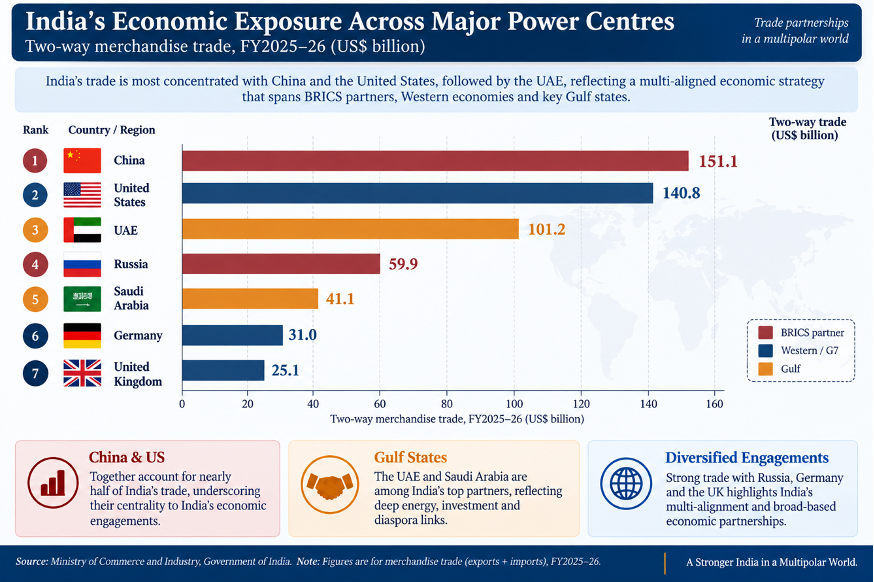
Table 2. India’s Strategic Autonomy: Multiple Relationships, No Single Bloc
| Power centre | Cooperation | Competition or constraint |
| United States | Defence and technology cooperation under TRUST/iCET; Quad coordination; a February 2026 tariff de-escalation to 18% | A 50% tariff regime (Aug. 2025–Feb. 2026) imposed explicitly over Russian oil purchases; recurring friction over agriculture and digital rules |
| Russia | Discounted crude oil since 2022; legacy defence platforms; consistent diplomatic alignment on Ukraine-related votes | Secondary-sanctions exposure for Indian refiners and banks; dependence on a single, sanctioned supplier for a growing share of energy needs |
| China | BRICS and SCO coordination; resumed direct flights and visas; $151 billion in FY2025-26 two-way trade | Unresolved boundary dispute; a $112 billion trade deficit; competing influence across South Asia |
| Gulf states | Energy security, sovereign investment, and a large resident Indian workforce | Regional politics (Iran-Gulf tensions, West Asia conflict) that India navigates without formal alignment |
| European Union | A concluded free trade agreement (Jan. 2026); technology, green-energy and critical-minerals cooperation | Regulatory divergence on carbon-border rules and data governance |
| Global South / BRICS | Convening role through Voice of Global South summits and the 2026 BRICS chairship; a shared reform agenda on the IMF and UNSC | Rival leadership claims, chiefly from China; internal BRICS splits, as the failed May 2026 foreign ministers’ statement showed |
On the Global South, the more honest question is not whether India speaks for it. Everyone with a microphone claims to. It is whether India is building durable capacity to shape it. Its own Voice of Global South summits, deliberately excluding China, suggest an attempt to hold a convening role distinct from Beijing’s rival claim to developing-world leadership (Tribune India 2024). BRICS’s declaration backs India and Brazil for greater UN representation, but China, a BRICS member, remains the sole P5 power declining to explicitly endorse India’s Security Council candidacy in its separate P5 capacity, an unresolved contradiction the declaration’s language does not paper over so much as leave unaddressed (IMPRI 2026). Symbolic solidarity and institutional follow-through are not the same achievement, and the New Delhi Declaration mostly delivers the former.
The declaration itself rewards a “what actually changed” test more than a celebratory one. There is no common BRICS currency, and none is imminent; what exists is incremental growth in local-currency settlement and payment interoperability, alongside continued reliance on dollar-denominated bond markets even at the New Development Bank (EBC 2026; Rio Times 2026a). The NDB’s own expansion is instructive: Uzbekistan completed accession in June 2026, while Colombia, announced as a member back in July 2025, still had not ratified by September 2026, and Iran’s claimed membership remains, per the bank’s own communications office, unconfirmed (Rio Times 2026b). Institutions expand more slowly than communiqués suggest. Meanwhile Trump’s tariff threats against the bloc, one hundred percent in November 2024 over de-dollarisation, a further ten percent in July 2025 over “anti-American” alignment, never materialised as broad-based policy, which says as much about the limits of that threat as about BRICS’s cohesion (Time 2025; PBS 2024).
Table 3. From Bloc Politics to Bridge Politics
| Dimension | G7-centred model | BRICS model | India’s Modi-era approach |
| Strategic alignment | Formal treaty alliances (NATO and bilateral defence pacts) | Non-aligned coordination; no mutual-defence commitments | Issue-by-issue partnerships; no formal alliance obligations to any pole |
| Economic integration | Deep integration among advanced, high-income economies | Heterogeneous economies at very different stages of development | Concurrent integration with Western markets (EU FTA) and BRICS trade |
| Currency and finance | Dollar-centred; IMF and World Bank governance | Local-currency settlement and NDB financing; no common currency | Promotes local-currency and payments options while keeping reserves diversified |
| Global governance reform | Institutional incumbency; permanent UNSC seats unchanged since 1945 | Collective push for Bretton Woods and UNSC reform | Runs the same reform case through both the G4 and BRICS channels at once |
| Posture toward Russia and China | Sanctions on Russia; containment-oriented approach to China | Explicit non-alignment with Western sanctions regimes | Sanctions-skeptical on Russia; trade-open but security-wary toward China |
None of this adds up to India replacing the G7-led order with something else. It adds up to something narrower and, arguably, more durable: an India that has made itself hard to categorise, simultaneously a BRICS founder, a Quad partner, Russia’s largest oil customer outside sanctioned channels, and a country that just concluded, after two decades of negotiation, a free trade agreement with the EU that both sides called the “mother of all trade deals” (ISAS 2026). The risk is real. A country that belongs everywhere can end up decisive nowhere, and India’s UNSC campaign, nearly three decades old now, is the clearest evidence that a seat at every table doesn’t guarantee a permanent chair at the one that matters most. But the capacity to be read simultaneously as a Western partner, a BRICS member and a Global South leader, without any one audience concluding it has been abandoned, is not a trivial diplomatic asset. In a system fragmenting into overlapping networks rather than consolidating into rival blocs, that capacity to translate across them, more than any single summit outcome, is what New Delhi actually exported this week.
Methodology Note
Gross domestic product figures are drawn from the IMF World Economic Outlook database (April 2026 edition unless stated otherwise) and are labelled nominal (market exchange rate) or PPP (purchasing power parity) throughout; the two are never combined in a single comparison. India’s nominal GDP growth since 2014 is calculated as a compound annual growth rate: CAGR = (Ending Value / Beginning Value)^(1/n) − 1, using a 2014 base of approximately $2.04 trillion and a 2025 final value of $3.92 trillion (IMF, April 2026), with n = 11 years, giving a CAGR of approximately 6.1 percent and cumulative growth of approximately 92 percent in current dollar terms. This is an unadjusted dollar figure, so it reflects exchange-rate movement as well as real output growth; it is not rebased to constant prices, a limitation stated here rather than smoothed over.
Trade figures for India’s bilateral partners (Figure 3) are two-way merchandise trade (exports plus imports) for the Indian fiscal year 2025-26 (April 2025–March 2026), as reported by the Ministry of Commerce and Industry and cited in Business Standard’s reporting of that data. BRICS-wide population, GDP (PPP) and trade-share figures reflect the 11-member configuration recognised by the 2026 Indian presidency, cross-checked across two independently reported sources. Where a comparable nominal-GDP or trade-share figure for the 11-member bloc could not be cross-verified, the relevant table cell is marked accordingly rather than estimated.
No influence scores, rankings or weightings were assigned to the relationships depicted in Figure 1. Line styles there distinguish the formal category of a tie (treaty membership, dialogue forum, or contested claim), not its strength, which cannot be quantified without arbitrary weighting.
Two claims in the Government of India’s own public communications are flagged rather than repeated as settled fact: the May 2025 announcement that India had become the world’s fourth-largest economy by nominal GDP, which the IMF’s subsequent April 2026 data revised to sixth; and informal “doubling” characterisations of 2014-2025 GDP growth, against a computed figure closer to 92 percent. Both discrepancies trace mainly to rupee depreciation and the gap between preliminary projections and finalised data, not to any retraction of underlying growth, which remains substantial by any measure.