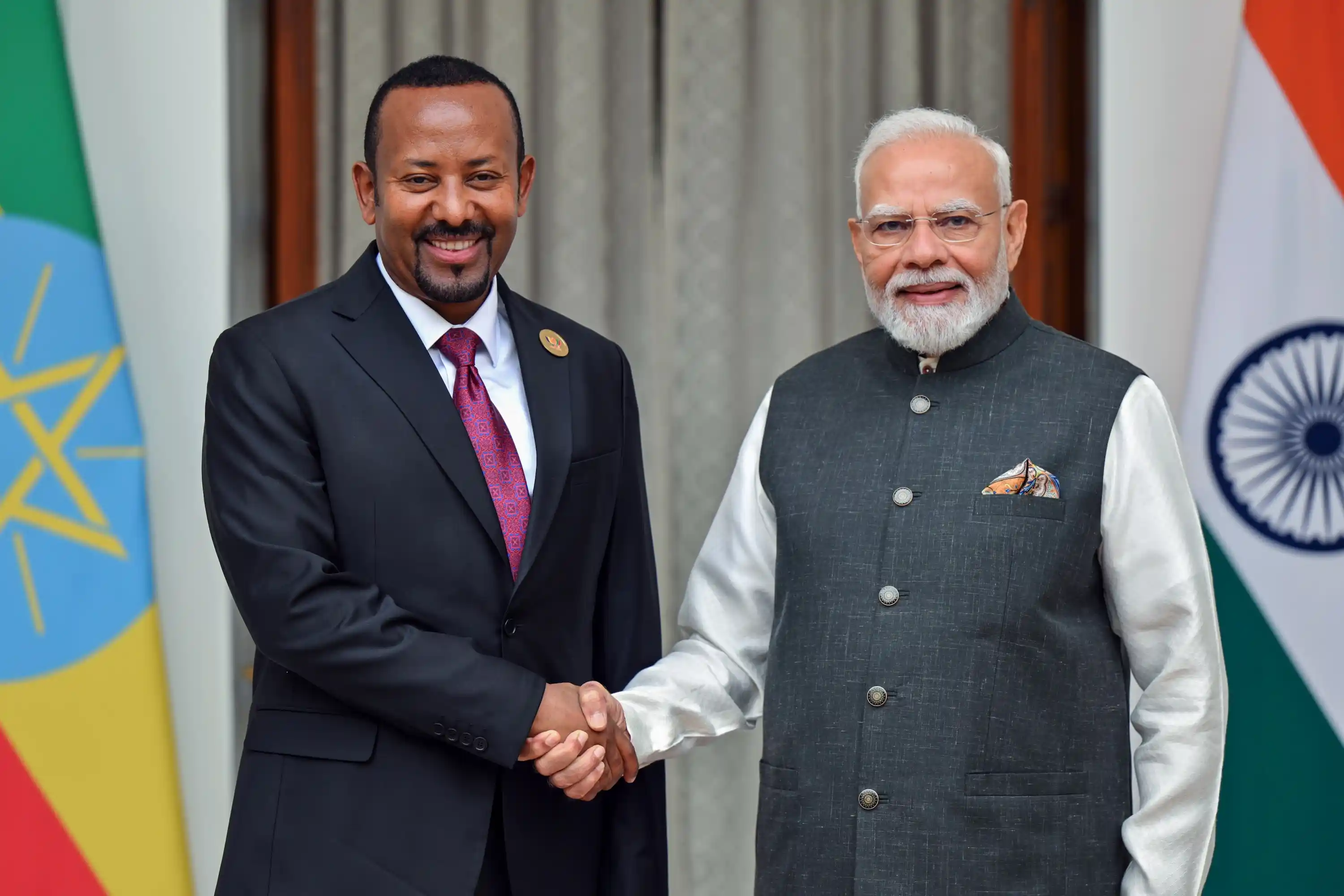
While the plenary produced a consensus New Delhi Declaration on resilience, innovation, UN reform, and counter-terrorism, Indian Prime Minister Narendra Modi used the gathering to lock in concrete defense, technology, and security understandings with African and Asian partners. Meetings with Ethiopia’s Abiy Ahmed Ali, South Africa’s Cyril Ramaphosa, Nigeria’s Vice President Kashim Shettima, Uganda’s Vice President Jessica Alupo, Burundi’s Évariste Ndayishimiye (as African Union chair), Malaysia’s Anwar Ibrahim, Kazakhstan’s Kassym-Jomart Tokayev, and the Philippines’ Ferdinand Marcos Jr. placed defense cooperation, technology transfer, maritime safety, and counter-terrorism at the center of India’s outreach.
This is how India practices multi-alignment in practice: keep the multilateral tent broad and non-aligned, then harvest bilateral strategic gains that actually move capability and influence.
Defense as the new connective tissue
Ethiopia and Malaysia both signaled interest in joint military training and procurement of Indian equipment. Ethiopia, already elevated to a strategic partnership during Modi’s December 2025 visit, discussed capacity-building and defense-industrial links alongside critical minerals and mining investment. Malaysia explored personnel training, possible BrahMos acquisition (including an air-launched variant for its Su-30s), and semiconductor collaboration. Nigeria’s talks covered defense and security alongside energy, agriculture, and digital technologies. The Philippines, already a BrahMos customer under a $375 million deal, agreed to deepen defense and security cooperation. Kazakhstan reviewed defense ties in the context of connectivity and critical minerals.
These are not ceremonial photo-ops. India’s defense exports hit a record ₹38,424 crore in FY 2025–26, a 63 percent surge, with the private sector now accounting for 45 percent. Firms offering drones, counter-drone systems, radars, patrol vessels, and training packages have identified Africa as a growth market. For African and Southeast Asian states seeking affordable platforms without the political strings often attached to Western or Chinese suppliers, India offers a third option: co-production, training, and technology transfer on terms closer to partnership than patronage.
Maritime safety and the MAHASAGAR frame
Maritime security is the quiet through-line. India’s Vision MAHASAGAR—Mutual and Holistic Advancement for Security and Growth Across Regions—extends the earlier SAGAR doctrine from the immediate Indian Ocean neighborhood to a broader Global South canvas. It links naval presence, information-sharing, capacity-building, and economic cooperation. The inaugural Africa-India Key Maritime Engagement (AIKEYME 2025), co-hosted with Tanzania and involving 11 African nations, practiced anti-piracy drills, visit-board-search-and-seizure, helicopter operations, and search-and-rescue. India’s Information Fusion Centre–Indian Ocean Region already maintains dozens of linkages for maritime domain awareness.
Western Indian Ocean instability—piracy, Houthi disruptions, jihadist networks, and chokepoint risks at Bab-el-Mandeb and the Mozambique Channel—is not a distant African problem. It is an Indian energy-security and trade problem. Bilateral talks on the BRICS sidelines allowed India to translate that shared vulnerability into practical offers: training, equipment, hydrography, and eventual logistics understandings. This is net-security-provider language made operational, without requiring BRICS consensus that an expanded, internally diverse grouping cannot easily deliver.
Counter-terrorism as common language
The New Delhi Declaration itself gave India a multilateral win: zero-tolerance language on terrorism in all forms, condemnation of the April 2025 Pahalgam attack, rejection of double standards, and attention to cyber-terrorism, online radicalization, and misuse of emerging technologies. Sideline meetings allowed that language to be operationalized country-by-country. Defense and security discussions with Nigeria, Ethiopia, South Africa, and others sit inside a wider pattern of intelligence-sharing, training, and capacity-building against transnational threats that do not respect the neat boundaries of “Asian” versus “African” security.
India’s pitch is consistent: terrorism and maritime disorder are shared problems of the Global South. Solutions should not wait for great-power permission or UN Security Council paralysis.
Why the bilateral-multilateral split matters
BRICS remains useful precisely because it is not an alliance. An 11-member grouping that includes China, Russia, Iran, Egypt, Ethiopia, and Indonesia cannot be a tight security bloc. India’s chairmanship kept the agenda on development, digital public infrastructure, local-currency trade, and Global South representation rather than turning the summit into an anti-West platform. That restraint is a feature, not a bug. It preserves India’s room to work with the Quad, Europe, and the United States while still claiming leadership among developing countries.
The sideline bilaterals convert that room into assets. Technology transfer and defense-industrial cooperation create long-term dependencies and goodwill that multilateral communiqués cannot. Maritime exercises and information-sharing networks create habits of cooperation that survive changes of government. Counter-terrorism coordination builds trust that later supports trade, minerals, and digital infrastructure deals. In short, India uses the BRICS stage for voice and the corridors for contracts and capability.
India is not choosing between non-alignment and alignment. It is practicing a more demanding version of both: stay uncommitted in the big-power contest while becoming indispensable to mid-sized partners who need security, technology, and markets. The BRICS sidelines showed how that works. The multilateral declaration keeps India inside the Global South tent. The bilateral defense, maritime, and counter-terrorism understandings start furnishing the tent with Indian equipment, training, and operational links. That is not contradiction. It is strategy.