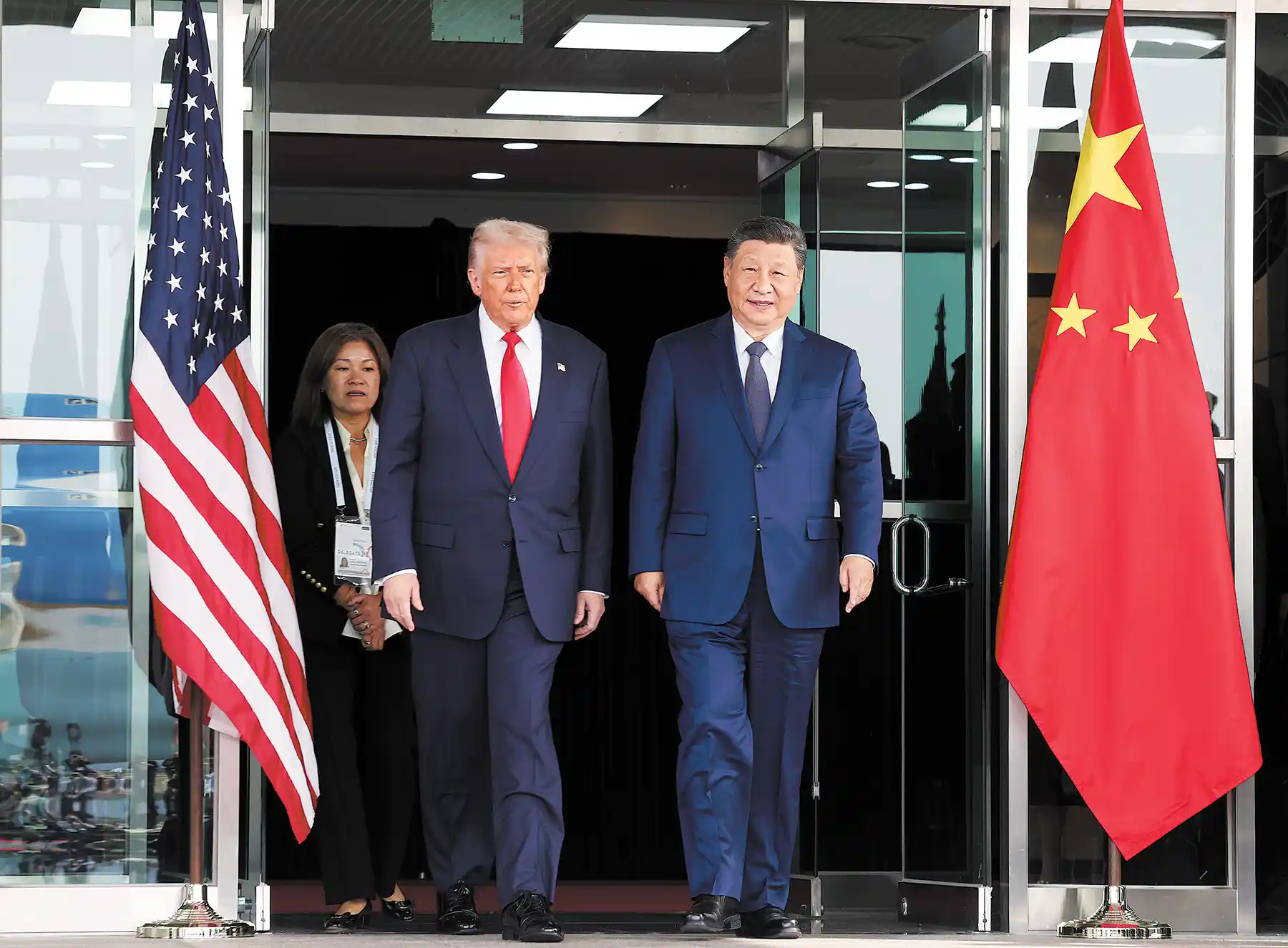
The most important message from Beijing was not delivered in a speech. It was what was silently, unmistakably signalled.
Watching the choreography, I was struck by how dramatically the language of international politics has changed in two decades. Once, an American president arrived in a foreign capital as the emissary of an order hardly anyone seriously challenged. Today, even America’s closest partners hedge their bets, diversify their ties, and quietly prepare for a world where power is spread more widely.
For roughly three decades after the Cold War, the world ran on an assumption rarely questioned: the United States sat at the heart of the international order. Its military power was unrivalled. Its financial system underpinned global commerce. Its alliances stretched across continents. Its political values wielded enormous influence.
Even critics of American foreign policy mostly accepted this. The debate was never about whether the United States led. It was about how it exercised that leadership.
What has changed over the past decade is not that America has suddenly become weak. It hasn’t.
Other powers have become stronger, more confident, and far less willing to accept a world where major decisions are made primarily in Washington, Brussels, or a handful of Western capitals.
China is the clearest example.
For years, policymakers in Washington believed economic pressure could alter Beijing’s strategic calculations. The logic seemed sound: China depended heavily on Western markets; its growth model looked vulnerable; tariffs, sanctions, and technology restrictions would force adjustments.
But events unfolded differently.
China absorbed economic pain. The property sector remains troubled, local government debt is serious, demographics are unfavourable, and youth unemployment remains a political challenge. These vulnerabilities are real.
What many Western observers underestimated was China’s capacity to adapt while bearing that pain.
Instead of retreating, Beijing doubled down on long-term strategic priorities. It expanded trade with the Global South, accelerated advanced manufacturing, strengthened domestic supply chains, and pushed harder for technological self-sufficiency under its “dual circulation” strategy.
The confidence visible in Beijing today is rooted in more than GDP figures. It reflects a belief within the Chinese leadership that the country has weathered intense external pressure and emerged stronger than many expected. That belief shapes China’s behaviour.
Technology is now reinforcing that confidence.
For much of the early 2000s, critics argued that China could manufacture but not innovate. That argument is becoming harder to sustain.
In electric vehicles, batteries, renewables, drones, and AI, China is no longer just following global trends. In several sectors, it is helping set them. BYD now rivals Tesla in EV sales; Chinese firms dominate solar panel production; and Huawei, despite sanctions, remains central to 5G and beyond.
If twentieth-century geopolitics revolved around oil, the twenty-first revolves around materials powering advanced technologies. Lithium, rare earths, graphite, gallium—these strategic minerals are now as important to economic security as hydrocarbons once were. China recognised this early, investing heavily in critical minerals, refining, and downstream technologies to enhance its material security.
While many Western countries focused on innovation at the top of the value chain, Beijing quietly built dominance across large parts of the processing and refining ecosystem. It now controls a decisive share of rare earth processing and battery supply chains, giving it significant influence over future industrial supply chains that policymakers in Washington and Europe are only now fully appreciating.
None of this means Western power is disappearing. The dollar remains dominant, American alliances remain unparalleled, and the United States continues to lead in many frontier technologies. But influence is no longer exercised in the uncontested manner that characterised the immediate post-Cold War era.
Yet focusing solely on China risks missing the larger story.
The most significant geopolitical development of recent years is not China’s rise in isolation. It is the growing fragmentation of power across the international system.
The Ukraine conflict exposed this in ways that surprised many Western policymakers.
When Russia launched its military campaign in Ukraine in February 2022, governments across Europe and North America viewed the conflict as a defining test of the rules-based international order. They expected much of the world to rally behind that interpretation.
Instead, the response was far more complicated.
Many countries in Asia, Africa, Latin America, and the Middle East refused to align fully with either side. They did not necessarily endorse Russia’s actions, nor were they willing to subordinate their economic and strategic interests to Western priorities.
India’s approach was particularly revealing.
New Delhi maintained ties with both Moscow and Western capitals despite considerable pressure, increasing imports of discounted Russian oil while strengthening relations with the US and Europe. Many countries now possess options that did not exist in earlier eras of geopolitical competition.
Across large parts of the developing world, the debate was not only about security or regional politics. It was also about energy prices, shipping routes, inflation, and economic vulnerability. Red Sea disruptions in 2024, triggered by Houthi attacks, drove up shipping costs and reminded energy-importing nations how fragile global trade routes remain.
For countries dependent on imported energy, the US–Israel–Iran conflict carries immediate consequences. Yet many of those impacted have little influence over the decisions that generate such instability.
The cumulative effect has been profound.
Across the Global South, there is a growing sense that the institutions and assumptions that shaped the post-Cold War order no longer adequately reflect contemporary realities.
This frustration is often misunderstood as anti-Western sentiment. Many policymakers in developing countries do not object to Western leadership itself; they increasingly question the assumption that Western priorities should automatically become global priorities. This helps explain why countries that continue to value relations with the United States are simultaneously seeking greater strategic autonomy.
Perceptions matter. In geopolitics, perception often matters more than declared intent.
And the perception across much of the developing world is that the existing order remains disproportionately influenced by Western priorities.
This helps explain why both China and India have found receptive audiences across the Global South.
China’s appeal is relatively straightforward: it offers capital, infrastructure, manufacturing capacity, and a powerful example of economic transformation. It has constructed ports, railways, and power plants across Africa, Asia, and Latin America.
India’s appeal is different.
India’s most underappreciated geopolitical asset may be credibility. Much attention is devoted to its economic growth, demographic scale, and strategic importance. Yet credibility often matters as much as capability.
India speaks to many developing countries not from a position of established dominance, but from a shared developmental experience. It understands the challenges of poverty reduction, infrastructure creation, energy access, and economic modernisation because it continues to grapple with them itself.
That gives India a certain credibility that is difficult to manufacture.
Over the past several years, New Delhi has become increasingly comfortable presenting itself as a voice of the Global South. During India’s G20 presidency in 2023, this was evident not only in rhetoric but in the issues it chose to prioritise: African Union membership, climate justice, and reform of multilateral institutions. The final New Delhi Leaders’ Declaration reflected this balancing act.
There is a reason many countries are paying attention. They want room to manoeuvre.
India’s foreign policy increasingly reflects that instinct.
It works closely with the United States in the Indo-Pacific through the Quad and defence partnerships. It remains connected to Russia via defence and energy ties. It engages China where necessary, competes where required, and cooperates where possible, even as border tensions along the Line of Actual Control persist. It deepens ties with Europe while strengthening presence across Africa, the Gulf, and Southeast Asia.
This balancing act is not always easy. But it reflects the realities of a multipolar world.
Russia, too, remains part of this emerging picture.
Much has been written about Russia’s decline since the Ukraine conflict, and some of it is justified. Yet predictions of strategic irrelevance have been premature.
Russia continues to influence energy markets, security dynamics, and geopolitical calculations across large parts of Eurasia. Its partnership with China has deepened. Its relationships across Asia, Africa, and the Middle East remain consequential.
The visit offered a snapshot of a changing international order.
The United States remains indispensable, but no longer uncontested.
China is rising, but not without constraints.
Russia remains relevant, though diminished from its Soviet-era stature.
India is emerging as a balancing power whose influence increasingly extends beyond its immediate neighbourhood.
And the Global South is no longer content to be treated as an audience. It wants a seat at the table.
The images from Beijing captured more than a diplomatic visit. They captured a world in transition: an indispensable but no longer uncontested United States, a rising yet constrained China, a diminished but consequential Russia, and an India emerging as both a balancing power and a voice of the Global South.
Having watched international politics evolve over four decades, I am convinced the defining geopolitical question is not whether China will replace the United States. That debate is too narrow.
The world is not becoming post-American. It is becoming post-unipolar. That may prove to be the defining geopolitical story of the twenty-first century.