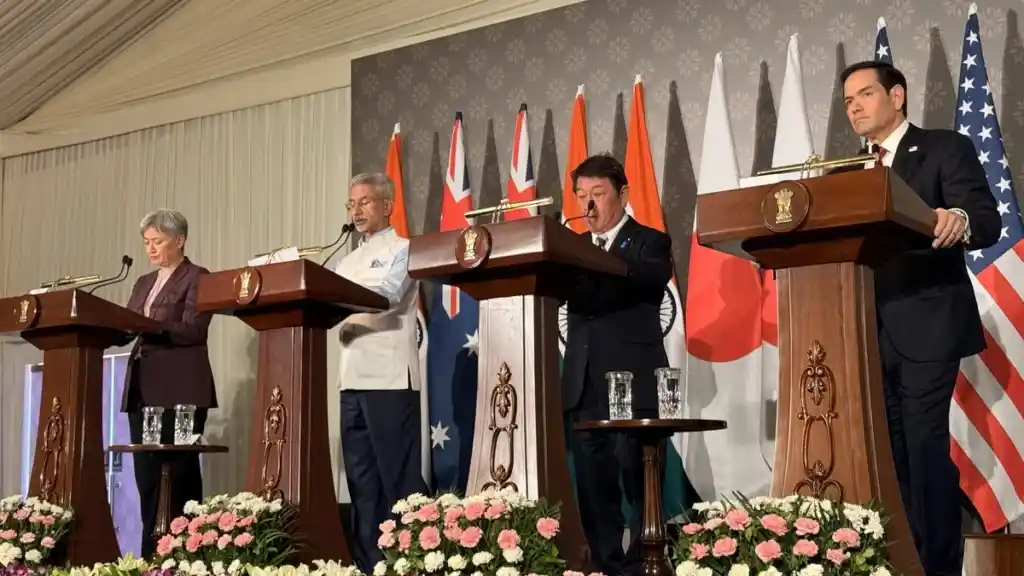
A common sentiment across media commentary surrounding Marco Rubio’s recent visit to India was whether the QUAD had lost momentum and if Washington still viewed India as central to Indo-Pacific balancing.
Amid Washington’s attempts to stabilize relations with China; trade tensions with India, its outreach to Pakistan and a broader geopolitical recalibration, the question is whether the QUAD can still function as a credible strategic platform if the US simultaneously seeks accommodation with China and sends mixed signals toward India ?
Rubio’s consistent public response throughout the visit was that India remained one of America’s most important strategic partners, QUAD stays relevant, and that “cooperation is expanding into maritime security, supply chains, AI, critical minerals, and energy”.
But the debate surrounding his visit also revealed an enduring misconception that the relevance of the QUAD depended entirely on how aggressively the United States confronts China. This interpretation is getting increasingly outdated.
The future utility of the QUAD will not be determined by whether it becomes an Asian NATO, nor by rhetorical competition with Beijing. Rather, its relevance will depend on whether it can evolve into a flexible strategic mechanism capable of stabilizing an increasingly fragmented maritime and economic order stretching from the Pacific to the Gulf. Its relevance should also instead be assessed across some strategic dimensions.
The Gulf region remains volatile. The possibility of escalation involving Iran, worsening disruptions in the Strait of Hormuz, more attacks on shipping infrastructure, or a wider energy instability – all continue to cast uncertainty over global markets. Simultaneously, the Indo-Pacific faces persistent tensions in the South China Sea, Taiwan Strait, and Indian Ocean. These are no longer disconnected issues.
The same shipping arteries that carry Gulf energy sustain Asian manufacturing, Indo-Pacific trade, and global supply chains. A disruption in Hormuz reverberates through Tokyo, Mumbai, Singapore, Sydney, and beyond. The strategic geography of this century has effectively fused the Gulf and Indo-Pacific into one interconnected maritime system. This is precisely where the QUAD’s future relevance emerges.
The grouping’s greatest strength lies not in collective defense commitments, but in coordinated strategic capacity. The United States provides unmatched naval reach and intelligence capabilities. India contributes geographic centrality across the Indian Ocean and growing maritime operational depth. Japan brings advanced technological and industrial capabilities. Australia contributes surveillance, interoperability, and regional connectivity across the Indo-Pacific sea lanes. Together, these capacities create a distributed stabilizing framework rather than a formal alliance structure.
If the QUAD can preserve freedom of navigation, coordinate naval presence, deter coercion, secure choke-points, and maintain Indo-Pacific stability, without becoming a formal alliance, then it remains strategically successful.
The recent joint statement emphasized maritime domain awareness, undersea cable security, coast guard cooperation, logistics interoperability, cyber resilience, and critical sea lanes. That indicates the QUAD is evolving into a “security network” rather than a treaty bloc.
The question whether QUAD can expand into economic and technology architecture is increasingly important. The current geopolitical climate also makes this transition unavoidable. China’s rise is not just naval, but also industrial and technological. So the relevance of the QUAD also depends on whether it can build alternative ecosystems and supply chains.
The significance of Rubio’s visit and the subsequent QUAD messaging lies in the gradual recognition of this broader role. The emphasis on maritime domain awareness, critical technologies, supply-chain resilience, secure infrastructure, and sea-lane stability indicates a deliberate widening of QUAD’s mandate beyond traditional deterrence narratives. This is a structural long-term competition framework.
This evolution is strategically prudent. The contemporary geopolitical environment is increasingly characterized not by conventional wars alone, but by grey-zone coercion, drone warfare, cyber disruptions, economic weaponization, choke-point vulnerabilities, and supply-chain insecurity. The QUAD’s flexible structure allows it to adapt more effectively to these hybrid threats compared to traditional alliance models.
Importantly, the grouping’s utility does not require permanent confrontation with China. In fact, even Washington’s attempts to stabilize relations with Beijing do not negate the need for strategic balancing mechanisms. The objective is not necessarily containment, but the preservation of maritime equilibrium and systemic resilience.
This distinction is particularly important for India. New Delhi has consistently resisted formal alliance structures while simultaneously expanding operational coordination with the United States, Japan, and Australia. In that sense, India’s strategic autonomy does not weaken the QUAD, instead, it shapes the grouping into a more flexible and sustainable platform capable of accommodating multiple national priorities without forcing bloc politics.
The Gulf dimension further reinforces this trajectory. Frameworks such as I2U2 already indicate the emergence of overlapping strategic coalitions connecting the Gulf, the Indian Ocean, and the Indo-Pacific. If these architectures deepen over time, potentially through greater engagement with countries like the United Arab Emirates, the QUAD could gradually evolve into the nucleus of a broader maritime-security and connectivity framework linking energy corridors, logistics hubs, technology ecosystems, and critical trade routes.
Such a structure would surely not resemble NATO. It would instead reflect the geopolitical realities of an interdependent multi polar world: flexible, issue-based, economically integrated, and strategically coordinated.
The long-term credibility of the QUAD depends a lot on India. The US, Japan, and Australia are already treaty-aligned in various ways. India is a strategic swing state.
If India continues naval interoperability, expands defense logistics cooperation, participates in Malabar exercises, and deepens technology/supply-chain integration,
then QUAD remains highly consequential. If India disengages or reverts toward strict nonalignment, the QUAD could weaken.
Ultimately, the true test of the QUAD will depend on whether the grouping can demonstrate practical problem-solving capacity during crises such as protecting sea lanes, stabilizing energy flows, coordinating humanitarian responses, securing infrastructure, and preserving the operational integrity of the maritime commons. In an era defined by interconnected instability, that may prove far more consequential than any formal military alliance.
What the ongoing Gulf war has demonstrated is that countries want balancing mechanisms but not bloc confrontation. This is especially true for India. The QUAD fits that model perfectly as it can not only be flexible enough, credible enough for deterrence and broad based enough to include trade, technology and maritime security.