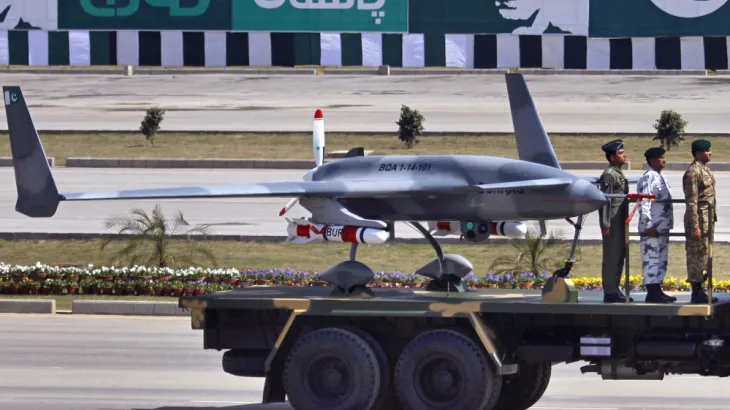
Pakistan has significantly developed its drone capabilities by cooperating with Ukraine. The recent development has raised concerns in India, signaling a dangerous shift in the subcontinent’s security architecture.
The issue came to public attention after a video of Pakistani military personnel being trained by Ukrainian drone specialists went viral on social media earlier this month. Although some details in the video are unclear, it signals a dangerous development. Deadly battlefield experience could be transferred to Kashmir and the Indian border by the Pakistani military or insurgents, who have long used asymmetric warfare tactics against India. Transferring such operational know-how, especially regarding long-range strikes, first-person-view (FPV) drones, and coordinated swarm tactics, to Pakistan’s military or proxy actors operating in Kashmir could significantly alter the tactical balance along India’s borders.
Pakistan Pushes Public-Private Drone Cooperation
The Ukrainian connection extends beyond mere training. The Alsons Group, a Karachi-based industrial conglomerate, recently unveiled a new line of locally developed drone engines and unmanned aerial vehicle (UAV) platforms. The firm introduced compact piston engines optimized for loitering munitions and one-way attack drones. They emphasized the engines’ modular design, simplified electronic architecture, and cost-effective manufacturing processes.
The presentation took place only one month after Pakistan’s Ministry of Defense Production held a session on drone technology with several private-sector developers. The session, which took place in Rawalpindi and was chaired by Secretary of Defense Production Lt. Gen. (Ret.) Muhammad Chiragh Haider, aimed to strengthen the coordination between the public and private sectors regarding drone warfare and surveillance.
It is clear that Pakistan is adopting Ukraine’s system of drone production. Ukrainian drones, often assembled by decentralized private workshops supported by state contracts, have demonstrated that low-cost systems can inflict disproportionate battlefield damage. Pakistan appears to be adopting elements of this startup war model.
War Expertise Worth to Export
Pakistan’s previous drone operations against India were notably unsuccessful, prompting Islamabad to seek expertise from countries with proven combat experience. Ukraine’s battlefield experience, honed during more than five years of intense warfare against Russia, is among the most advanced and lethal in the world.
Ukrainian officials have clearly recognized their dominance in drone technology and skills, and they are actively seeking to export expertise. High-ranking officials and private industry representatives have traveled to Asian countries to discuss drone cooperation. They view this expertise as a potential source of revenue and a means of building strategic partnerships.
The geopolitical context of Pakistan’s decision is equally significant. Earlier this year, Russia and the Afghan Taliban signed a defense cooperation agreement, which deepened Moscow’s outreach to Kabul. This shift have complicated Islamabad’s strategic calculations, opening a window for Ukrainian engagement.
India Watching Closely
India is closely monitoring Pakistan’s drone force development. Army Chief General Upendra Dwivedi says, “It is evident that they have been investing significantly in drones and unmanned systems and continue to draw upon multiple sources for such capabilities. We continuously monitor these developments and assess both capabilities and intentions”.
For New Delhi, a key concern is the potential use of tactics derived from Ukraine in Kashmir. It seems that Pakistan’s evolving drone architecture, which combines foreign training by Ukraine, localized engine production, and an innovation model inspired by startups, could potentially lead to a significant enhancement in the capabilities of the Pakistani Drone Force. However, there is a possibility that this development could also result in the dissemination of this advanced technology to non-state actors, which could present a challenge for India’s defense posture.
Ultimately, drone warfare is reshaping interstate and internal conflicts at an unprecedented rate. In South Asia, this transformation is unfolding across borders and within them, raising the stakes for all parties involved. India cannot afford to be passive. Although it has made progress in developing its own drones and air defence systems, the pace of change demands faster adaptation. Counter-drone technologies, electronic warfare capabilities and operational preparedness must evolve in parallel with emerging threats.