Finnish President Alexander Stubb recently argued that the “Global West” — comprising Western democracies and their allies — and the “Global East” — largely China-led, anti-West, and allegedly “illiberal” states — are competing to win the confidence of the Global South. Developing and middle-income countries across Asia, Africa, and Latin America are increasingly viewed as pivotal to shaping the emerging global order.
In an era marked by escalating geopolitical conflicts and fears of a breakdown in the current international system, the importance of the Global South has become more pronounced. BRICS, now expanded to 11 member states representing nearly half the world’s population and around 40% of the global economy, offers formerly “Third World” nations an opportunity to evolve from passive decision-makers into active shapers of global affairs.
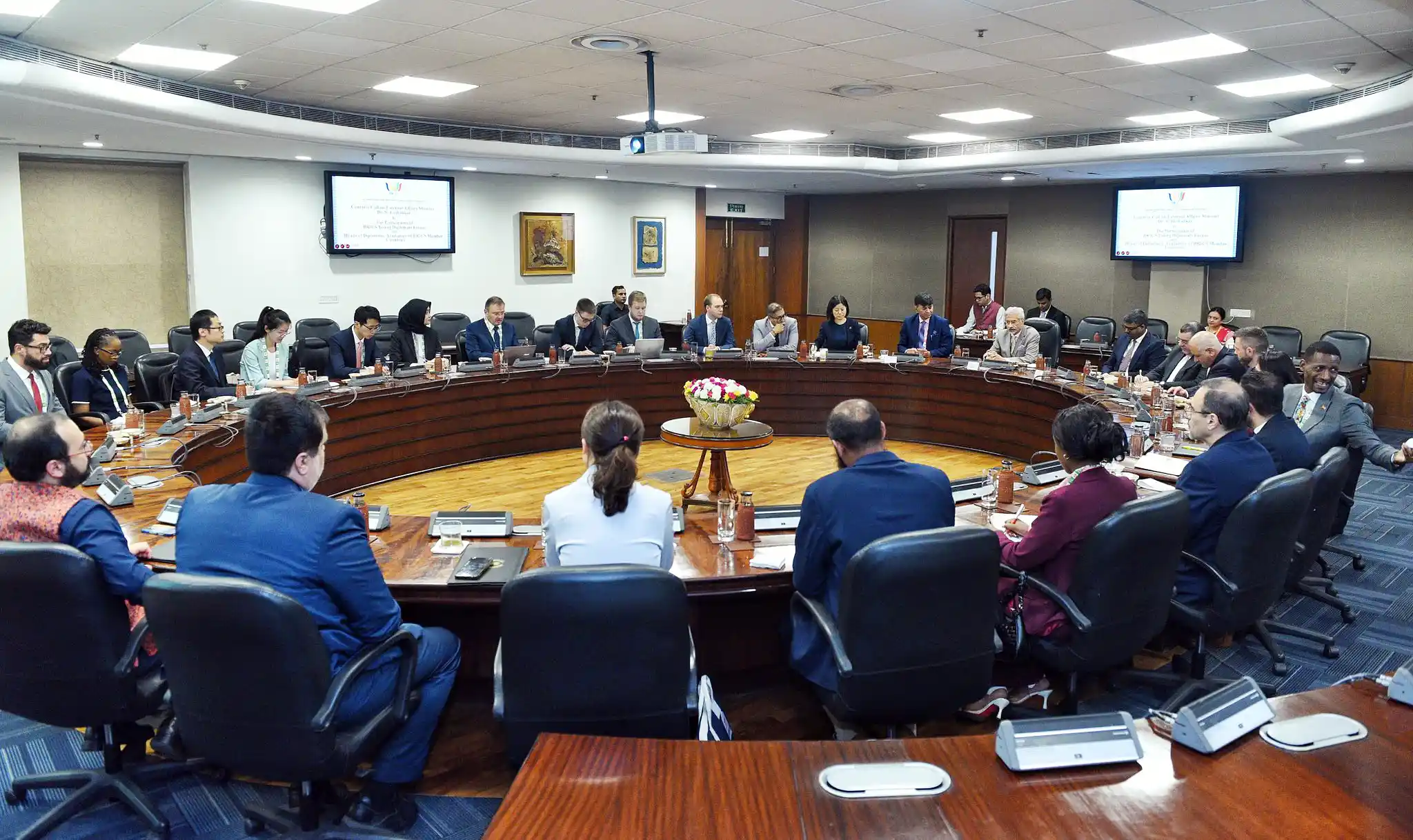
However, divisions within the bloc surfaced during the recent BRICS Foreign Ministers’ Meeting in New Delhi, reinforcing skepticism in sections of the Western media — often distrustful of non-Western initiatives — about the unity and effectiveness of the organisation. The Iran-UAE disagreement over the UAE’s stance during the US-Israel-Iran conflict highlighted the serious internal challenges confronting BRICS. It also placed India’s leadership role under scrutiny ahead of the BRICS Summit scheduled for September.
The ongoing West Asia conflict cast a long shadow over the New Delhi meeting held in May. Iranian Foreign Minister Abbas Araqchi reportedly accused a fellow BRICS member — widely understood to be the UAE — of indirectly aiding the US-Israel campaign against Iran. The tensions exposed fractures within the grouping, which failed to issue a joint statement at the conclusion of the meeting. Strategic affairs analyst C. Raja Mohan observed that this failure underscored the widening gap between BRICS’ growing ambitions and its limited political cohesion. Unsurprisingly, the episode embarrassed India in its dual role as chair and host. Yet, India also has the opportunity to emerge as the bloc’s stabilising force.
At the heart of India’s foreign policy lies the principle of balancing multiple partnerships without aligning completely with any single bloc. Since the Cold War era, this strategy of strategic autonomy has enabled India to maintain credibility among nations weary of geopolitical rivalry and its destabilising effects. This reputation encouraged many countries to rally behind India-led initiatives such as the Bandung Conference and the Non-Aligned Movement (NAM).
India’s foreign policy has never been driven by rigid ideological commitments. Rather, it has consistently prioritised national interest. Even within historical groupings such as the Bandung Conference, India faced disagreements. At the 1955 conference, Indonesia advocated a more militant anti-colonial posture, which India opposed. The Philippines, supported by Pakistan and Turkey, also challenged India’s opposition to military blocs. Nevertheless, India remained a leading voice of the Afro-Asian and non-Western world because of its consistent commitment to anti-colonialism and the concerns of developing nations.
Today, BRICS faces similar internal tensions. As disagreements intensify among member states, India continues to advocate a cooperative and inclusive vision for the bloc. Although the New Delhi meeting failed to produce a joint communiqué, India issued a Chair’s Statement emphasising the importance of collective action to strengthen international peace and security in a deeply polarised global environment.
This non-confrontational diplomatic approach has strengthened India’s standing among war-weary countries of the Global South seeking peaceful solutions to international crises. Iran, for instance, has shown openness to Indian diplomatic engagement in the West Asia conflict after Pakistan’s widely publicised mediation efforts failed to gain traction. Tehran appears reluctant to place full trust in Islamabad, given Pakistan’s longstanding strategic relationship with the United States. India, by contrast, benefits from its image as a non-aligned and balanced power capable of engaging all sides.
Any meaningful Indian diplomatic initiative — even through quiet back-channel engagement — could reinforce India’s enduring reputation as a credible and trustworthy voice of the Global South. India’s emphasis on dialogue, consultation, equitable global governance, and mutually beneficial international relations remains highly relevant in today’s multipolar world.
The broader BRICS agenda of resisting a US-dominated unipolar order is increasingly challenged by the divergent interests of its member states. Iran’s confrontational posture towards the US and Israel has generated unease among several BRICS members in West Asia. Tehran’s demand for an outright BRICS condemnation of the US-Israel alliance risks deepening divisions within the grouping.
India, despite pursuing diversified global partnerships, has consistently resisted attempts to transform BRICS into an anti-Western alliance. New Delhi rejects the framing of international politics in rigid binaries. Instead, it advocates a pragmatic and non-aggressive approach to reducing Western dominance while avoiding unnecessary confrontation. India recognises that the Global South cannot afford a militant anti-Western posture, particularly when development and economic stability remain urgent priorities. Just as India once resisted efforts to turn NAM into an anti-West bloc, it is now pursuing a similar strategy within BRICS.
India’s policy of balancing relations across competing global powers offers an important model for countries seeking to avoid prolonged geopolitical confrontation. Increasingly, many nations of the Global South appear to be embracing this approach, especially amid perceptions of growing unpredictability in US foreign policy under Donald Trump.
Despite current tensions, BRICS is likely to endure because its members understand the dangers of a binary global order. Unlike organisations such as European Union or NATO, BRICS is neither a geopolitical nor a military bloc requiring complete policy alignment. Rather, it is a platform that recognises diversity in history, culture, geography, economic development, and foreign policy orientation.
Ultimately, BRICS aspires to promote a more balanced international order rooted in the principle of unity in diversity. With its non-aggressive and accommodative diplomatic tradition, India is uniquely positioned to guide the grouping towards a more equitable global framework — one that fosters constructive engagement among the Global East, West, and South, as envisaged by President Stubb.