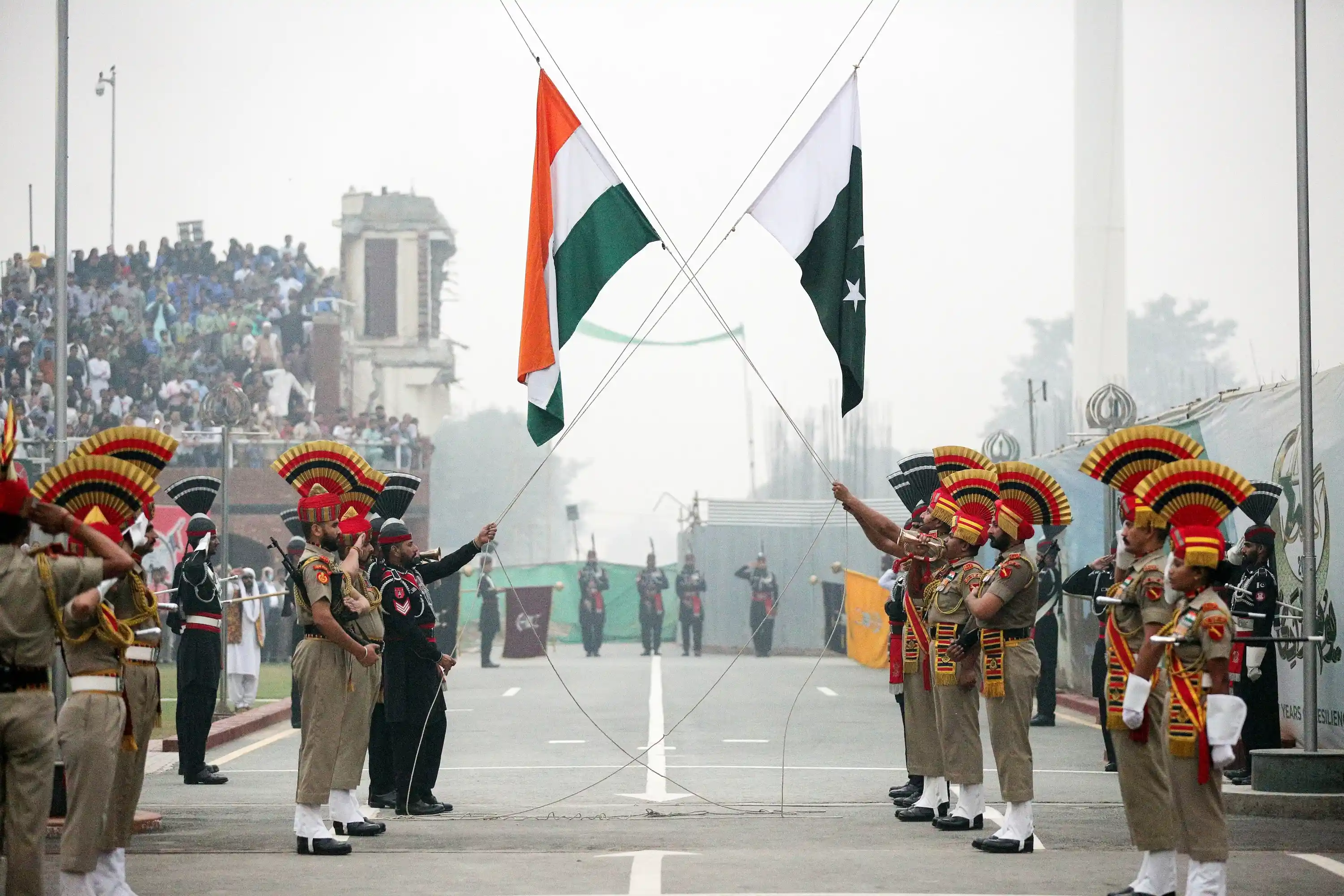
India and Pakistan share a border, a history and almost the same birthday. What they have never really managed to share is a neighbourhood.
As India marks its 80th Independence Day, there is value in looking beyond the familiar vocabulary of wars, terrorism and diplomatic crises to ask a simpler question: how did two countries that inherited so much together end up with so little between them?
Partition divided territory. The decades that followed divided the neighbourhood.
A neighbourhood is more than geography. It is built on movement, commerce, communication, familiarity and trust. Neighbours may disagree, even profoundly, but they continue to interact because geography leaves them little choice. The failure to build such a neighbourhood has come at a heavy cost. Increasingly, however, the costs are no longer equal.
The history behind this estrangement is well known. Partition left deep political and emotional scars. India and Pakistan fought wars in 1947–48, 1965 and 1971, followed by the Kargil conflict in 1999. But over time, the character of the conflict changed. Unable to alter the conventional military balance, Pakistan increasingly relied on asymmetric means, including support for terrorist organisations operating against India.
For decades, organisations such as Lashkar-e-Taiba and Jaish-e-Mohammed found space to recruit, train and organise from Pakistani territory. The United Nations Security Council identifies Lashkar-e-Taiba as a Pakistan-based terrorist organisation, while the United States has repeatedly noted that Pakistan remained a safe haven for regionally focused terrorist groups, including those targeting India.
Whether every action of these organisations reflected official policy or the preferences of elements within Pakistan’s security establishment has long been debated. What is far less contentious is that terrorism became an enduring instrument of pressure against India.
The attacks on Parliament in 2001, Mumbai in 2008, Pathankot, Uri, Pulwama and countless other incidents were not isolated acts of violence. They were attempts to shape India’s strategic choices through fear and coercion.
Yet perhaps the most remarkable aspect of this long and troubled history is not the persistence of provocation. It is India’s response to it.
India has fought when it had to. It has defended its sovereignty whenever required. It has increasingly demonstrated that terrorism carries consequences. But it has also shown something that is often overlooked: a consistent effort to calibrate its response so that even grave provocations do not automatically become an uncontrolled conflict between two nuclear-armed neighbours.
That restraint deserves to be understood correctly.
It was never the restraint of incapacity.
It was the restraint of a country that recognised that military success and strategic success are not always the same thing.
Strong nations are not defined only by the force they can employ. They are equally defined by the judgement with which they decide when—and how much—to employ it.
Seen from that perspective, India’s approach to Pakistan reflects something deeper than tactical calculation. It reflects a strategic culture that has generally preferred stability to permanent confrontation.
This becomes clearer when one steps back from the India–Pakistan relationship itself.
India has spent the past three decades managing simultaneously some of the world’s most complicated bilateral relationships. It has maintained engagement with China despite an unresolved boundary dispute. It has preserved long-standing ties with Russia while steadily expanding strategic cooperation with the United States. It has built close partnerships with Israel without weakening its relations with the Arab world. It has strengthened ties across Southeast Asia, Africa, Europe and the Gulf while retaining its strategic autonomy.
The underlying principle has remained remarkably consistent.
India has never expected a world without disagreements. Instead, it has sought to ensure that disagreements do not prevent the pursuit of larger national interests.
That is precisely why Pakistan should not occupy a disproportionate place in India’s strategic imagination.
Pakistan matters to India.
But Pakistan should not define India.
This distinction has acquired new significance because India itself has changed beyond recognition.
The India that emerged from Partition in 1947 was a poor, deeply divided and institutionally fragile country. The India celebrating its 80th Independence Day is among the world’s largest economies, a leading technological power, an indispensable player in the Indo-Pacific and an increasingly influential voice in global affairs.
That transformation changes the context in which India should think about Pakistan.
It also invites reflection on what the two countries failed to build together.
Imagine, for a moment, a different trajectory.
Two neighbouring countries with shared languages, overlapping cultures and complementary markets could have created one of the world’s most dynamic regional economic spaces. Trade across Punjab could have rivalled some of Asia’s busiest commercial corridors. Energy grids might have linked the region. Transport routes through Pakistan could have connected India more directly with Afghanistan and Central Asia. Tourism, education, healthcare, sports and the creative industries could have flourished across borders. Families divided by Partition would not have required extraordinary determination merely to visit one another.
This is not nostalgia.
It is an acknowledgement that geography had already provided many of the ingredients of cooperation. Political choices and strategic miscalculations prevented them from being realised.
The opportunity cost of that choice has grown steadily over time.
For India, the absence of normal economic relations with Pakistan is no longer strategically consequential. It has progressively built alternative partnerships across the world. Today it trades extensively with North America, Europe, the Gulf, Southeast Asia, East Asia and Africa. Its economic future no longer depends on the quality of its relationship with Pakistan.
Pakistan’s position is rather different.
A strategy intended to constrain India has, over time, constrained Pakistan even more.
Recognising this asymmetry is not an argument for triumphalism. India has nothing to gain from instability in Pakistan. A peaceful, economically secure and outward-looking Pakistan would almost certainly serve India’s long-term interests better than one trapped in recurring cycles of political and economic uncertainty.
Equally, however, India cannot make Pakistan’s choices for it.
Nor should India’s own ambitions remain tied to Pakistan’s trajectory.
That is an important distinction as India’s wider neighbourhood evolves.
The lesson from the past is not that India should become suspicious of every change in its neighbourhood.
It is that India should combine vigilance with confidence. Confidence is the product of capability. Capability creates options. And countries with options are able to act with patience.
That, perhaps, is where India’s Pakistan policy should now begin. Not with expectations. Not with grievances. But with confidence. But for all these steps to begin, cross border terrorism from Pakistan will need to stop.
India has every reason to remain uncompromising on terrorism. Violence cannot become a legitimate instrument of statecraft. There can be no durable improvement in relations so long as terrorism remains available as an instrument of policy or organisations committed to violence continue to find protection or operating space.
The prime objective should be predicability.
Predictability reduces risk. Stability encourages contact. Contact can gradually create habits of cooperation. Only then can broader normalisation become conceivable.
History offers very few examples of countries moving directly from hostility to friendship.
Most travel through a long period of cautious coexistence.
India should be prepared for precisely such a journey if circumstances permit.
If they do not, India is no longer without alternatives.
That may be the single greatest strategic change since Independence.
For much of the twentieth century, Pakistan occupied an outsized place in India’s foreign-policy discourse. Today, India’s strategic horizon stretches from the Indo-Pacific to Europe, from the Gulf to Africa, from emerging technologies to global supply chains. Pakistan remains an important neighbour, but it is not the principal reference point for India’s place in the world.
That is not indifference.
It is perspective.
History cannot be rewritten. Geography cannot be altered. India and Pakistan will remain neighbours.
The real question is whether they will continue to share only a border, or whether they might one day begin to share something more meaningful.
India’s rise has given it something that was in short supply in the early decades after Independence: strategic confidence.
Confidence to respond firmly when necessary.
Confidence to exercise restraint when restraint serves the national interest.
And confidence to look beyond Pakistan without forgetting it.
Perhaps that is the most significant freedom India has earned in eighty years of Independence.
The real measure of India’s rise is not that it has outgrown Pakistan.
It is that Pakistan no longer defines the limits of India’s ambition.
If there is a lesson to draw on this Independence Day, it is this: nations cannot choose their neighbours, but they can choose how much those neighbours shape their future.
For India, that choice has become clearer than ever before.