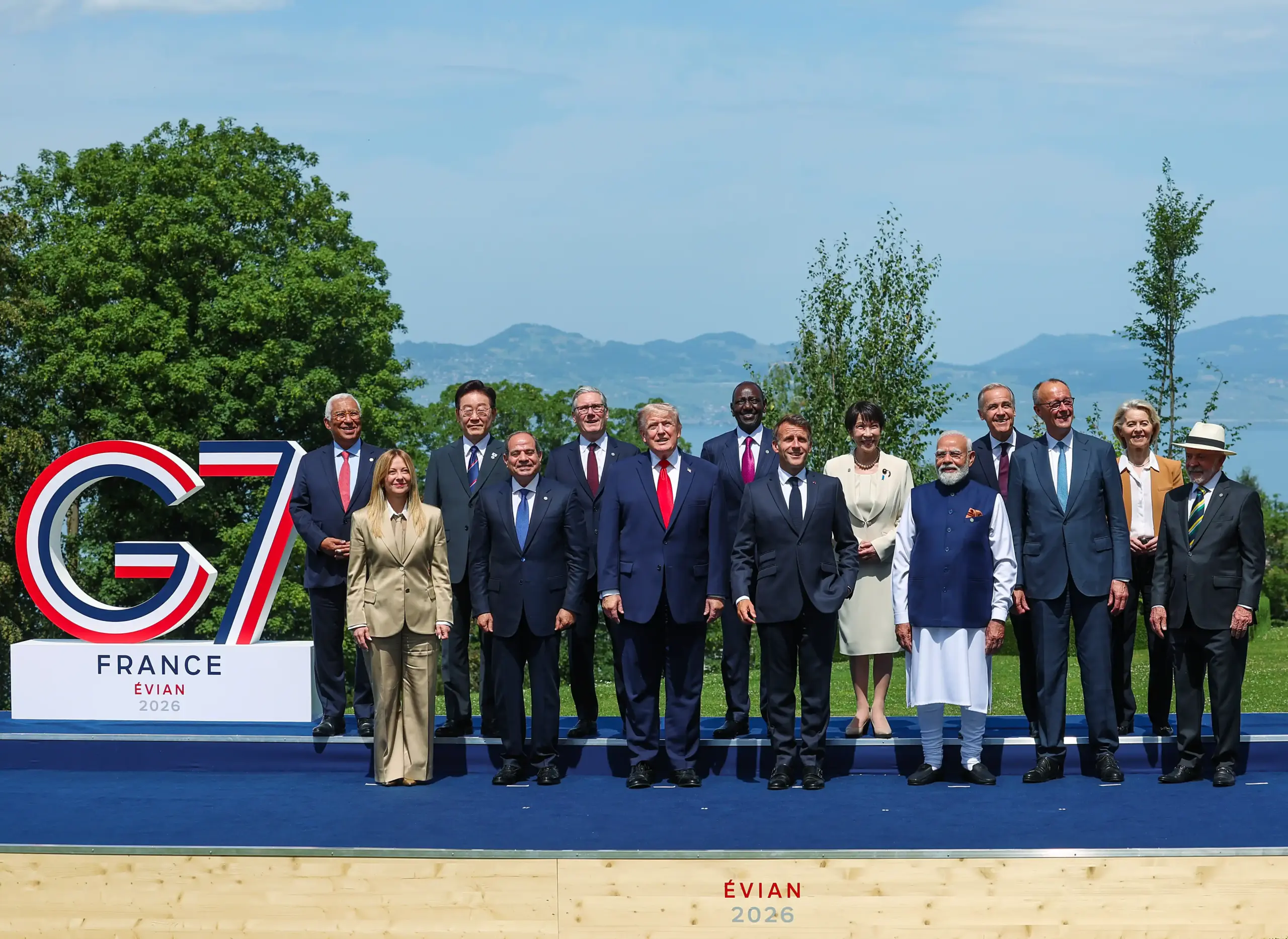
Prime Minister Narendra Modi’s participation in the 2026 G7 Summit in Evian, France, confirms a reality that has been building for years: India is no longer an occasional guest in major Western forums, but an indispensable actor in any serious discussion on the future of global order. The invitation itself is significant, yet its deeper meaning lies in what it reveals about the changing balance of power. The G7 still represents some of the world’s richest democracies, but its ability to shape outcomes on trade, technology, climate, and security increasingly depends on engagement with powers outside its formal membership. India, by virtue of its economic weight, demographic scale, strategic geography, and political legitimacy in the Global South, has become central to that effort.
The importance of India’s presence at the summit is therefore twofold. For New Delhi, the G7 platform offers influence without formal alliance obligations, allowing India to shape global debates while preserving the strategic autonomy that has long defined its foreign policy. For the G7 countries, India’s attendance lends both practical relevance and political credibility to discussions that would otherwise risk appearing detached from the concerns of the wider developing world. In that sense, India’s invitation is not merely symbolic. It reflects the emergence of a new grammar of global governance in which old clubs must adapt to new centres of power.
Why the G7 Needs India
The G7 was created in an era when Western economies overwhelmingly dominated global production, finance, and diplomacy. That world has changed. Today, economic growth, energy demand, digital transformation, and supply-chain restructuring are increasingly concentrated in large emerging economies, and among them India stands out. As the world’s fifth-largest economy and a state with growing manufacturing, technology, and strategic capabilities, India has become too consequential to exclude from discussions on the international system’s future direction.
India matters to the G7 not only because of size, but because of function. It serves as a bridge between advanced industrial economies and the developing world, especially on contentious issues such as climate finance, energy transition, debt vulnerability, and technological governance. This role became especially visible after India’s G20 presidency, which enhanced its profile as a state capable of translating the language of the Global South into institutional diplomacy. For G7 members seeking broader legitimacy, India offers something no communique alone can supply: connection to the political concerns of countries that lie outside the Western alliance system.
India is also increasingly relevant to the G7’s economic-security agenda. Critical minerals, resilient manufacturing, semiconductor ecosystems, and trusted technology networks now occupy the centre of strategic planning in the West. Efforts to diversify away from overdependence on China have elevated India’s importance in exactly these areas. Whether the issue is clean-energy supply chains or the governance of artificial intelligence, India is no longer peripheral. It is now part of the architecture through which the G7 hopes to reduce strategic vulnerability.
Why India Needs the G7
For India, the value of the G7 lies in access, influence, and visibility. It is one of the few forums where India can engage, almost in a single diplomatic frame, with the United States, major European powers, Japan, and Canada on urgent strategic questions. Even without formal membership, the summit provides India a high-level arena to shape narratives on growth, technology, energy security, and crisis management. This matters because global rules are often informally framed in elite settings before being codified in broader institutions. Presence at the table helps India avoid being merely a rule-taker.
The summit also offers India an opportunity to convert its foreign-policy doctrine of multi-alignment into practical diplomacy. India’s strategy has been to deepen ties with the West without surrendering freedom of manoeuvre on Russia, West Asia, or trade. The G7 invitation fits neatly into that model. It allows New Delhi to engage advanced democracies on its own terms, cooperating where interests align while signalling that partnership does not imply subordination.
Equally important, the G7 enables India to project itself as a responsible power rather than simply a rising one. Participation in discussions on artificial intelligence, international solidarity, debt stress, climate, and maritime security reinforces the argument that India is not merely demanding a place in global governance but already contributing to it. For a country seeking greater voice in institutions such as the UN Security Council and other multilateral bodies, this reputational dimension should not be underestimated.
Ongoing Dialogues and Agreements at the 2026 Summit
The 2026 summit underscored that India’s role is increasingly substantive, not ceremonial. On the sidelines in Evian, Modi held a bilateral meeting with U.S. President Donald Trump, with economic growth and technology cooperation among the central themes. He also participated in a trilateral engagement with European Council President Antonio Costa and European Commission President Ursula von der Leyen, while separately interacting with other leaders including Italy’s Giorgia Meloni. According to summit reporting, Modi additionally met leaders from the UAE, Kenya, Egypt, South Korea, and Japan, with the conversations focused on trade, investment, strategic coordination, and people-to-people ties.
These conversations matter because they show how the G7 summit now functions for India as more than a single multilateral event. It has become a dense diplomatic marketplace in which bilateral ties can be accelerated through concentrated summitry. This is especially important at a time when India is trying to widen its partnerships across Europe, the Indo-Pacific, West Asia, and Africa without being locked into one geopolitical bloc.
The summit’s broader outcomes were also relevant to Indian interests. G7 leaders pledged to intensify action against organised crime through stronger financial investigations targeting illicit assets, including cryptocurrencies. They reaffirmed support for Ukraine’s sovereignty and promised additional pressure on Russia’s war economy through sanctions, while also committing to bolster energy security by diversifying supply routes and reducing dependence on the Strait of Hormuz. Reporting from the summit further indicated stronger attention to development finance and debt vulnerabilities, with leaders calling for more support to countries facing constrained fiscal space. In strategic terms, the G7’s push on critical mineral supply chains is especially consequential for India, which is positioning itself as a trusted partner in the effort to build alternatives to China-centric processing systems.
Limits and the Larger Meaning
Yet the significance of India’s invitation should not be romanticised. India remains an outreach partner, not a formal member, and therefore lacks full control over agenda-setting or final declarations. Differences with G7 states on trade rules, carbon border measures, Russia, and development priorities will continue to surface. New Delhi’s challenge is to use the forum for influence without allowing participation to blur its independent strategic profile.
Even so, the larger direction is clear. The G7 increasingly needs India to remain geopolitically relevant, while India can use the G7 to translate its material rise into institutional voice. The relationship is therefore neither one of accession nor simple partnership; it is a mutual adjustment to a world in which power is more dispersed and legitimacy more contested.