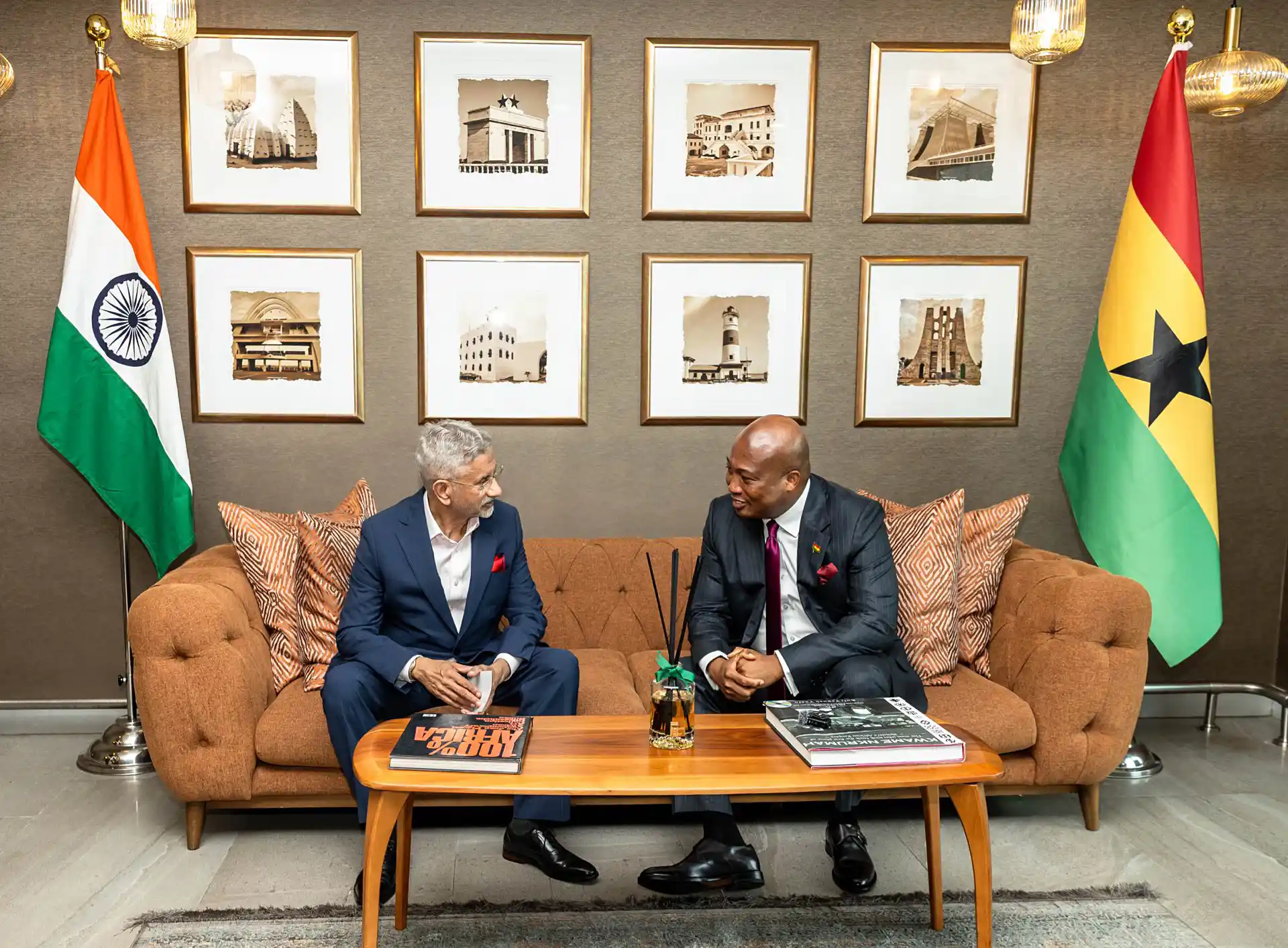
When India’s external affairs minister, S. Jaishankar, sat down in Accra this week with President John Dramani Mahama and Foreign Minister Samuel Okudzeto Ablakwa, the meetings were easy to file as routine diplomacy. They were not. Ghana is the first stop of a five-day tour that also takes him to Côte d’Ivoire and Ethiopia, and the agenda — trade, pharmaceuticals, railways, mining, defence, digital cooperation, and Ghana’s formal bid to join BRICS — is the practical sequel to a larger argument India has been making about Africa’s place in the world.
That argument has two recent markers that Africans should not treat as symbolism. In 2023, during its G20 presidency, India pushed through permanent membership for the African Union, ending a long absurdity in which a continent of 1.4 billion people was represented at the world’s principal economic table by a single invited guest. Last month, New Delhi voted with 163 other countries for the General Assembly resolution “Correct the Map,” an African Union-backed text, sponsored by Togo, calling for equal-area projections so that Africa is no longer drawn as a shrunken appendage of a Mercator world. The United States cast the only vote against. Maps are not policy. But a power that will defend Africa’s actual size in a cartographic fight, and Africa’s actual seat in a club fight, is doing something more useful than the ritual communiqué.
The Accra visit is where that posture meets a balance sheet. Ties were raised to a Comprehensive Partnership during Prime Minister Narendra Modi’s state visit in July 2025, the first by an Indian prime minister in more than three decades. Jaishankar was explicit that his job was to live up to that elevation. Two memoranda were exchanged: one between the Zoological Survey of India and the University of Ghana, on research and training; another between the Indian Council of Agricultural Research and Ghana’s CSIR-Crops Research Institute. The more interesting list is what both sides said they are now negotiating — local pharmaceutical and vaccine production, health, mining, defence, railways and digital public infrastructure.
The parallels they drew are not accidental. Ghana’s Accra Reset, aimed at health sovereignty, sits next to India’s Ayushman Bharat. Feed Ghana sits next to India’s farmer and millet programmes. Accra’s target of one million coders sits next to Digital India. President Mahama invited Indian firms to manufacture medicines locally; Atlantic Life Sciences is already working with KinaPharma on vaccines. He also noted that Ghanaian exports to India have risen from about $3 billion toward $7 billion, while Indian agricultural machinery, automobiles and buses move the other way. Indian companies have roughly $2 billion invested across some 900 projects in the country. The older landmarks — Jubilee House, the Ghana-India Kofi Annan Centre for ICT, the Tema–Mpakadan railway — are the inheritance. The new conversation is about whether the next decade produces factories, rail and code, not just contracts.
Two political facts give the stop its weight. Ghana’s cabinet has approved a formal application to join BRICS, and Jaishankar said India was “very sympathetic and supportive.” Accra was careful to say this diversifies partnerships rather than discarding old ones — language that matches Jaishankar’s own line at the Foreign Service Institute, that partnerships should expand a country’s options, not restrict them. And President Mahama is due to assume the African Union chair in 2027. A comprehensive partnership with the incoming AU chair, discussed alongside India’s engagement with the Union and with ECOWAS, is a West African bet as much as a Ghanaian one.
From Lagos, that bet is worth taking seriously, and worth watching closely. India is not a substitute for Europe, China or the United States, and it should not be sold as one. Its advantage is different. It is a large developing economy that industrialised late, built digital public rails at population scale, and has a habit of tying diplomacy to lines of credit, standards, scholarships and small-to-medium investment rather than to a single flagship port. The $100 million facility India Exim Bank has just extended to the Africa Finance Corporation is of a piece with that method: unspectacular, repeatable, aimed at infrastructure rather than headlines.
The test, for Ghana and for the rest of us, is whether the new sectors survive the communiqué. Local pharma only matters if technology and regulatory capacity stay in Accra. Rail only matters if it moves goods to ports and markets, not merely dignitaries. A BRICS application only matters if it buys financing and voice without a new set of conditions. Jaishankar told his Ghanaian audience that India carries Africa in its heart and intends a partnership for generations. Hearts are cheap. Generations are not. If the MoUs on crops and biodiversity are followed by plants that make medicines, lines that carry freight, and a digital stack Ghana actually owns, Accra this week will have been the start of something that outlasts both governments. That is the standard Africa should now apply — to India, and to everyone else at the door.