When India’s External Affairs Minister S. Jaishankar responded to a Finnish interlocutor’s criticism of Indian oil purchases from Russia — ‘I buy oil based on cost and availability’ — the remark was widely treated as a diplomatic retort. It was, more precisely, a diagnosis. In a single sentence, it identified the central contradiction of contemporary Western foreign policy: the assertion of universal normative authority by actors whose own material behaviour routinely departs from the principles they seek to enforce. The more consequential follow-up — ‘No European country has been attacked with Indian weapons. I wish I could say that for European weapons used against India’ — did not merely turn the argument around. It named the architecture of selective accountability that has sustained Western normative dominance since 1945, and implicitly announced that this architecture no longer commands uncontested acceptance.
The argument of this analysis is not that India has displaced the West, nor that the liberal international order is dissolving. It is more precise: Western normative authority was always underwritten by material preponderance. As that preponderance erodes — measurably, structurally, and irreversibly at the margins — the enforcement capacity behind Western rule-making weakens with it. What has changed is not the West’s capacity to articulate principles, but the world’s willingness to accept those principles as binding in the absence of the power asymmetry that once made non-acceptance costly.
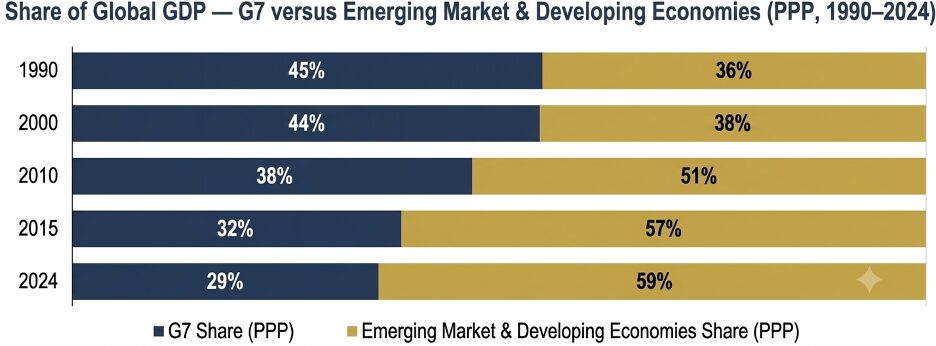
The numbers above are not incidental background. They are the structural condition that explains everything that follows. In 1990, the G7 accounted for roughly 45 percent of global output at purchasing power parity; by 2024, that figure had declined to approximately 29 percent. Over the same period, emerging market and developing economies expanded their collective share from around 36 percent to nearly 59 percent. This is not cyclical fluctuation. It is a structural redistribution of economic capacity — and with it, of diplomatic leverage, import dependence, and the ability to absorb or resist external pressure. When power is concentrated, norms can be enforced. When it is diffused, norms must be negotiated. The transition from the former condition to the latter is precisely what Jaishankar’s exchanges have exposed.
India’s response to Western pressure on Russia represents the most analytically instructive case precisely because it forces a comparison between European and Indian behaviour that Western critics initially preferred not to make. The EU derived approximately 40 percent of its natural gas imports from Russia in 2021, a dependency built deliberately over fifteen years despite sustained American warnings. India’s post-2022 increase in Russian crude purchases was opportunistic and recent; Europe’s dependency was structural and self-constructed. The comparison in Table 1 below is not rhetorical — it is evidentiary.
Table 1: Russian Energy Exposure — European Union versus India (Comparative Analysis)
| Metric | EU (Pre-invasion, 2021) | EU (Post-adjustment, 2023–24) | India (2023–24) |
| Russian natural gas share | ~40% of total imports | ~8% (reduced via LNG substitution) | Negligible |
| Russian crude oil share | ~26% of total imports | ~3–4% (post-embargo adjustment) | ~35–40% of total imports |
| Duration of dependency | ~15 years (Nord Stream era) | Declining; structural shift underway | Post-2022 opportunistic |
| Policy rationale | Diversification failure / commercial lock-in | Emergency substitution at high fiscal cost | Price arbitrage; energy security |
Sources: Eurostat Energy Statistics; European Commission REPowerEU reports; IEA Oil Market Reports 2023–24; Centre for Research on Energy and Clean Air (CREA) India tracker
The asymmetry here is important. Europe’s dependency was a policy choice rationalized by commercial logic and geopolitical complacency; India’s expansion of Russian oil purchases was a rational response to price signals in a disrupted global market. That European governments — having spent a decade and a half deepening their structural reliance on Russian fossil fuels — should then position themselves as arbiters of appropriate energy policy toward Moscow is precisely the inconsistency that the Global South finds difficult to accept. The credibility gap is not invented; it is calculable.
This pattern extends far beyond energy. A structurally similar argument applies to the history of Western arms transfers. Jaishankar’s reference to weapons ‘used against India’ is grounded in a documented record. Beginning in 1954 and continuing episodically through the post-9/11 period, the United States supplied Pakistan with advanced weapons systems — F-86 Sabres, F-16s, Harpoon missiles, surveillance aircraft — in each case rationalizing the transfer through a succession of strategic frameworks: Cold War alliance architecture, the Soviet–Afghan War, and later counter-terrorism cooperation. In every instance, the strategic benefit accrued to Washington; the regional security costs were borne by India. The relevant data from SIPRI is summarized below.
Table 2: Selected Western Arms Transfers to Pakistan — Historical Record
| Period | Supplier | Key Systems | Strategic Context |
| 1954–1965 | United States | F-86 Sabre aircraft; M47/M48 tanks | SEATO/CENTO membership; Cold War counter to India–USSR alignment |
| 1981–1990 | United States | F-16A/B Block 15; M113 APCs; Harpoon missiles | Soviet–Afghan War; Pakistan as frontline state; authorized under congressional oversight |
| 2001–2011 | United States | P-3C Orion; F-16 upgrades; helicopters; night-vision equipment | Post-9/11 counter-terrorism logic; Coalition Support Fund reimbursements exceeded $10bn |
| 2000s–present | China (PRC) | JF-17 Thunder; Agosta-90B submarines; HQ-9/P air defence | China–Pakistan Economic Corridor; strategic counterbalance to Indian regional influence |
Sources: SIPRI Arms Transfers Database (accessed 2024); US Congressional Research Service, ‘Pakistan: Key Current Issues and Developments’ (various years); Security Assistance Monitor
What connects energy, arms transfers, and the broader phenomenon of Indian diplomatic assertion is a single analytical thread: the selective application of universalist principles by actors who benefit from the selectivity. This is not a moral indictment; it is a description of how great powers have always operated. The difference today is that the diffusion of economic capacity has produced a set of middle powers — India, Turkey, Saudi Arabia, Brazil, the UAE, Indonesia, South Africa — that possess sufficient strategic autonomy to name this pattern publicly without bearing prohibitive costs. Table 2 below maps this convergence.
Table 3: Multi-Alignment Among Middle Powers — Comparative Posture Analysis
| Country | NATO / US Alliance | Russia Energy/Trade | China Economic Ties | Sanctions Compliance (Ukraine) |
| India | Strategic Partner (non-ally) | Major oil buyer post-2022 | 3rd largest trade partner | Declined to join |
| Turkey | Full NATO member | Maintains gas imports | Active trade ties | Partial / selective |
| Saudi Arabia | Security partner (no treaty) | OPEC+ coordination w/ Russia | BRI investments received | Declined to join |
| Brazil | Non-NATO major ally | Continued trade | Significant trade ties | Abstained/Declined |
| UAE | Security partner (US bases) | Trade maintained | Largest Arab BRI recipient | Declined to join |
| Indonesia | Non-aligned; US partner | Trade continued | Major BRI recipient | Declined to join |
Sources: NATO official membership data; SIPRI Military Expenditure Database; IEA; European Commission sanctions tracker; UNCTAD Trade Statistics; official government statements
The table above reveals a structural pattern rather than a set of individual policy choices. No major non-Western power — and several formally aligned Western partners, including Turkey — has adopted wholesale sanctions compliance against Russia. The reasons vary: energy dependence, trade exposure, historical relationships, domestic political calculus. But the aggregate result is that the Western sanctions regime, however significant in its direct economic impact on Russia, has failed to achieve the universal legitimacy that Western governments sought. This failure is itself diagnostic. It signals that the post-Cold War assumption — that Western norms, once articulated, would achieve near-universal acceptance — no longer holds.
The Trump administration’s second term introduced a further complication that merits direct acknowledgement. The imposition of broad tariff regimes against allies and rivals alike, combined with expressed ambivalence about NATO commitments and multilateral institutions, weakened the internal consistency of Western normative claims precisely when those claims were under external challenge. One cannot simultaneously argue that the rules-based international order is sacrosanct and pursue aggressive unilateral economic nationalism; the contradiction is not lost on the countries being asked to bear the costs of solidarity. Jaishankar observed this dynamic with characteristic directness, noting that certain Western actors apply principles selectively depending on whether compliance suits their national interest at a given moment.
What emerges from this comparative analysis is a world in transition between two equilibria. The first was characterized by Western preponderance sufficient to sustain the equation of Western preferences with universal norms. The second — still forming — is one in which norms must be constructed through genuine multilateral negotiation among actors of more comparable weight. This transition is neither linear nor peaceful; it produces precisely the kind of friction visible in the exchanges that opened this analysis. But its direction is structurally determined. The G7’s share of global output will not return to its 1990 level. The emerging economies’ collective weight will not diminish. And the middle powers that now constitute the swing constituency of global governance will not voluntarily accept a normative framework built without their meaningful participation.
The significance of Jaishankar’s diplomacy, then, is neither its cleverness nor its assertiveness. It is its timeliness. These arguments — about energy double standards, about arms transfer histories, about the self-appointment of custodians — have been made before, in various registers, by various actors. What is different now is that the structural conditions necessary to make them consequential have arrived. The world is not listening because India is speaking loudly. It is listening because the argument has become, for the first time in a generation, structurally credible.
“The real story is not that India is challenging the West. The real story is that an increasing number of countries no longer believe that global legitimacy flows from the West alone.”