Elon Musk led SpaceX’s initial public offering, which generated considerable buzz in the United States, also prompted excitement among European retail investors. At the same time, the US decision to delay the Lunar Gateway Station and to cancel the Mars Sample Return prompted calls for greater collaboration among European firms to remain competitive and reduce dependence on the United States. Director General of European Space Agency, Josef Aschbacher, noted that “Europe has become too exposed to decisions beyond its control,” and added that “the choice before Europe is clear: Do we pilot, or are we merely passengers?”
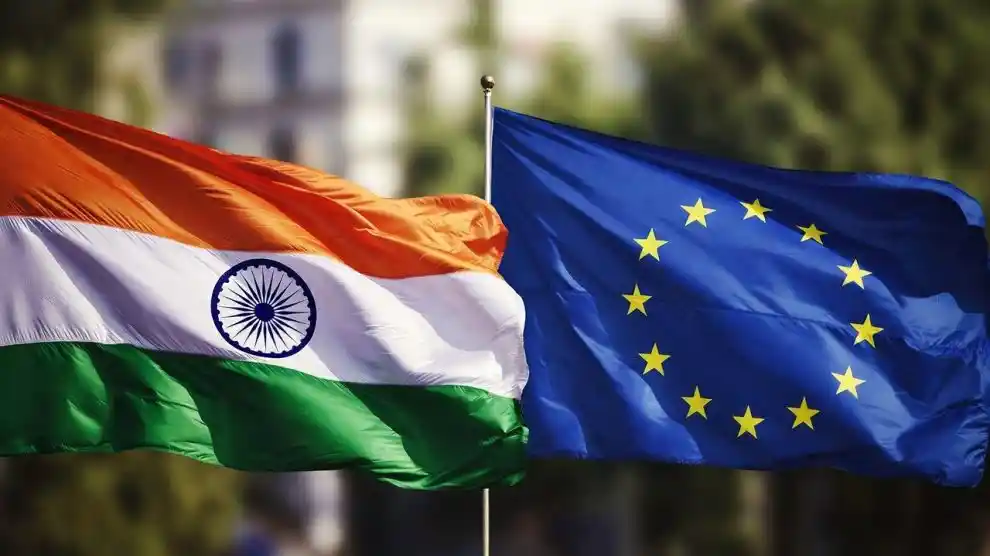
In the recent past, there has been considerable disappointment in Europe with the policies of the United States. Consequently, Europe is attempting to diversify its external economic interactions. When European Commission President Ursula von der Leyen described the recently concluded India-EU trade agreement as the“mother of all deals,” most attention focused on tariffs, market access, and the promise of deeper economic ties. Yet the agreement may prove significant for reasons that extend far beyond trade.
The breakthrough comes at a moment when Europe is rethinking the foundations of its economic and technological power. Due to supply chain disruptions, growing geopolitical competition, and increasing pressure to strengthen strategic autonomy, European policymakers are seeking reliable partners capable of supporting the continent’s industrial ambitions. Therefore, one sector that particularly illustrates this challenge well is space.
The global space economy is expected to grow dramatically over the coming decade, with estimates suggesting $ 1.8 trillion by 2035. Satellites these days underpin everything from navigation and telecommunications to financial transactions, climate monitoring, logistics, and military operations. Space is no longer a niche scientific enterprise. It has become a critical component of economic competitiveness and national security.
Europe understands this reality. Through flagship programs such as Galileo, Copernicus, and IRIS², the European Union has invested heavily in developing sovereign space capabilities. The EU’s 2023 Space Strategy for Security and Defence further emphasised the importance of protecting critical space infrastructure and reducing strategic dependencies.
Yet ambition alone does not guarantee success.
Europe faces several structural constraints that could complicate its efforts to remain competitive in the emerging space economy. The demographic trends point towards shrinking working-age populations across much of the continent, even as demand for aerospace engineers, software developers, artificial intelligence specialists, and advanced manufacturing expertise continues to grow. At the same time, recent disruptions, from the COVID-19 pandemic to semiconductor shortages and instability in maritime trade routes, have exposed vulnerabilities in the supply chains that underpin advanced industries.
These challenges are forcing European policymakers to confront an uncomfortable reality that strategic autonomy cannot be achieved through domestic capacity alone. It requires resilient industrial ecosystems and trusted international partnerships.
This is where India enters the picture.
For decades, India’s space program was primarily associated with cost-effective missions conducted by the Indian Space Research Organisation (ISRO). However, today India is rapidly emerging as a significant space power in its own right.
The country produces roughly 1.5 million engineering graduates annually and possesses one of the world’s largest STEM talent pools. Its space economy, currently valued at around $8billion, is projected to exceed $40 billion by 2040. Since the liberalisation of the space sector and the introduction of India’s Space Policy 2023, private investment has accelerated, producing a growing ecosystem of startups involved in launch technologies, satellite manufacturing, Earth observation, and downstream services.
What makes India particularly attractive is not simply its technological progress. It is the combination of talent, manufacturing potential, cost competitiveness and scale. Few countries can offer all four simultaneously.
For Europe, this matters because future leadership in space will depend not only on technological breakthroughs but also on the strength of the industrial ecosystems that support them. Satellites require semiconductors, advanced materials, precision manufacturing, software systems, launch infrastructure, and highly skilled workforces. Building resilient networks across these sectors, therefore, has become a strategic priority.
Viewed through this lens, recent diplomatic developments begin to look less coincidental.
The India-EU trade breakthrough follows closely on the heels of the recent India-United Kingdom Free Trade Agreement. It also comes amid growing European interest in the India-Middle East-Europe Economic Corridor (IMEC) and India’s increasingly prominent role in discussions surrounding economic security and critical technologies.
India’s repeated invitations to G7 summits offer another clue. These invitations are often framed as efforts to engage the Global South, but they also reflect India’s growing importance to debates on supply chain resilience, infrastructure development, emerging technologies, and economic security.
Prime Minister Narendra Modi’s recent remarks at the G7 summit regarding the protection of seafarers and maritime commerce highlighted this very connection. Nearly 90 per cent of global trade by volume travels by sea, and disruptions in routes such as the Red Sea have demonstrated how vulnerable modern supply chains remain. The security of maritime trade is increasingly linked to the resilience of industrial ecosystems, which depend on the uninterrupted movement of goods, components, and technologies.
For Europe, these concerns are directly relevant to the future of its space sector.
The continent’s ambition in satellite systems, launch capabilities, and space-based services ultimately depends upon secure supply chains, access to talent, and diversified industrial partnerships. India’s geographic position, expanding technological capabilities, and growing manufacturing base make it an increasingly attractive partner in addressing such challenges. Not surprisingly, the ‘India–EU Space Dialogue was held in Brussels in November 2025.’ The joint statements between India and some of the major powers in Europe also outline a substantive agenda for cooperation in the space sector.
None of this means that Europe’s future in space depends exclusively on India. The United States, Japan, South Korea, and other partners will remain essential contributors to Europe’s technological ecosystem. Nor does it suggest that the India-EU trade agreement was designed primarily with space cooperation in mind.
However, it suggests that Europe’s evolving relationship with India reflects a broader strategic logic. As economic security and technological competitiveness become increasingly intertwined, policymakers are looking beyond traditional trade relationships and towards partnerships that can support long-term industrial resilience.
Space is also becoming one of the clearest examples of this shift.
The significance of the India-EU agreement, therefore, lies not only in the trade it may generate but also in the strategic possibilities it creates. Europe possesses capital, advanced research capabilities, technological dynamism, and growing geopolitical influence. Together, they possess complementary strengths that could help shape the next phase of the global space economy.
As governments increasingly view space as a strategic domain rather than a scientific frontier, partnerships like these will matter more. The “mother of all deals” may ultimately be remembered not for the tariffs it removed, but for the industrial relationships it helped build.
The copyright of this article remains with the Politeia Research Foundation ©️PRF.
*****
End Notes
- Fernández Aparicio, Javier, and Harsh Pandey. “A Strategic Partnership: Security Cooperation Between India and the European Union.” IEEE Analysis Paper 11/2025. Instituto Español de Estudios Estratégicos, February 11, 2025. https://www.defensa.gob.es/documents/2073105/2352431/una_asociacion_estrategica_2025_dieeea11_eng.pdf.
- European Commission, and High Representative of the Union for Foreign Affairs and Security Policy. “Joint Communication to the European Parliament and the Council on a New Strategic EU-India Agenda.” JOIN(2025) 50 final, September 17, 2025. https://www.eeas.europa.eu/sites/default/files/2025/documents/JOIN_2025_50_1_EN_ACT_part1_v9.pdf.
- Giri, Chaitanya. “Charting a Path to Controlled Growth for India’s ‘Sunrise’ Space Economy.” ORF Issue Brief No. 810. Observer Research Foundation, May 30, 2025. https://www.orfonline.org/research/charting-a-path-to-controlled-growth-for-india-s-sunrise-space-economy.
- Ernst & Young LLP. “India–EU FTA Highlights.” January 27, 2026. https://www.ey.com/content/dam/ey-unified-site/ey-com/en-in/pdf/2026/ey-india-eu-fta-highlights.pdf.
- Press Information Bureau. “India’s Trade Partnerships Powering Global Integration and Growth.” Government of India, February 27, 2026. https://static.pib.gov.in/WriteReadData/specificdocs/documents/2026/feb/doc2026227806201.pdf.
- Bharadwaj, Tejas, and Swasti Sachdeva. “India–EU Space Cooperation in 2026 – The drivers and a template for cooperation.” India’s World, May 7, 2026. https://indiasworld.in/india-eu-space-cooperation-in-2026-the-drivers-and-a-template-for-cooperation/
- Mallikarjuna, KG. “Integration of India with Global Start-up Networks: The Role of 2026 Free Trade Agreements with the EU and USA.” International Journal for Multidisciplinary Research (IJFMR) 8, no. 2 (March–April 2026). https://www.ijfmr.com/papers/2026/2/80892.pdf.
- Orbital Today. “SIA-India: Proposed EU Space Act Might Hurt EU’s Space Competitiveness.” November 14, 2025. https://orbitaltoday.com/2025/11/14/sia-india-proposed-eu-space-act-might-hurt-eus-space-competitiveness/.
- CSDR. “Securing the Final Frontier: Collaborative Pathways for India and Europe in Space Governance and Security.” Policy Brief. https://csdronline.com/global-gateway-advancing-eu-india-priorities-in-the-indo-pacific-copy/.
- Sonali Gokhale, Visvaniti. “Modi-Trump at G7: Shaping Global Resilience.” June 21, 2026. https://visvaniti.org/2026/06/21/modi-trump-at-g7-shaping-global-resilience/
- World Economic Forum, “Space Economy Set to Triple to $1.8 Trillion by 2035, New Research Reveals,” April 8, 2024, accessed July 3, 2026, World Economic Forum.
- International Institute for Strategic Studies. Advancing European Military Capacity in Space. By Erin Pobjie, Alexander K. Bollfrass, Ester Sabatino, and Annemiek Dols. Research Paper. March 30, 2026. Accessed July 3, 2026. International Institute for Strategic Studies
- News On AIR. “India’s Space Economy Poised to Grow from 9 Billion Dollars to 45 Billion Dollars in Next Decade.” June 14, 2026. Accessed July 3, 2026. News On AIR
- Space Insider. “Inside India’s Rising Space Sector: A Comprehensive Snapshot.” March 27, 2025. Accessed July 3, 2026
- Nipun Sharma. “Why Are So Many of India’s 1.5 Million Fresh Engineers Every Year Unemployable?” Forbes India, November 13, 2025. Accessed July 3, 2026.