A sudden wall of water and debris tore through Nepal’s northern border district of Rasuwa on August 26. A reminder that echoes: The high-altitude Himalayan states of South Asia stand at a critical crossroads where climate change, development pressures, and human vulnerability converge. Yet, these same fragile landscapes are powering the region’s green energy transition, built on increasingly fragile grounds.
With vital road links washed out, international engineers working on green energy projects cut off, and hundreds of pilgrims stranded along the Kailash Mansarovar transit route, the catastrophe highlights why disaster rescue, cross-border weather data sharing, and climate resilience must be urgently de-linked from politics.
The First-Responder Imperative: India’s HADR Footprint
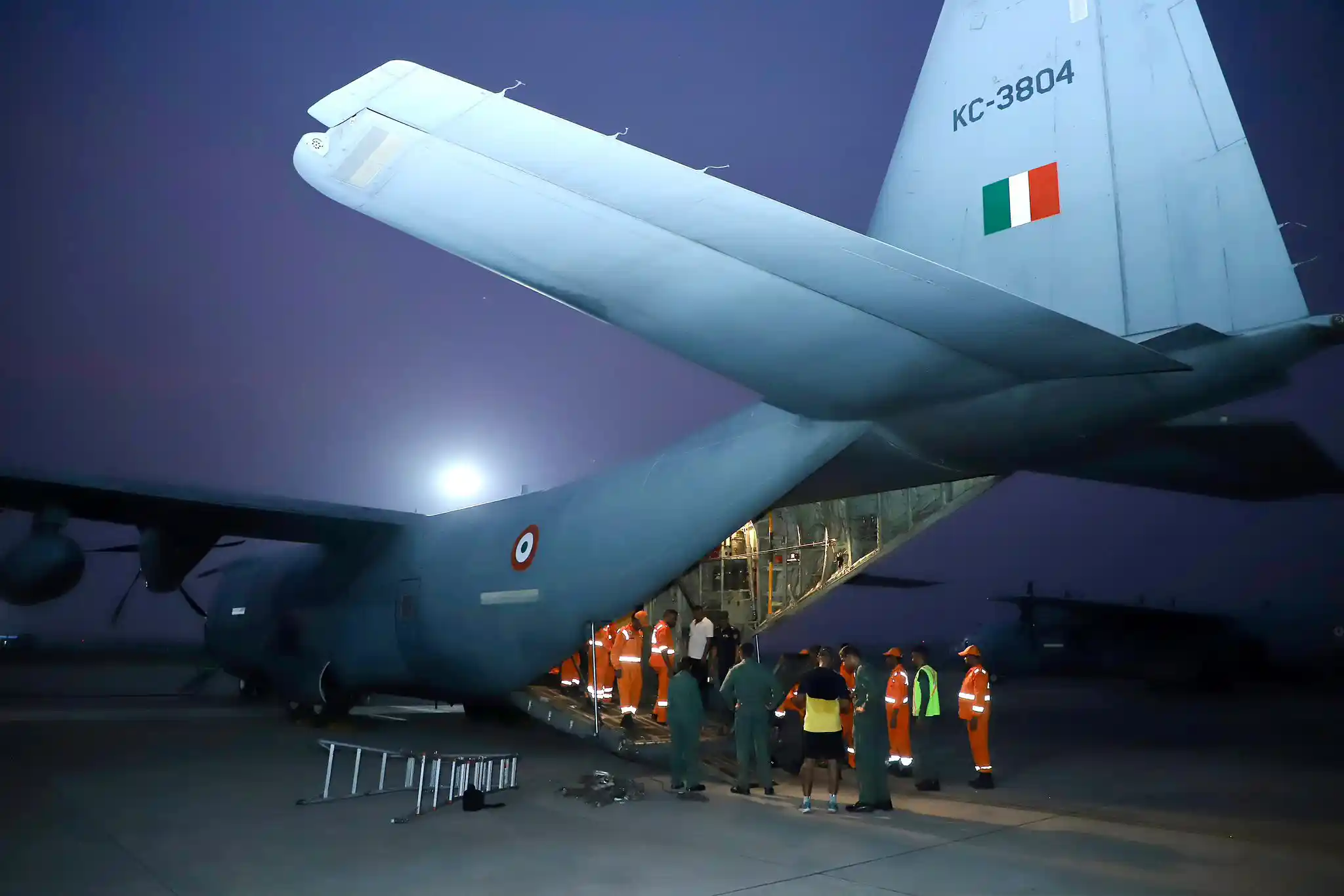
New Delhi’s capacity for rapid Humanitarian Assistance and Disaster Relief (HADR) makes India the natural first responder. The operational capability was proven during the 2015 Gorkha earthquake under Operation Maitri, where the Indian Air Force, the National Disaster Response Force (NDRF), and military medical units mobilized an air-bridge to Kathmandu within hours. As for the current disaster, India has moved from “prepared to assist” to actually airlifting relief supplies to Nepal, while keeping additional air and ground assets on high alert. As of late evening:
- An Indian Air Force C‑130J transport aircraft has already taken off from Hindon airbase near Delhi and landed in Kathmandu with 10 tonnes of HADR supplies and essential medicines for Nepal.
- A larger C‑17 Globemaster is now expected to depart for Nepal on August 27 with more relief material, while other aircraft (C‑130J, C‑295) remain on standby for further sorties.
- External Affairs Minister S. Jaishankar has publicly confirmed the dispatch of this first tranche of aid and stated that India “stands with Nepal and its people” as more consignments are planned.
- The Indian Embassy has activated three emergency WhatsApp helplines.
- Indian missions in Beijing and Dehradun are supporting coordination for affected pilgrims and workers.
- Nine NDRF teams are deployed in Bihar and eleven in Uttar Pradesh to prepare for possible downstream flooding.
- The SSB has deployed 18 teams along the India–Nepal border, with seven on standby.
The Hydropower angle
The current catastrophe exposes a major challenge in South Asia’s green energy transition. Himalayan states like Nepal depend heavily on run of the river hydropower to generate revenue, power domestic industries, and export clean electricity across the region.
There is no doubt that Hydropower is central to Himalayan development but this is also some of the most hazard‑prone terrain on earth. The Rasuwa disaster, a sudden transboundary surge likely linked to an upstream lake or landslide scenario in Tibet roared into Nepal, overwhelming both communities and hydropower infrastructure. The international workers missing in Rasuwa are a stark reminder that the human cost of “green” energy can be paid in remote project sites, not boardrooms.
Urgent Need for Climate Data Collaboration
The Rasuwa catastrophe has triggered conversation around climate data sharing and information failure. Across Himalayan basins, hydrological and meteorological data are often treated as security assets rather than public good information. In a transboundary flood like Rasuwa, if upstream data are delayed or withheld, downstream communities are effectively blind.
When glacial lakes swell, moraines collapse, or torrential downpours saturate high-altitude catchments across the border, downstream communities in Nepal often receive little to no upstream hydrological warning. Historically, data sharing from the Chinese side has often been delayed, sporadic, or caught in bureaucratic red tape.
How India can help, beyond politics
While India cannot substitute for China’s upstream responsibilities in Tibet, it can reshape the regional data environment by treating the mountains as a shared risk system.
India and Nepal already cooperate on water resources and flood management through structured committees. It should further propose real-time data sharing, crucial for neighborhood policy, by offering real-time sharing of its own Himalayan hydrometeorological data for basins that impact Nepal.
The long support for hydropower development in Nepal, both as an investor and buyer of electricity, needs a shift towards resilience. This is achievable by early warning systems, GLOF modeling, and evacuation infrastructure as tangible parts of financing conditions.
Barring strategic concerns, it is time to agree at least in principle that Floods, GLOFs, and earthquakes do not recognize borders, and precisely so, information about an oncoming flood is not a strategic secret; it becomes a lifesaving warning.
Further:
- ISRO’s capabilities through operation of synthetic-aperture radar and high-resolution satellites can monitor Himalayan glacial lake expansion, landslide dams, and moraine stability in real time.
- The India Meteorological Department (IMD) and Central Water Commission (CWC) can directly link their regional Doppler radar grids and flood forecasting models with Nepal’s Department of Hydrology and Meteorology.
Unlocking South Asian Climate Leadership
The mountains do not recognize political boundaries or sovereign rivalries. Revamping institutional solutions to Himalayan vulnerabilities can turn a recurring ecological tragedy into an opportunity for regional leadership.
As the resilient proponent for the Global South, it is time for India to lead the creation of an open-access meteorological and hydrological platform across the BBIN (Bangladesh, Bhutan, India, Nepal) region. While setting climate-resilient standards for mountain infrastructure is a must, providing rapid HADR reinforces India’s Neighborhood First approach and establishes it as a credible regional security player.
To build lasting safety for the present and the future, New Delhi and Kathmandu must:
- Ensure that “friendship” is not just remembered as Operation Maitri in 2015, but as a continuous practice of sharing data, skills and risk assessments before the next catastrophe.
- Shape hydropower and infrastructure in a manner that makes the Himalaya more liveable, not more fragile.
- De-link ecological and meteorological data from strategic secrecy, treating weather and river telemetry as an open regional public good.