In 2002, the Indian government under Prime Minister Atal Bihari Vajpayee embarked upon an ambitious National River Linking Project (NRLP) to interlink around 30 major rivers. The idea behind this was to explore ways to transfer surplus river water through a network of canals and utilise it for irrigation of drought-prone regions and water-stressed areas for drinking purposes.
Twenty-four years later, Vajpayee’s vision has found relevance in Himachal Pradesh’s tribal district of Lahaul-Spiti, where the Government of India has decided to reinforce its control over its share of the Indus basin water—the Chenab River.
This move comes as a sequel to India’s decision to place the 1960 Indus Waters Treaty (IWT) in abeyance following the Pahalgam terror attack.
Soon, the government is set to roll out two strategic mega-infrastructure projects. One of these projects envisages the diversion and optimal utilisation of the surplus waters of the Chenab and its further utilisation for setting up irrigation, drinking water, and hydro-power projects, significantly benefiting the states of Punjab, Haryana, Rajasthan, Delhi, and Himachal Pradesh.
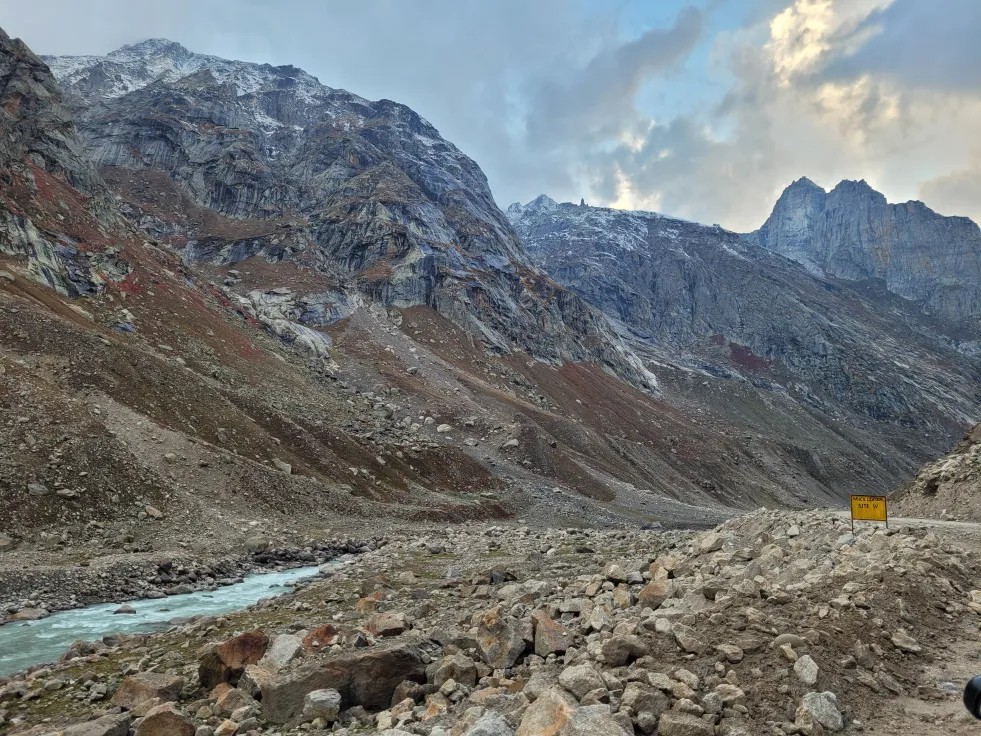
Chenab flows through Himachal Pradesh’s Lahaul-Spiti district in the name of the Chandra-Bhaga River before it enters Jammu & Kashmir to become the Chenab River. It is formed by the confluence of two streams—the Chandra River, originating from the Chandra Glacier near Baralacha La, and Bhaga, originating from Suraj Tal near Baralacha La. The two rivers meet at Tandi in Lahaul, forming the Chandra-Bhaga. Chenab is one of the six rivers of the Indus basin.
According to the details of the project, the surplus water from Chenab will be diverted through an 8.7 km long underground tunnel into the Beas River in the Kullu valley. It will be called the Chenab-Beas link project to be developed with an estimated cost of Rs 2,300 crore.
Says former Chief Minister Jairam Thakur, “The Chenab-Beas tunnel project is of great strategic importance to the country and northern states. This will not only prevent the surplus waters of the Indus system from flowing into Pakistan but will be productively used to meet the country’s development needs.”
Himachal Pradesh, which is termed the “powerhouse” of the nation because of its hydropower potential, currently has private and public sector projects generating 14,000 MW of power, while a series of mega and medium projects are also under construction to harness the potential of its river systems.
State Chief Minister Sukhvinder Singh Sukhu confirmed that the government was fully aware of the proposed Chenab–Beas river interlinking project and would extend all necessary support to facilitate its implementation. The project will add another 4000 MW capacity to the existing river potential in the state.
“The state government has learned that a 19-meter-high barrage will be built in the Lahaul valley for channelisation of the water. Besides power generation, the project will also help in extending irrigation facilities and meet drinking water needs in the northern states.”
The state government’s only concern will be preventing any environmental degradation or displacement of the population and granting the state’s legitimate share in the power. But this project being of national importance, the state government sees a lot of advantages as the state is the host of several rivers, including Chandra-Bhaga, another name for the Chenab River.
Water diverted from these rivers will feed into the Indira Gandhi Canal, significantly boosting irrigation and drinking water availability in arid regions of Rajasthan, Punjab, Haryana, and Delhi.
Behind the project’s conceptualisation is a simple thought process of the BJP’s former spokesperson Praveen Sharma, a mandi-based young leader, who wrote a series of articles in newspapers and also wrote letters to Prime Minister Narendra Modi in 2016.
“The concept of linking the Chenab and Beas rivers emerged in my mind from the realisation that a substantial portion of India’s share of Indus waters was flowing unused into Pakistan. A detailed assessment revealed that diverting surplus Chenab waters to the Beas through a tunnel could be a game-changing project for Himachal Pradesh, Punjab, and other northern states. Besides boosting water availability for agriculture, hydropower, and drinking purposes, the project also holds the potential to reduce interstate water conflicts, including the decades-old SYL dispute between Punjab and Haryana.
Praveen Sharma says he had met several union ministers and heads of statutory bodies between 2016 and 2023, advocating changes to the Indus Waters Treaty with Pakistan in the national interest.
“I am happy that finally the PMO has given its green signal,” he says and adds, “My information suggests the agencies have been told to meet a timeline of 30 to 33 months to complete the project”
Meanwhile, a second project has also received the GoI’s attention and pertains to Jammu and Kashmir, where silt management work will be carried out at the Salal Dam. This project will cost Rs 268 crore.
The 690 MW Salal dam, located near Reasi in Jammu and Kashmir, was completed in phases between 1987 and 1995. It was the first major hydroelectric project constructed on the Chenab River and remains an important component of India’s utilisation of waters allocated under the Indus Waters Treaty.