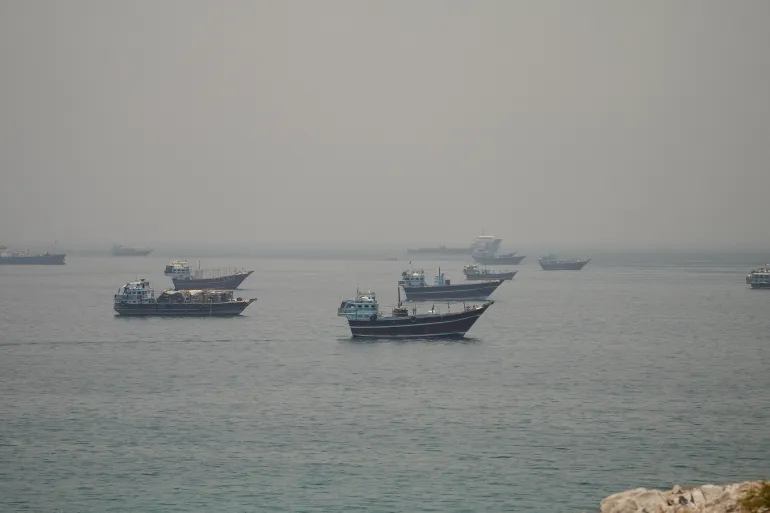
Three Indian merchant mariners died in the Strait of Hormuz in late 2023 and early 2024 as drone attacks struck vessels they crewed. India’s diplomatic protest was duly registered and equally duly ignored. The episode reveals something more uncomfortable than a maritime security failure: it exposes the structural position India occupies in a geopolitical order where middle powers accumulate enormous commercial and human stakes in contested corridors while retaining almost none of the coercive instruments needed to protect them. This is not new. It has happened before, repeatedly. What is new is the scale of India’s exposure and the continued absence of a strategic doctrine adequate to address it.
The Strait of Hormuz concentrates more economic consequences per nautical mile than any comparable chokepoint on earth. The U.S. Energy Information Administration estimates that approximately 20–21 million barrels per day transited Hormuz in recent years — roughly 20 percent of global petroleum liquids. No pipeline network meaningfully replaces this. The Saudi East-West Pipeline, the only partial alternative, carries perhaps 5 million barrels per day. Contrast this with the Suez Canal, where a disruption triggers rerouting via the Cape of Good Hope at financial cost but without supply rupture. Hormuz offers no such exit. For India, which imports approximately 85 percent of its crude oil requirements and draws the bulk from Gulf producers, this structural inescapability is the central strategic fact — not the geopolitics of the confrontation itself, which India cannot meaningfully influence.
Table 1 · Global Maritime Chokepoints: Comparative Strategic Profile
| Chokepoint | Daily Oil Transit | Global Oil Share (%) | India’s Crude Import Exposure | Viable Alternative Route | Closure Impact (India) |
| Strait of Hormuz | ~20–21 mb/d | ~20% | High — bulk of Gulf imports transit here; ~85% of Indian crude is imported | Saudi E-W Pipeline (~5 mb/d capacity only; partial) | Critical — no full substitute; immediate supply shock |
| Strait of Malacca | ~16–17 mb/d | ~16% | Moderate — Southeast Asian crude; India less dependent than China/Japan | Lombok / Sunda Strait (viable but adds cost) | Significant — but India has alternative Eastern route options |
| Suez Canal / Bab-el-Mandeb | ~8–9 mb/d | ~8–9% | High — critical for India-Europe trade corridor and Red Sea LNG | Cape of Good Hope (+10–15 days, +20–30% freight costs) | Severe for trade; manageable for oil supply alone |
| Turkish Straits (Bosphorus) | ~3 mb/d | ~3% | Low — primarily Black Sea / Russian exports; indirect India impact | Limited; used for Caspian exports | Marginal for India directly |
Sources: U.S. Energy Information Administration, World Oil Transit Chokepoints; International Energy Agency, Oil Market Report; UNCTAD Review of Maritime Transport. mb/d = million barrels per day.
What distinguishes the current crisis from earlier episodes is not the pattern — which is entirely familiar — but the simultaneity of disruptions and the depth of India’s embedded exposure. During the Iran-Iraq Tanker War of 1984–1988, over 400 commercial vessels were attacked and neutral seafarers, predominantly from South and Southeast Asia, bore the casualties. The Gulf of Aden piracy crisis of 2005–2012, rooted in Somalia’s state collapse, saw the IMO document over 3,700 seafarers attacked or captured. The Red Sea crisis triggered by Houthi attacks from late 2023 onward caused UNCTAD to record a decline of over 50 percent in Suez Canal transit volumes at its height, sharply compressing Indian exporter margins. In each episode, the conflict’s animating parties pursued their own strategic logic with minimal consideration for the Indian citizens absorbing the consequences. The pattern is not coincidental; it is structural.
Figure 1 · Four Crises, One Pattern: When Commercial Shipping Becomes a Battlefield
| Episode | Period | Conflict Parties | Impact on Commercial Shipping | Third-Party Cost Pattern (India / Neutral States) |
| Iran–Iraq Tanker War | 1984–1988 | Iran, Iraq | 400+ commercial vessels attacked; tanker rates surged | Neutral seafarers (Indian, Filipino, Greek) bore casualties; no compensation mechanism; U.S. reflagging protected Kuwaiti ships only |
| Gulf of Aden Piracy Crisis | 2005–2012 | Somali factions (internal collapse) | 3,700+ seafarers attacked or captured (IMO data); insurance premiums multiplied | Indian, Filipino, Bangladeshi crew disproportionately affected; Indian Navy deployed but lacked formal legal mandate |
| Red Sea / Houthi Crisis | 2023–2025 | Houthi forces (Iran-backed) vs. Israel/U.S. | Suez Canal transit down ~50% at peak; freight costs surged 200–300% on Asia-Europe routes (UNCTAD) | Indian exporters absorbed higher freight costs; no Indian party to the Gaza conflict; diplomatic protest ineffective |
| Hormuz Drone Attacks on Indian-Crewed Vessels | 2023–2024 | Iran/proxies vs. Israel/U.S. | Indian crew fatalities; war-risk insurance premiums spiked; vessel rerouting increased transit costs | Direct Indian human cost in a conflict India has no role in; no established protocol for crew extraction; diplomatic response insufficient |
Sources: IMO Maritime Safety Committee reports; UNCTAD Review of Maritime Transport (2024); U.S. Naval Institute historical records; Directorate General of Shipping, Government of India.
The structural explanation is not complicated, though its implications are routinely underweighted by Indian policymakers. Weaponizing commercial shipping is strategically rational for a weaker belligerent: it imposes costs on adversaries and their trading partners without crossing the threshold of a formal attack on state assets, maintains deniability, and exploits commercial actors’ own incentive to avoid confrontation. India’s exposure is magnified by its maritime labour profile. BIMCO and the Directorate General of Shipping estimate over 240,000 Indian nationals serve on foreign-flagged vessels — roughly 11 to 12 percent of the global seafarer workforce — and they are disproportionately concentrated in the tanker and bulk carrier segments that are the primary targets in current Gulf operations. This converts India’s maritime labour advantage into a liability in conflict zones.
Table 2 · India’s Structural Vulnerability to Hormuz Disruption: Four Dimensions
| Dimension | Quantitative Exposure | Comparative Position (vs. Peers) | Strategic Implication |
| Energy | ~85% crude oil import dependency; Gulf states supply majority of imports (IEA) | Higher than China (~73%), comparable to Japan, South Korea | Hormuz disruption translates directly to supply shock; SPR coverage limited; no viable rapid-diversification path in short term |
| Maritime Labour | ~240,000+ seafarers on foreign-flagged vessels; ~11–12% of global seafarer workforce (BIMCO/DGS) | Second largest after Philippines (~16–18%); India disproportionate in tanker/bulk segments | Indian workers concentrated precisely in vessel categories most targeted; casualty risk is structural, not incidental |
| Diaspora / Remittances | ~8–9 million Indians in GCC states; remittances among India’s largest FX inflow sources (RBI/World Bank) | India largest recipient of Gulf remittances globally; far exceeds other large states’ Gulf diaspora | Conflict escalation triggers evacuation costs + remittance disruption + fiscal pressure simultaneously; 1990 Kuwait precedent (200,000 evacuated) remains live scenario |
| Trade Routes | West Asia is top regional trading partner; India-Europe corridor runs via Red Sea/Suez; freight cost sensitivity high | India more dependent on Gulf/Red Sea corridor than most large Asian economies due to westward export orientation | Red Sea crisis 2023-24 already compressed Indian exporter margins; Hormuz closure would compound this across energy AND trade simultaneously |
Sources: IEA World Energy Outlook 2024; BIMCO/ICS Seafarer Workforce Report 2021; World Bank Remittance data; Reserve Bank of India Annual Report; Directorate General of Shipping.
The escalation dynamics that generate these costs follow a logic older than the current Iran-U.S.-Israel confrontation. Each retaliatory action — whether an Iranian drone strike, a Houthi interdiction, an American naval interdiction, or an Israeli strike on Iranian proxies — is, from the actor’s perspective, a proportionate response to a prior provocation. The sequence is internally coherent to its participants and externally disastrous for bystanders. The 1917 resumption of German unrestricted submarine warfare is instructive precisely because it was strategically rational by Berlin’s calculations: it aimed to starve Britain of supplies before American entry could change the balance. It instead accelerated American entry and Germany’s ultimate defeat. The lesson — that retaliation spirals escape their initiators’ control — has not prevented their recurrence.
Figure 2 · The Escalation Spiral and India’s Cost Exposure at Each Stage
| Stage | Trigger / Action | Retaliatory Logic | Commercial Shipping Impact | India’s Cost at This Stage |
| 1 | U.S./Israel coercive pressure on Iran (sanctions, strikes on proxies) | Iran activates proxy networks; signals Hormuz closure threat | War-risk insurance premiums rise; some vessels reroute | Higher import costs; elevated insurance premiums for Indian shipping operators |
| 2 | Drone/missile attacks on commercial vessels; Iranian proxy operations | U.S. increases naval presence; further sanctions; Israeli countermeasures | Indian-crewed vessels targeted; seafarer fatalities; freight cost surge | Direct human cost (seafarer casualties); Indian diplomatic protest; no redress |
| 3 | Direct U.S.-Iran military exchange; regional escalation | Gulf states drawn in; shipping companies halt Gulf transits | Effective Hormuz closure; LNG and crude exports disrupted | Energy supply crisis; oil price shock; Indian SPR activated; fiscal pressure |
| 4 | Wider regional war; GCC states threatened; diaspora at risk | International coalition responses; risk of broader conflict | Gulf trade networks collapse; global oil shock | Mass evacuation of ~8–9M Indians; remittance collapse; currency pressure; energy emergency — simultaneous |
Author’s analytical framework drawing on historical escalation patterns; referenced against SIPRI Conflict Database, IEA scenario analyses, and IMF Gulf crisis modelling.
Three trajectories now compete for the Gulf’s immediate future. A negotiated de-escalation between Washington and Tehran remains possible but is not the most probable outcome given the current political configurations in both capitals. A prolonged low-intensity confrontation — the base case — sustains periodic attacks and elevated insurance premiums, imposing cumulative costs that are politically invisible precisely because no single incident crosses an emergency threshold, yet aggregate over time into a structural competitive disadvantage for Indian exporters and importers alike. A regional war involving direct U.S.-Iran hostilities and potential Hormuz closure would constitute a compound emergency: an energy supply shock to India’s 85-percent import-dependent crude oil system, a diaspora evacuation crisis involving up to 9 million nationals, and a foreign exchange pressure point — all simultaneously.
Table 3 · Forward Scenarios: Hormuz Trajectory and India’s Strategic Position
| Scenario | Prob. (Indicative) | Energy Implication | Trade Implication | Diaspora Risk | India’s Strategic Response Window |
| A: De-escalation / U.S.-Iran agreement | 25–30% | Insurance premiums ease; normal transit resumes within 3–6 months | Freight costs normalise; Indian export competitiveness recovers | Low; GCC stability maintained | Wide — opportunity to build doctrine, SPR, and multilateral frameworks during calm |
| B: Prolonged low-intensity confrontation (Base Case) | 45–55% | Chronically elevated import costs; periodic supply anxiety; SPR under pressure | Sustained freight premium; Indian exporters lose margin vs. non-Gulf competitors | Moderate; periodic individual incidents; no mass event | Narrowing — cumulative costs mount invisibly; institutional inertia likely; gradual competitive disadvantage |
| C: Regional war / Hormuz closure | 15–25% | Critical supply shock; global crude price spike (estimated $20–30/barrel; IEA); SPR cover insufficient beyond 60–90 days | Gulf trade routes severed; Indian export chains disrupted; massive freight inflation | High; potential mass evacuation of 8–9M Indians; 1990 Kuwait scenario at larger scale | Closed — crisis management only; no space for doctrine-building; maximum cost, minimum leverage |
Probability assessments are indicative, based on the author’s analysis of prevailing geopolitical conditions. Sources: IEA oil price shock scenario modelling; IMF Regional Economic Outlook: Middle East and Central Asia; World Bank remittance vulnerability assessments.
What India currently lacks is not information about these risks, but a strategic doctrine that treats maritime security as a core national interest rather than a peripheral operational concern. Three priorities are analytically defensible. First, a permanent crisis coordination mechanism — integrated across the Ministry of External Affairs, the Directorate General of Shipping, and the Indian Navy — capable of real-time vessel tracking, crew extraction, and maritime risk assessment is overdue. Analogous mechanisms exist in several European maritime states; India, despite having a vastly larger economic stake in Gulf stability, has none. Second, India’s strategic petroleum reserve, currently providing only limited emergency cover, requires accelerated expansion alongside supplier diversification that reduces structural Hormuz dependency. Third, India possesses unique diplomatic standing — as the world’s largest democracy with established relations on all sides of the Gulf confrontation — to lead an international initiative strengthening legal protections for civilian maritime workers. No such initiative exists. India has neither championed it nor accounted for its absence.
The deaths of three Indian mariners in Hormuz are, in a narrow legal sense, someone else’s war crimes. In a strategic sense, they are India’s problem — one it has inherited from a geopolitical order that externalises the costs of great-power rivalry onto whoever stands in the shipping lane.
Modern conflicts no longer remain confined to their originating theatres. They travel through trade corridors, insurance markets, diaspora networks, and energy supply chains. For India, safeguarding national interests now requires protecting not only its territorial frontiers but the people, the ships, and the commercial lifelines that connect the country to the wider world. That order will not reform itself. The question is whether India builds the capacity to navigate it, or continues to absorb its costs with diplomatic protests that no one particularly fears.
Key Sources and Data References
U.S. Energy Information Administration (EIA) — World Oil Transit Chokepoints
International Energy Agency (IEA) — Oil Market Reports and World Energy Outlook
UNCTAD — Review of Maritime Transport (various years)
BIMCO / International Chamber of Shipping — Seafarer Workforce Report 2021
International Maritime Organization (IMO) — Seafarer Data and Maritime Safety Reports
Directorate General of Shipping, Government of India — Annual Reports
Stockholm International Peace Research Institute (SIPRI) — Arms Transfers and Conflict Data
United Nations Convention on the Law of the Sea (UNCLOS) — Articles 37–44, Transit Passage
International Monetary Fund (IMF) — World Economic Outlook; Regional Economic Outlook: Middle East and Central Asia
Ministry of External Affairs, Government of India — Statements on Gulf security and diaspora welfare
Geneva Conventions Additional Protocol I (1977) — Protections for civilian objects