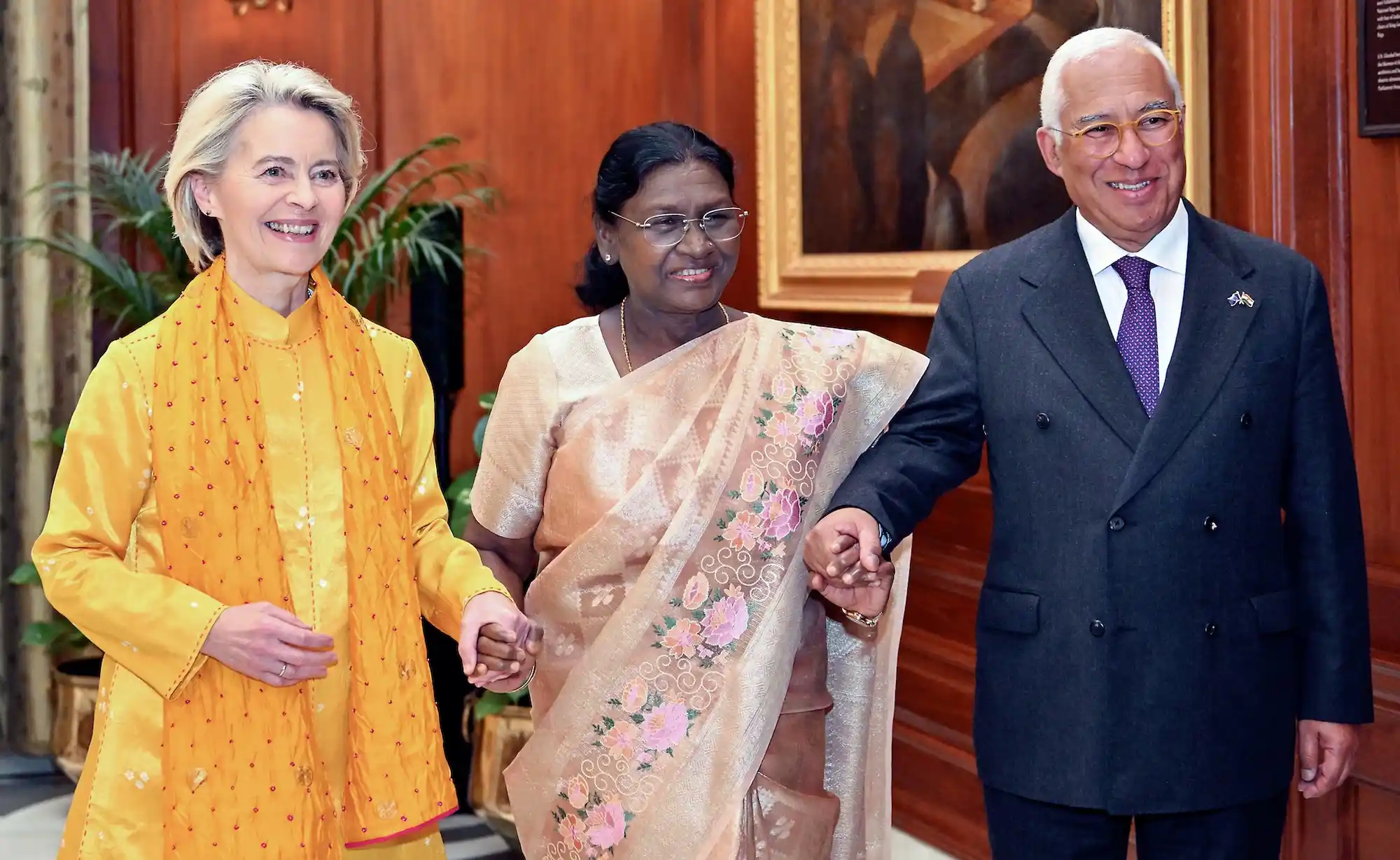
India and the European Union sealed a landmark Free Trade Agreement (FTA) on January 27, 2026, at the India-EU Summit in New Delhi, hailed as the “mother of all deals” after two decades of intermittent negotiations. Spanning a combined market of two billion consumers and a quarter of global GDP—roughly $27 trillion—this pact arrives amid escalating US tariff threats under President Donald Trump’s second term. For India, it accelerates economic diversification and ‘Make in India’ ambitions; for the EU, it fortifies supply chain resilience against over-reliance on China. Geopolitically, the FTA recalibrates power dynamics in the Indo-Pacific, positioning both as counterweights to unilateralism.
Negotiation Milestones and Framework
Talks, relaunched in 2022 after a 2007-2013 stalemate, gained momentum through 15 rounds, culminating at the 16th India-EU Summit. Commerce Secretary Rajesh Agrawal and European Commission President Ursula von der Leyen announced the breakthrough, with formal signing slated post a 5-6 month legal scrub for ratification by mid-2027. The comprehensive pact encompasses goods (96% tariff liberalization), services (preferential access for IT, finance), investments, government procurement, intellectual property, sustainable development, and customs facilitation. Sensitive sectors like Indian agriculture and EU dairy face phased reductions or exclusions, balancing domestic lobbies. This “living agreement” includes review clauses for digital trade and green tech, reflecting post-COVID supply chain lessons.
The deal builds on interim frameworks like the 2024 Trade and Technology Council (TTC), fostering collaboration in semiconductors, AI governance, and critical minerals. India’s concessions on data localization and EU commitments to ease non-tariff barriers (e.g., sanitary standards) were pivotal breakthroughs.
Economic Gains for India: Export Surge and Industrial Leap
India stands to unlock EU markets worth Rs 6.4 lakh crore ($77 billion annually), slashing average tariffs from 10% on $33 billion in key exports. Labor-intensive sectors—textiles, gems, leather, pharmaceuticals, and engineering goods—gain zero-duty access, potentially adding 2-3 million jobs in export hubs like Gujarat, Maharashtra, Tamil Nadu, and Karnataka. IT and BPM services, projected at $350 billion by 2026, benefit from mutual recognition of professional qualifications, easing mobility for 10,000+ Indian professionals yearly.
FDI inflows could double to $50 billion by 2030, channeling EU capital into electronics manufacturing, renewables, and EVs under PLI schemes. MSMEs, comprising 45% of exports, gain via simplified rules of origin, integrating into EU value chains. Macro impacts include a 0.5-1% GDP boost over five years, easing India’s $600 billion import bill through cheaper EU machinery and chemicals. However, risks loom: dairy lobbies may protest EU cheese inflows, and IP tightening could raise pharma costs in the short term.
Economic Advantages for the EU: Market Penetration and De-Risking
The EU anticipates €4 billion in annual savings from tariff cuts on 96.6% of exports to India, targeting a doubling to €20 billion by 2032. Machinery, automobiles, chemicals, and wines secure phased duty reductions (from 100-150% to zero), while services like finance, logistics, and maritime transport gain ‘positive list’ access—unprecedented for India. SMEs in Italy’s machinery belt and Germany’s auto clusters benefit most, with IP protections safeguarding Airbus and pharma innovations.
Crucially, the FTA de-risks EU supply chains: India emerges as an alternative to China for textiles, APIs, and solar panels, aligning with the EU’s Carbon Border Adjustment Mechanism (CBAM). Post-Ukraine war energy shocks, Indian LNG and green hydrogen imports stabilize supplies. Yet challenges persist—India’s standards on GE crops and data sovereignty could spark disputes, though TTC arbitration mitigates this.
| Economic Dimension | India’s Projected Wins | EU’s Projected Wins |
| Trade Volume | +$77B exports; 15-20% growth in textiles/pharma | +€4B savings; exports double to €20B by 2032 |
| Sectoral Focus | Engineering ($300B target by 2030), IT services, MSMEs | Machinery, finance, renewables; IP enforcement |
| Investment/Jobs | $50B FDI; 2-3M jobs in coastal states | Supply chain shift from China; SME export hubs |
| Risks | Dairy competition; short-term IP costs | Regulatory hurdles; CBAM compliance costs |
Geopolitical Ramifications: Hedging Against Uncertainty
Timed against Trump’s 25-50% reciprocal tariffs on Indian steel and EU autos, the FTA exemplifies “friend-shoring” in a deglobalizing world. India diversifies from USMCA dependencies, elevating its multi-alignment: FTAs with the UK, Australia, and the UAE now complement EU ties, targeting $2 trillion exports by 2030. The EU bolsters “strategic autonomy,” reducing China’s exposure (60% of rare earths) via India’s QUAD synergies on Indo-Pacific maritime security, undersea cables, and IMEC corridor linking India, the Middle East, and Europe.
Broader implications ripple through forums such as the G20 and the WTO. India-EU convergence on WTO reforms pressures US protectionism, while joint clean energy pacts (e.g., 200 GW solar) counter China’s Belt and Road dominance. For Indo-Pacific stability, enhanced naval dialogues and semiconductor supply chains (India’s $10B push) fortify resilience against Taiwan risks. Critics note power asymmetries—EU leverage on human rights clauses could irk India’s sovereignty—but mutual interests in countering authoritarian tech stacks prevail.
This India-EU FTA transcends commerce, forging a resilient axis for the 2030s. India gains a premium market and tech partner; the EU secures a democratic counterweight to Asia’s giants. As global fissures deepen, their pact underscores trade’s enduring role in geopolitical equilibrium—provided implementation navigates domestic headwinds with agility.