
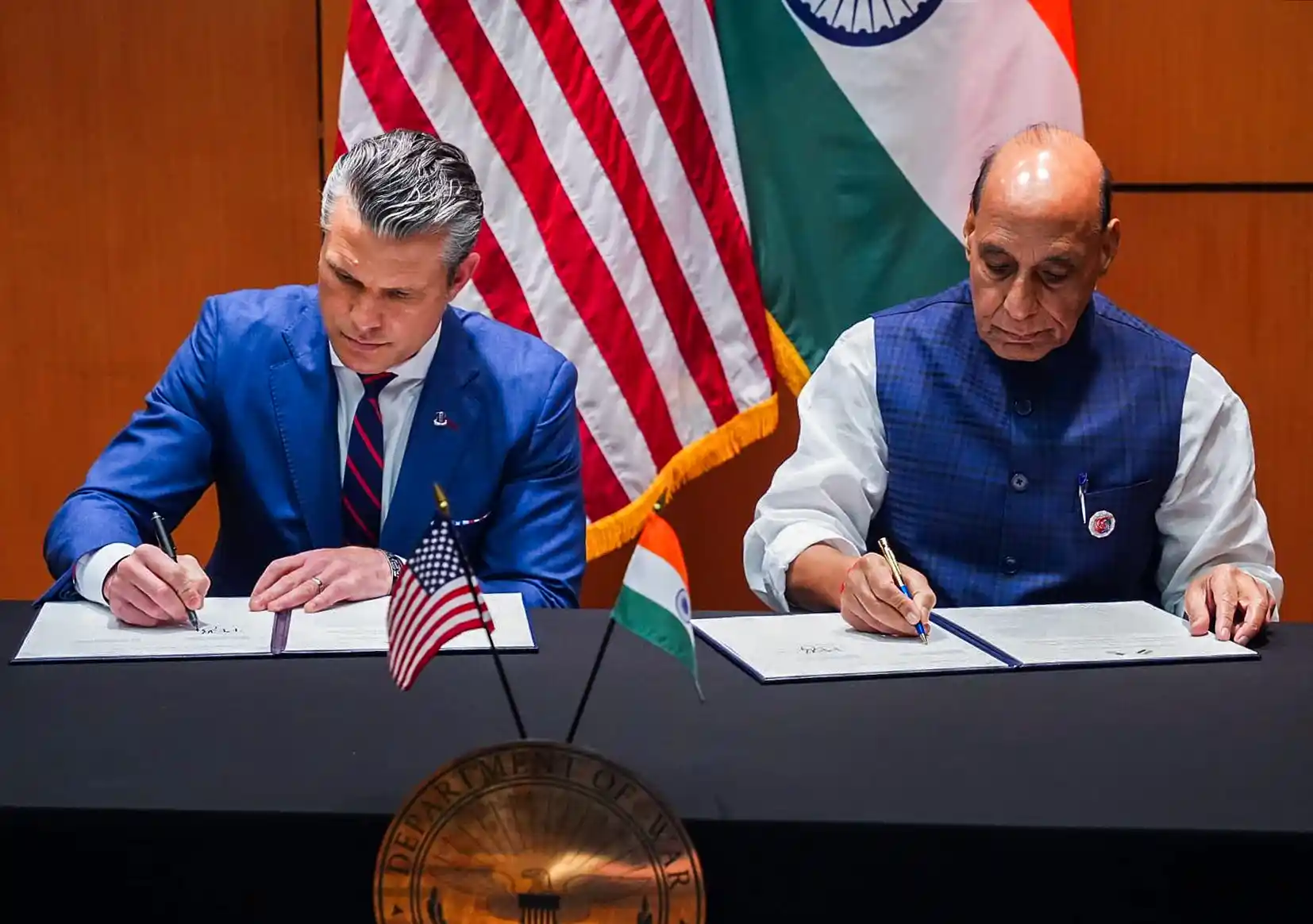
India and the United States have signed a landmark 10-year Defence Framework Agreement, marking a new era in bilateral military cooperation and strategic convergence. This pact is widely regarded as a foundation for deepening their defence partnership and enhancing India’s indigenous military capabilities. The historic agreement, inked in Kuala Lumpur by Defence Minister Rajnath Singh and US Secretary of War Pete Hegseth, aims to set a policy direction for the entire spectrum of India-US defence ties, with profound implications for India’s security, technological advancement, and its position in the Indo-Pacific region.
What is the India-US 10-Year Defence Framework?
The 10-year framework is an ambitious roadmap outlining deeper military collaboration, capacity building, joint production, intelligence sharing, and access to advanced defence technologies. It emerged from high-level political interactions earlier in the year, including meetings between Prime Minister Narendra Modi and US President Donald Trump, and has now been formally enacted during a strategic engagement in Malaysia. The agreement promises enhanced coordination across all defence domains—land, maritime, air, space, and cyber—ensuring the two countries’ militaries become increasingly interoperable and responsive to shared security challenges.
Key Features of the Pact
- Long-term strategic alignment: The pact provides a decade-long policy framework for continuing high-level defence interactions, joint operations, war games, training, and logistics support.
- Technology transfer and co-development: The agreement sets the stage for expanded joint production and indigenous manufacturing of defence equipment, leveraging US technologies under India’s Make in India initiative.
- Intelligence and information sharing: Both nations will integrate processes for secure information exchange and intelligence cooperation to address regional and global security threats.
- Regional stability and deterrence: The framework positions India and the US as key stabilizers in the Indo-Pacific region, responding to maritime security challenges and China’s expansionist endeavours.
How the Pact Benefits India
India stands to gain on multiple fronts from the 10-year defence pact:
The agreement is expected to significantly advance India’s self-reliance in defence manufacturing through joint ventures, co-development programs, and the transfer of technology from US firms. This will accelerate domestic capability in critical areas such as aircraft systems, naval platforms, missile defence, and secure communication technologies, directly empowering the Make in India campaign.
With the US now committed to sharing its latest defence technologies, India gains access to platforms like advanced drones, radar systems, and possibly fifth-generation fighter jets such as the F-35. This infusion of cutting-edge equipment will modernize the Indian armed forces and improve operational effectiveness against evolving threats.
Routine joint exercises, intelligence sharing, and closer operational alignment make India far more resilient in dealing with security challenges in the Indo-Pacific and beyond. Improved trust and procedural interoperability mean quicker responses to emergencies, whether they are conventional military threats, natural disasters, or counter-terrorism operations.
India’s role as a security provider in the Indo-Pacific will be significantly strengthened. The pact signals a shared commitment to a free, open, and rules-based order, deterring authoritarian expansion and enhancing collective security for like-minded democracies in the region.
Defence deals and technology collaboration have ripple effects for broader India-US trade and diplomatic relations. As both nations move past recent friction, including tariff disputes, a stronger defence partnership can lead to more pragmatic negotiations in other sectors. Shared innovation stimulates India’s high-tech sectors, generating new opportunities for skilled employment and research.
The India-US 10-year Defence Framework marks a dramatic step forward in bilateral relations, not only serving India’s security needs but also cementing its stature as a reliable partner in shaping regional and global security architecture. By aligning strategic interests, accelerating indigenous defence production, and institutionalizing technology transfer, the framework sets the stage for lasting gains, positioning India as a pivotal player in the Indo-Pacific’s future.

