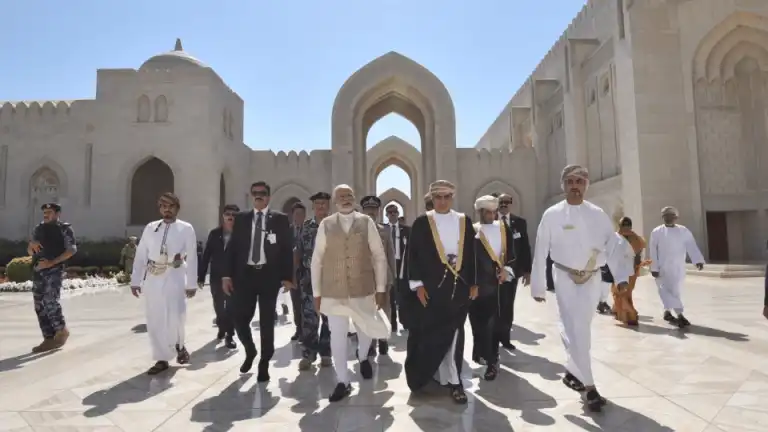
Centuries of goodwill and recent high-level pacts have laid a strong foundation, and yet there are significant opportunities for India-Oman operational engagement to be upgraded substantially. As regional rivalries sharpen and security risks spill into the Western Indian Ocean, New Delhi and Muscat need to scale up their strategic partnership.
India and Oman share a longstanding maritime and civilisational relationship. Today, these ties have become more strategically important as regional rivalries intensify and maritime security risks escalate across the Western Indian Ocean.
Operational ties between India and Oman reached a new milestone in November 2026 with the conclusion of the 15th edition of their bilateral naval exercise, Naseem Al Bahr. The exercise featured the Indian Navy’s Project 15B stealth guided-missile destroyer INS Surat and the Royal Navy of Oman’s RNOV Al-Mu’azzar, with harbour exchanges on explosive ordnance disposal and hydrography, followed by sea-phase Visit, Board, Search, and Seizure (VBSS) drills and a subsequent Coordinated Patrol (CORPAT) off Muscat.1
Such regular operational engagements enable both navies to share best practices, build interoperability, and strengthen maritime domain awareness across the Gulf of Oman and the Arabian Sea. For India, the number of joint exercises and coordinated patrols with Oman is an indicator of its operational readiness and continued presence in the Western Indian Ocean, and thus of its role in safeguarding the security of vital sea lines of communication.2
Deepening Historical, Economic and Maritime Ties
For thousands of years, India and Oman have maintained maritime relations, underpinned by civilisational and trade linkages that stretch back a long way. These historical connections have also been sustained by centuries-old people-to-people ties, with Indian merchant families, particularly from Gujarat, establishing roots in Oman’s coastal cities, including Muscat, Muttrah and Sur, from the late eighteenth century. Some Indian families have remained in Oman for 150–200 years, contributing to trade, commerce and the country’s wider development.
Today, the Indian community of nearly 695,000 people, comprising professionals, businesspeople, doctors, engineers, teachers and other workers, remains an important bridge between the two countries.3 The presence of 22 Indian schools serving more than 48,000 students, along with Indian social clubs, religious institutions, and cultural associations, further strengthens these societal connections. The historical depth of these ties is also reflected in the digitisation of over 7,000 archival documents belonging to 32 old Indian diaspora families, some dating back as far as 1838.4
Economic and commercial relations have also become an important pillar of the bilateral partnership.5
Bilateral trade reached US$11.19 billion in FY 2025–26, compared with US$10.61 billion in FY 2024–25. India’s major exports include petroleum products, iron and steel, processed minerals, machinery and motor vehicles, while imports from Oman are dominated by crude petroleum, petroleum products, fertilisers and industrial raw materials.
More than 6,000 India–Oman joint ventures operate in Oman, with estimated contributions of nearly US$7.5 billion to its economy through investments across various sectors. Major Indian companies operating in Oman include Larsen & Toubro, JSW Group, Tata Consultancy Services, UltraTech Cement and Jindal Shadeed Iron and Steel. The Oman India Fertiliser Company (OMIFCO), a joint venture between the Indian fertiliser cooperatives IFFCO and KRIBHCO, is another important example of industrial cooperation.6
Over the past few years, these links have strengthened through regular high-level visits and key agreements. Prime Minister Narendra Modi’s visit to Muscat in February 2018 and the signing of an important annexure to their military cooperation MoU, which granted the Indian Navy logistical, berthing and maintenance access to the Port of Duqm, set the stage for a more sustained operational presence in the Western Indian Ocean.7
During the visit of Prime Minister Modi in December 2025, the two countries signed a Comprehensive Economic Partnership Agreement (CEPA), which entered into force on June 1, 2026, providing duty-free access for 99.38 per cent of India’s exports to Oman, and an MoU on maritime heritage. They also agreed on a Joint Vision Document on Maritime Cooperation, expanding their engagement into the strategic domain, with emphasis on maritime security, blue economy and sustainable management of ocean resources.8
This cooperation was further reinforced by a maritime security MoU on white shipping information exchange between the Indian Navy and Oman’s Maritime Security Centre, renewed in October 2026, which subsequently expanded defence-industrial engagement.9
Alongside these new-age strategic initiatives, there have been attempts to revive the ancient maritime links with the Indian Navy’s traditional stitched sailing vessel, INSV Kaundinya – a vessel built without nails or modern propulsion based on a 5th-century depiction from an Ajanta cave – which completed a historic maiden overseas voyage from Porbandar in Gujarat to Muscat in January 2026. These developments are important in the evolution of bilateral relations.
Why Bilateral Ties Remain Below Potential
However, despite these milestones, India–Oman ties have remained below their potential. First, India’s own reluctance to engage more deeply with the region—driven by historical ideological baggage, non-aligned thinking, and a defensive mindset—contributed to this gap.
Second, a considerable gap remains between its political commitments and their operationalisation. For example, although India secured logistical access to the Port of Duqm, actual usage has largely remained limited to routine naval turnarounds and dry-docking rather than sustained operational maritime cooperation. Similarly, ambitious frameworks like the Joint Vision Document on Maritime Cooperation and the Comprehensive Economic Partnership Agreement (CEPA) 2026 must be translated into tangible outcomes on the ground.10
Thirdly, the Gulf countries have traditionally viewed India more as an economic partner than as a security partner.
Fourth, their longstanding dependence on the United States for regional security has further limited the scope for deeper defence engagement with New Delhi. Fifth, broader Middle Eastern geopolitical dynamics—such as US–Iran tensions and intra-Gulf rivalries—have further constrained India’s room to manoeuvre as New Delhi seeks to balance ties across competing blocs.
Sixth, although Oman’s ports are located outside the immediate crisis areas, they are not entirely free from regional vulnerabilities. The recent strikes on commercial vessels off Oman’s coast—including the November 2026 drone attack on the Indian-flagged cargo ship MSV Al Jusufi near Limah and the earlier strike on the MT Petro Dolphin off Sohar, which killed and endangered Indian seafarers—demonstrate that the ongoing Gulf crisis and regional instability can affect maritime security across the broader region.11
Although several of the factors that previously constrained India–Oman relations have evolved, many challenges remain.
Seizing the Strategic Opportunity
India should therefore invest more in this relationship. As India’s close maritime neighbour, Oman’s strategic location can provide India with greater access to the Middle East, Europe, Africa, and the wider Indian Ocean region, especially following the Comprehensive Economic Partnership Agreement (CEPA). Logistical access to ports such as Duqm, Salalah, and Sohar can serve as a vital launchpad for Indian trade with other parts of the world. Furthermore, these ports lie outside immediate crisis areas—bypassing the Strait of Hormuz—and face the Western Indian Ocean directly.
Moreover, China has been steadily expanding its strategic influence in Oman through massive infrastructure investments in Duqm, dominant bilateral trade, and dual-use digital and space partnerships, making deeper Indian engagement even more important to counterbalance Beijing’s growing footprint.12
Moreover, given New Delhi’s commitment to an Indo-Pacific vision of a free, open, and secure maritime domain, as well as its MAHASAGAR doctrine, which emphasises mutual security and growth through regional maritime cooperation, India’s engagement with Oman needs to be further deepened, particularly in safeguarding freedom of navigation and unimpeded commerce.13
Furthermore, as the security landscape in the Middle East changes rapidly, regional countries are increasingly looking to diversify their security partnerships beyond traditional partners like the US, with Pakistan also expanding its role in the region through various pacts and agreements. At the same time, Washington is encouraging greater regional burden-sharing as part of its evolving strategy. Against this backdrop, India should deepen its engagement with countries across the region to protect and advance its strategic interests while preventing hostile external actors from gaining greater influence.
Greater engagement with Oman also offers another distinct advantage: it serves as a stabilising force in the region, maintaining good relations with rival countries such as the United States, Iran, Saudi Arabia, and diplomatic channels with Yemen’s Houthis. Oman’s independent foreign policy has always been grounded in the principles of dialogue, reconciliation and regional stability.14
At the end, the India-Oman partnership is at an inflection point where the centuries of goodwill have to be matched by strategic determination. As Middle Eastern alignments are in flux and maritime risks spill beyond immediate conflict zones, New Delhi can no longer afford to be cautious about Muscat. India can make Oman a critical anchor for its Western Indian Ocean and Indo-Pacific strategy by converting high-level agreements into concrete cooperation in naval interoperability, defence co-production and CEPA-driven trade, thereby securing regional stability and its long-term maritime interests.
The copyright of this article remains with the Politeia Research Foundation ©️PRF.
References
- Ministry of Defence, Government of India, “Indian Navy and Royal Navy of Oman Conduct 15th Edition of Bilateral Maritime Exercise Naseem Al Bahr (Sea Breeze),” November 11, 2026. https://www.pib.gov.in/PressReleasePage.aspx?PRID=2335193®=48&lang=2 ↩
- News Desk, “INS Surat Arrives Muscat for Bilateral Exercise with Omani Navy,” Defence Standard, November 9, 2026. https://defencestandard.com/ins-surat-arrives-muscat-for-bilateral-exercise-with-omani-navy ↩
- Abhishek Dayal and Shabbir Azad, “India and Oman Sign Comprehensive Economic Partnership Agreement (CEPA),” Press Information Bureau, Government of India, December 18, 2025. https://www.pib.gov.in/PressReleasePage.aspx?PRID=2205889®=48&lang=2 ↩
- Akashvani News, “National Archives of India Undertakes First Overseas Digitization of Diaspora Records in Oman,” May 28, 2024. https://newsonair.gov.in/national-archives-of-india-undertakes-first-overseas-digitization-of-diaspora-records-in-oman ↩
- Embassy of India, Muscat, “Trade and Commerce Brief: India–Oman Economic and Commercial Relations,” November 2026. https://www.indemb-oman.gov.in/page/trade-and-commerce-brief/ ↩
- EGROW Foundation, India–Oman at 70: From Enduring Partnership to New Economic Opportunities, India–Oman Economic Conference Concept Note and Programme, November 4, 2026. https://egrowfoundation.org/site/assets/files/2974/india-oman_brochure.pdf ↩
- Government of India, Ministry of External Affairs, “India–Oman Joint Statement during Visit of Prime Minister to Oman,” February 12, 2018. https://www.mea.gov.in/bilateral-documents?dtl/29479/India%B1Oman%B1Joint%B1Statement%B1during%B1visit%B1of%B1Prime%B1Minister%B1to%B1Oman.html ↩
- Government of India, Ministry of External Affairs, “India–Oman Joint Statement during the Visit of Prime Minister of India Shri Narendra Modi to Oman (December 17–18, 2025),” December 18, 2025. https://www.mea.gov.in/bilateral-documents?dtl/40518/India+ +Oman+Joint+Statement+during+the+visit+of+Prime+Minister+of+India+Shri+Narendra+Modi+to+Oman+December+1718+2025 ↩
- Oman News Agency, “Oman and India Renew Maritime Security Pact to Safeguard Navigation Routes,” The Arabian Stories, October 6, 2026. https://www.thearabianstories.com/2026/10/06/oman-and-india-renew-maritime-security-pact-to-safeguard-navigation-routes ↩
- “Why Oman May Be India’s Most Important Untapped Strategic Partner in the Gulf,” India Today, April 8, 2026. https://www.indiatoday.in/world/story/why-oman-may-be-indias-most-important-untapped-strategic-partner-in-the-gulf-2893475-2026-04-08 ↩
- “The Indian Seafarer Killed as Aerial Object Strikes Cargo Vessel off Oman Coast; 13 Rescued,” The New Indian Express, November 3, 2026. https://www.newindianexpress.com/amp/story/india/2026/Nov/03/indian-seafarer-killed-as-aerial-object-strikes-cargo-vessel-off-oman-coast-13-rescued ↩
- Oman Ministry of Foreign Affairs, “Oman and China – A Growing Economic Partnership,” October 31, 2026. https://www.fm.gov.om/en/62859 ↩
- Suchitra Durai, “India’s Maritime Vision: From SAGAR to Indo-Pacific to MAHASAGAR,” Embassy of India, Dili, August 13, 2025. https://www.indembassydili.gov.in/section/articles-commissioned-by-xpd-division/india-s-maritime-vision-from-sagar-to-indo-pacific-to-mahasagar-by-amb-suchitra-durai ↩
- “The Role of Oman’s Neutrality as a Crucial Stabiliser in Gulf Crises,” The Arab Weekly. https://thearabweekly.com/omans-neutral-role-emerges-crucial-stabiliser-gulf-crises ↩