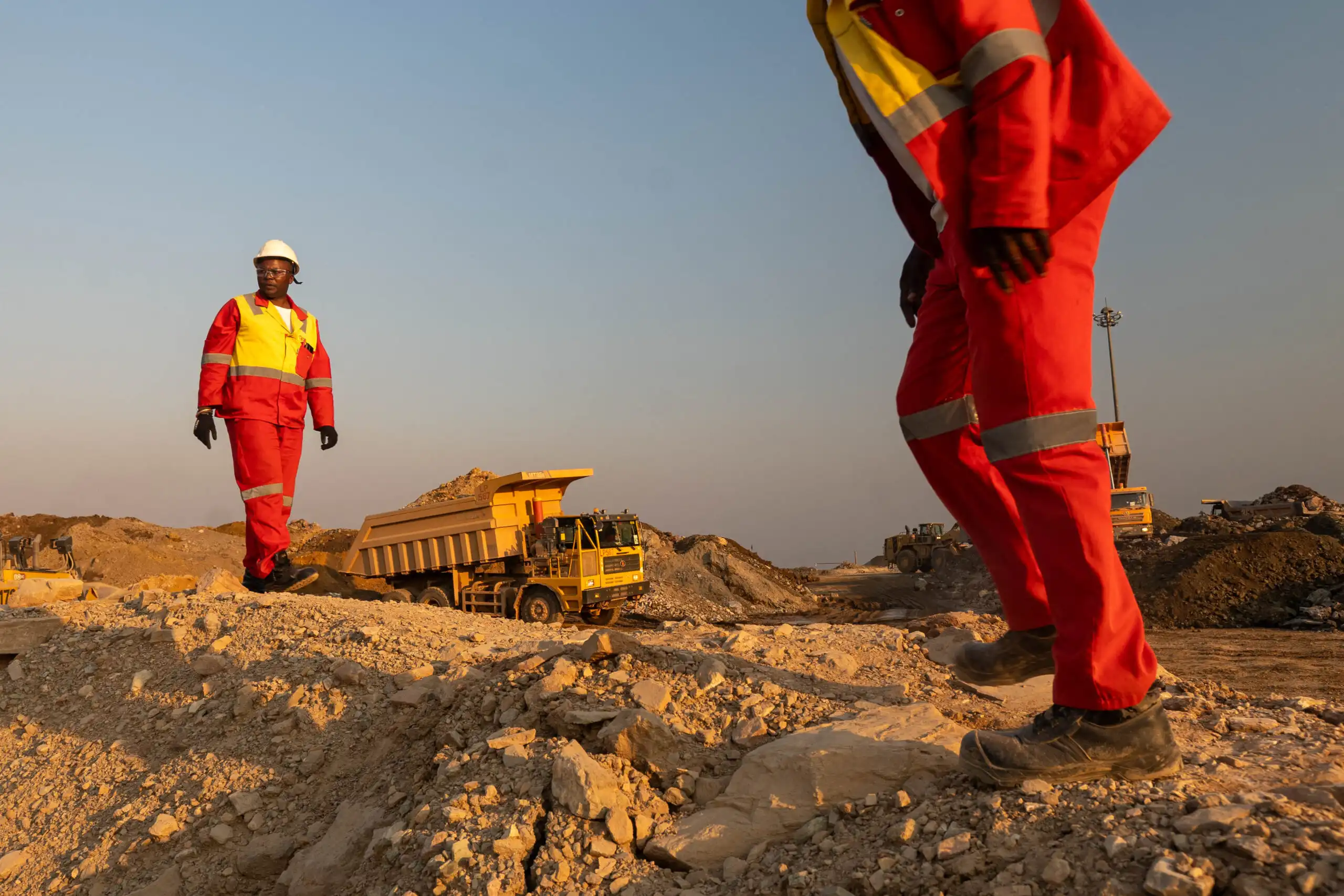
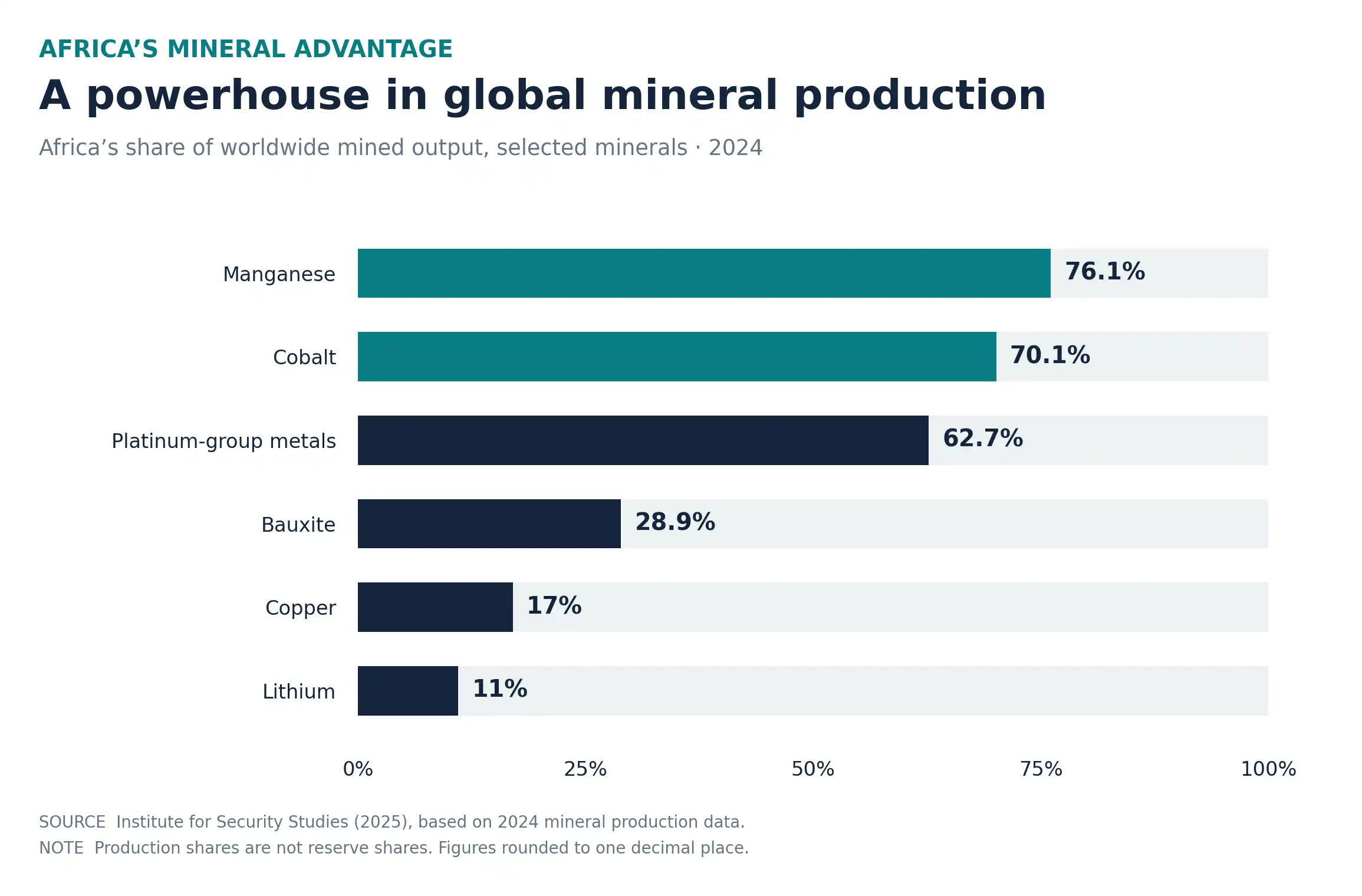
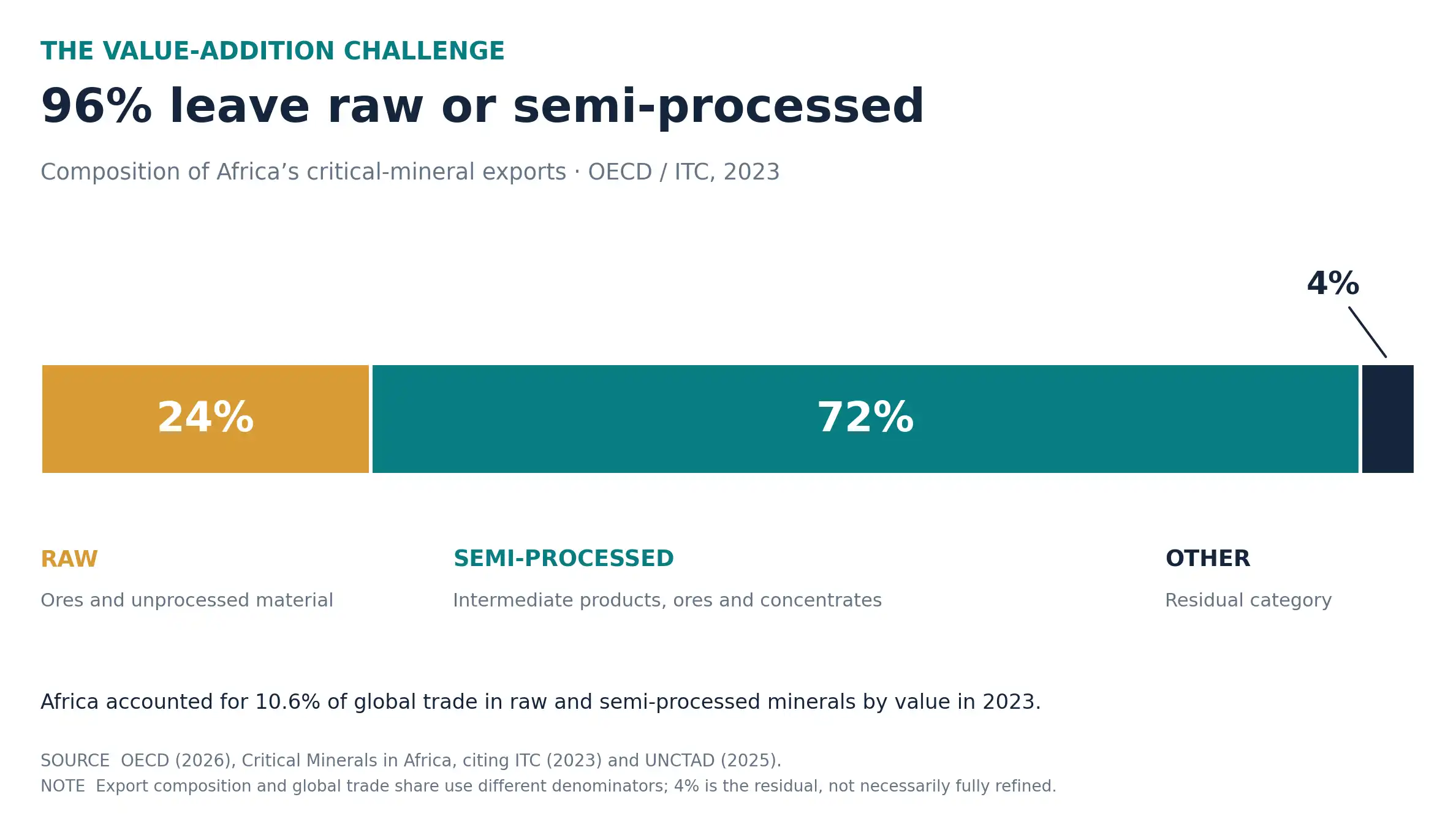
Africa holds roughly 30 percent of the world’s critical mineral reserves and produces more than 70 percent of global cobalt and manganese, yet it captures only a sliver of the downstream value. An OECD assessment finds the continent accounts for just 10.6 percent of global critical-mineral exports, nearly all of them raw or semi-processed. The Democratic Republic of Congo mines the bulk of the world’s cobalt; almost none of it is refined into battery-grade material on African soil. Zimbabwe, Africa’s leading lithium producer, has banned raw ore exports since 2022 precisely because the metal leaves the country before any significant processing occurs.
That pattern is no longer politically sustainable. Across the continent, governments are rewriting the terms of resource engagement. The African Mining Vision and the newer African Green Minerals Strategy call for beneficiation, local content, and regional industrial linkages. Zambia has imposed escalating local-procurement quotas that will reach 40 percent within five years. Namibia and the DRC have restricted or quotaed unprocessed critical minerals. Ghana aims to end raw ore exports by 2030. These measures reflect a straightforward calculation: mining already contributes about 9 percent of GDP on average in the most mineral-rich sub-Saharan economies and more than half of export earnings, yet the high-wage, high-skill jobs and manufacturing multipliers remain elsewhere.
India is one of the few major economies currently positioned to respond to this demand without simply replicating the extractive model. New Delhi’s National Critical Mineral Mission, approved in early 2025, explicitly seeks overseas assets, processing technology, and diversified supply chains to feed its own manufacturing and electric-vehicle ambitions. Indian companies are already present in midstream operations rather than pure offtake.
In Zambia, Vedanta’s Konkola Copper Mines operates an integrated complex that includes a smelter with roughly 311,000 tonnes of annual capacity. After regaining control of the asset, the company has restarted the smelter, is expanding tailings-leach recovery, and is being pressed by Lusaka to increase local sourcing and power investment. Production targets aim at several hundred thousand tonnes of copper within the decade—refined metal, not concentrate. In Zimbabwe, Indian firm Lohum secured ten lithium blocks estimated at 30–40 million tonnes of ore and has already shipped material; crucially, its stated plan is to produce lithium sulphate inside Zimbabwe before further refining in India. That is intermediate processing on African soil, not a pure export of spodumene. Elsewhere, smaller Indian operators are developing graphite processing capacity in Tanzania and integrated iron-ore-to-steel facilities in Nigeria.
These are still early and partial steps. The commercial logic is different from pure extraction. India already runs a large, cost-sensitive manufacturing base in pharmaceuticals, auto components, and electronics. Its firms have experience scaling mid-technology processes and training technicians at volume. India’s merchandise exports to Africa rose 44 percent in the first half of the 2026–27 financial year, led by engineering goods and pharmaceuticals—evidence of existing industrial linkages rather than one-way mineral flows. Historical lines of credit and technical cooperation have focused more on capacity building than on locked-in offtake.
For African economies the potential gains are concrete. Processing multiplies employment relative to mining alone; McKinsey estimates that better infrastructure clustering, cost reduction, and local value addition could unlock roughly $40 billion in additional mining-related value and millions of jobs by 2035. Intermediate products such as copper cathode, lithium sulphate, or ferro-manganese can feed regional manufacturing under the African Continental Free Trade Area rather than leaving the continent immediately. Skills transferred in metallurgy, quality control, and plant operations are more portable than those limited to open-pit extraction.
Processing, however, is power-intensive, and hundreds of millions of Africans still lack reliable electricity. Capital costs are high, technical skills are scarce, and policy volatility has historically deterred long-term plant investment. Export bans without parallel incentives for refining capacity can simply shift trade into informal channels or reduce overall revenues. Indian partners will need predictable fiscal terms, clear local-content rules, and access to competitive power. African governments, in turn, must insist on joint-venture structures that include meaningful local equity, mandatory technology and skills transfer, and regional rather than purely bilateral offtake so that intermediate products can circulate inside Africa.
The opening exists because interests partially converge. India needs secure, diversified feedstock for its industrial growth and cannot afford total dependence on a single refining geography. African states need partners willing to locate midstream capacity, train operators, and accept local content rather than treating the continent solely as a mine. Whether that potential is realized depends on whether the next generation of contracts treats beneficiation and skills as core commercial terms, not optional add-ons. The minerals will be mined either way. The question is whether more of the subsequent value—and the jobs that accompany it—will stay on the continent.