The closing months of the year saw a concentrated series of back-to-back multilateral gatherings — the ASEAN, ADMM-Plus and APEC summits — that drew leaders from major, emerging and middle powers. Most notably, Chinese President Xi Jinping hosted a trilateral meeting with US President Donald Trump and Russian President Vladimir Putin on the sidelines of the Shenzhen APEC Summit. Analysts quickly characterised the gathering as both a ‘G3’ summit, symbolising the consolidation of global power among three states, and ‘Yalta 2.0’, evoking the 1945 conference that established post-war spheres of influence and ushered in the Cold War. The international order established after the Second World War faces unprecedented disruption today. Washington’s growing reluctance to uphold its traditional security commitments coincides with Beijing’s assertive regional posture, heightening anxiety among its neighbouring states. Consequently, both US allies and nations wary of Chinese influence are exploring new security frameworks, positioning ADMM-Plus members — most notably India — as critical stabilising actors.
The Association of Southeast Asian Nations (ASEAN) convened the 13th ASEAN Defence Ministers’ Meeting-Plus (ADMM-Plus) in Lapu-Lapu City, Cebu, Philippines, on October 28–29, 2026. Established in 2006 as ASEAN’s highest defence consultative mechanism, the ADMM was expanded in 2010 through the ADMM-Plus framework to institutionalise security cooperation with eight dialogue partners: Australia, China, India, Japan, New Zealand, Russia, South Korea and the United States. Held under the theme ‘Navigating Our Future, Together’, the summit brought together defence ministers from all 11 ASEAN member states and their Plus counterparts — including India — to reinforce ASEAN centrality, advance practical defence collaboration and address complex regional security challenges through collective action. At the meeting, Defence Minister Rajnath Singh reaffirmed India’s commitment to collective regional security.
Amid China’s rapid rise, which has reshaped the geopolitical landscape in Asia over the past few decades, Southeast Asian policymakers have favoured a ‘balance of influence’ over a confrontational, nineteenth-century European-style balance of power. Rather than encouraging direct military competition among rival powers, they have pursued ambitious economic and diplomatic engagement to give external actors a vested interest in regional cooperation, growth and stability. The ADMM-Plus forum is a product of this strategy.
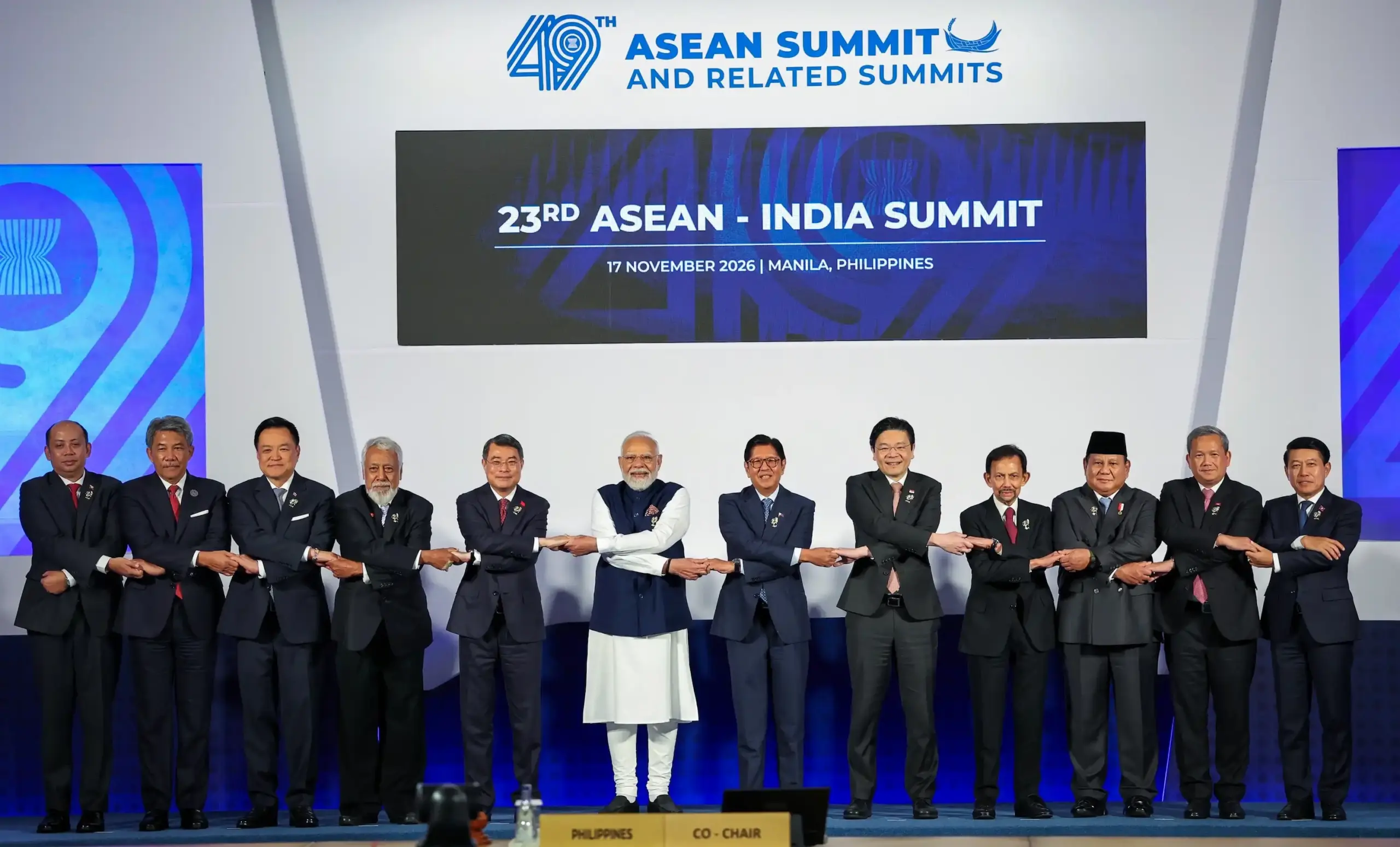
Long before the term ‘Indo-Pacific’ entered the strategic lexicon, India had begun laying the groundwork at the turn of the millennium. This was marked by then External Affairs Minister Yashwant Sinha’s declaration at the 2003 India-ASEAN Business Summit that India’s Look East Policy had entered Phase II, expanding its geographical scope beyond ASEAN to encompass East Asia, China and Australia, while integrating economic ties with broader security cooperation. India’s approach to the Indo-Pacific is structured around two foundational pillars — broadening its engagement and strengthening ties with like-minded states — in pursuit of a free, open and inclusive Indo-Pacific order. This was reiterated by Prime Minister Narendra Modi while addressing the 23rd India-ASEAN Summit in the Philippine capital of Manila on November 17. This approach is crucial in the context of the power competition between Beijing and Washington, which poses considerable diplomatic and security challenges to regional states. Moreover, China’s expanding military posture and irredentist assertions in the South China Sea generate significant territorial and sovereignty disputes for claimant states such as the Philippines and Vietnam. India’s Indo-Pacific strategy seeks to navigate the US-China rivalry while deepening cooperation with like-minded small and middle powers within the ADMM-Plus framework.
Much like India, regional players such as Australia, South Korea, Japan and ASEAN member states pursue a nuanced balancing strategy: they aim to preserve vital economic ties with China while maintaining deterrence against potential Chinese aggression. Furthermore, amid growing uncertainty regarding the reliability of US military commitments, middle powers across the Asia-Pacific are increasingly building a cooperative defence architecture. For instance, Australia and the Philippines recently signed a defence cooperation agreement to streamline joint military operations and bolster bilateral security ties. Similarly, the Philippines has sought to counter China by expanding the ‘Squad’ — an informal quadrilateral security grouping comprising the Philippines, Japan, Australia and the United States — to include India and South Korea. While Manila has been a steadfast US ally for decades, growing scepticism regarding American security commitments under the current Trump administration has prompted the Southeast Asian nation to actively diversify its strategic ties. Notably, the Philippines recently reaffirmed its defence and infrastructure commitments with South Korea and Japan during separate bilateral talks. Through an expanding latticework of bilateral and minilateral agreements, Australia, the Philippines, Japan and South Korea are increasingly integrating their defence architectures to address shared regional security challenges. These efforts are not meant to sideline the United States but rather to integrate the allies’ defence capabilities with those of the US through joint drills, intelligence sharing and new access agreements, thereby strengthening Indo-Pacific deterrence vis-à-vis China’s growing assertiveness.
Maintaining a balance of power in the Indo-Pacific is crucial for India, particularly in the context of China’s rise. Counterbalancing Beijing is a strategic imperative for New Delhi, as a shift in the balance of power in China’s favour risks creating either a US-China bipolar order or outright Chinese hegemony should the US withdraw from the region. Both scenarios run counter to India’s core interests. However, India cannot afford to adopt an overtly aggressive posture, nor can it join a formal military alliance without jeopardising its long-standing commitment to strategic autonomy. Under these constraints, strengthening bilateral defence and security ties with like-minded regional partners remains India’s most prudent course of action. The burgeoning India-Philippines defence partnership serves as a prime example of this trend. India and the Philippines elevated their ties to a strategic partnership during President Ferdinand Marcos Jr.’s visit to New Delhi in August 2025, with defence forming a core pillar. This momentum was anchored by Manila’s $375 million acquisition of the BrahMos supersonic cruise missile. The Philippines became the system’s first foreign buyer, with the delivery of the missiles in April 2024 marking a major milestone in India’s emergence as a defence exporter in the Indo-Pacific.
India is also actively advancing its defence and strategic cooperation with Japan and South Korea. By deepening bilateral ties and bolstering regional defence preparedness through defence exports, India is progressively integrating itself into the Indo-Pacific’s emerging minilateral and informal defence architecture. While it remains to be seen whether New Delhi will pursue deeper strategic alignment with more assertive, China-wary nations such as Japan and the Philippines to counterbalance Beijing, its intent to expand engagement in line with the emerging minilateral security framework is clear.