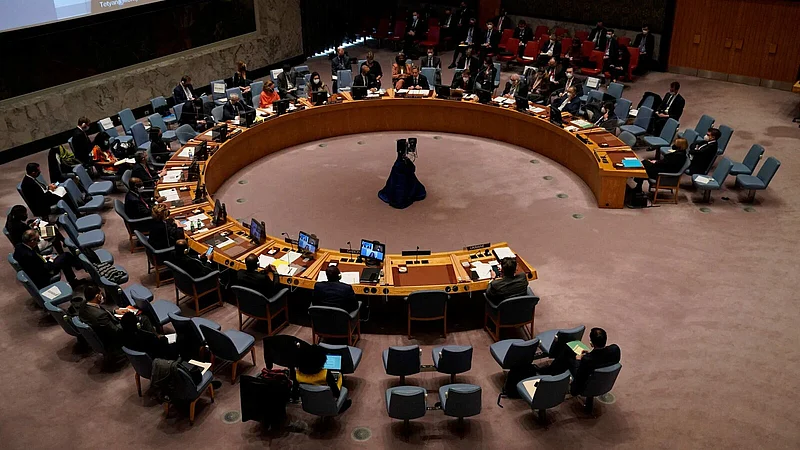
Japanese Prime Minister Sanae Takaichi, in September, used her first address to the UN General Assembly to declare the Security Council’s structure a relic of 1945. She called for its transformation “without delay” into a body that reflects current realities through expansion of both permanent and non-permanent seats, noting that a majority of member states already support such change. Days earlier, at the BRICS summit in New Delhi, Indian Prime Minister Narendra Modi was more direct: “UNSC reforms can no longer wait.” He described the existing order as a “pyramid of privilege” that must become a “platform of partnership,” where the Global South—front row in crises, back row in decision-making—gains a genuine voice.
The arithmetic is no longer contestable. India is home to roughly 1.48 billion people in 2026, the world’s largest population and nearly 18 percent of humanity. The Asia-Pacific region, which holds over 60 percent of the global population, has exactly one permanent seat on the Security Council. Europe, by contrast, holds two permanent seats plus disproportionate elected representation. This is not a minor imbalance. It is an institutional design frozen in the aftermath of a war that ended eight decades ago, while the world it was meant to govern has been remade by demography, economics, and power.
India’s economic weight makes the exclusion harder to defend. By the IMF’s October 2026 World Economic Outlook projections, India is the world’s sixth-largest economy in nominal terms at about $4.06 trillion, growing at roughly 7 percent—the fastest among major economies. In purchasing-power-parity terms, the more accurate measure of real economic scale, India ranks third at approximately $19.2 trillion, behind only China and the United States and ahead of Japan, Germany, and Russia. It is on a clear trajectory toward third place in nominal rankings in the coming years. A body charged with maintaining international peace and security that systematically excludes the third-largest economy by real output is not merely unrepresentative; it is inefficient.
The contribution argument is equally concrete. India has been among the most consistent and substantial troop contributors to UN peacekeeping since the first missions. More than 290,000–300,000 Indian personnel have served across over 50 missions since 1948. Indian peacekeepers have suffered the highest number of fatalities of any troop-contributing country, roughly 180–184 lives. As of mid-2026, India remains among the top two or three contributors of uniformed personnel currently deployed. It has also been a pioneer in deploying women peacekeepers and has used its Centre for UN Peacekeeping in New Delhi to train thousands of personnel from partner countries. These are not abstract claims of goodwill. They are measurable, repeated investments of blood and resources in the system India is told it must wait to help redesign.
Financially, India has paid its assessed contributions in full and on time—$35.18 million to the 2026 regular budget, placing it on the UN’s honour roll of prompt payers. Its assessment share is modest relative to its population and economic size, but the record of compliance is consistent. Meanwhile, the Council’s permanent members include states whose current economic and demographic weight no longer matches the veto power they exercise.
The deeper problem is legitimacy. When decisions on sanctions, interventions, or mandates are made by a body whose permanent composition reflects the victors of 1945 rather than the distribution of people, production, and responsibility in 2026, those decisions carry a built-in credibility deficit. Ambassador Harish Parvathaneni has recently noted that authority won in a war 80 years ago cannot compensate for a legitimacy deficit today. History can guide what not to do; it cannot freeze today’s choices. Expanding only non-permanent seats would leave the decisive power concentrated in the existing five, creating what India has correctly called “second-class” permanent status. As long as the veto exists, new permanent members must hold it on equal terms.
Mr. Modi’s “platform of partnership” is not rhetoric. It is a description of the minimum institutional change required for the Security Council to retain relevance. The alternative is continued reliance on ad-hoc coalitions, regional arrangements, and bilateral deals that bypass the UN precisely because the Council is seen as unrepresentative. That path weakens, rather than strengthens, multilateralism.
A nation of 1.4 billion people that is already the world’s third-largest economy by real output, a major democracy, a nuclear-weapons state, and one of the largest consistent contributors to UN peace operations has earned a permanent seat with full responsibilities. The structure Ms. Takaichi called a relic and Mr. Modi called a pyramid of privilege will not reform itself. Text-based negotiations with a definite timeline and clear outcomes—the demand both leaders have advanced—are the practical next step. The question is no longer whether India belongs at the table. It is whether the table will be rebuilt before the institution loses the capacity to matter.