The past fortnight has seen high-stakes developments in geopolitics. President Xi Jinping made his first trip to India in seven years, followed by a great power summit with the United States. Meanwhile, Indian PM Narendra Modi held a telephone conversation with Donald Trump after the US Parliament passed the Lindsey Graham Sanctions Bill, which gives Donald Trump the power to impose 100% sanctions on buyers of Russian oil. This was followed by an announcement by the US Trade Representative, James Greer, that an India-US trade deal was not imminent, as India was not yet convinced by the US’ terms for the deal. He said both sides had identified the terms of reference, i.e., the list of issues plaguing the interim Bilateral Trade Agreement. In reality, US wants to impose its terms on India and is preparing tools that can be used as leverage against India. On the other hand, Trump agreed to a $60 Billion trade truce with Xi Jinping that extends their Busan arrangement till 2027. Trump guided Xi Jinping for a tour of the White House, chaperoning him as the Chinese leader enjoyed Trump’s quirks and quips. At one point, Trump called his predecessor Joe Biden an “autopen” drawing a laugh out of the Chinese Leader.
Former NSA Jake Sullivan, plagued by the Biden administration’s own Gaza disaster, remarked that he was worried about the US’ reputation and leadership in the world due to the manner in which Xi was treated by Donald Trump. He said it would have been alright if the US got something in return, but the Chinese did not yield, and Xi Jinping walked in and out of Washington with his status enhanced vis-à-vis the United States. He agreed with his former colleague Rebecca Lissner when she said that going forward military power and security guarantees will not cut it as offers of cooperation. US terms to allies and partners will have to include economic, social, democratic, and values-based propositions for the restoration of American leadership. He agreed that American primacy or hegemony was gone forever. That he was always skeptical of what former CIA director William Burns called “American Indispensability” He would rather that US aspired to be a pivotal power and that American leadership has to look different after Trump. In short, the terms of American engagement with the world have to fundamentally change.
Meanwhile, the terms of engagement that the US is employing with India remain unchanged. A Democratic Party Senator Blumenthal advised India to “clean up its act”. Former Indian Ambassador to the US Navtej Sarna exhorted the Indian Government to “call the bully’s bluff”. This was after he argued last year that Trump would prove to be debilitating but not fatal for the India-US relationship. Last year, in September, Ambassador Sarna advised the government to persist with patience and caution. The Strategy has failed. Clearly, the advice to persist with pragmatic diplomacy has emboldened Trump to impose more terms on India “at the cost of the nation’s dignity,” as Ambassador Sarna put it.
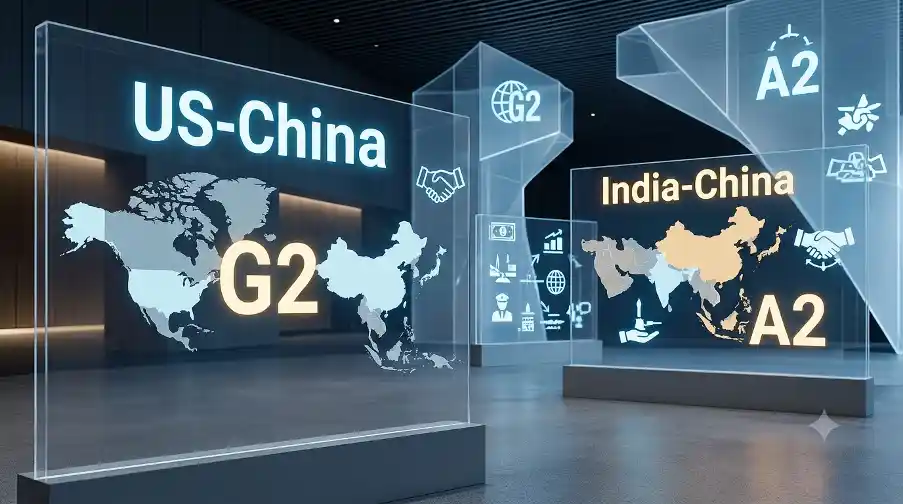
EAM Jaishankar, in an interview with the Asia Society, remarked that the main problem in the India-US relationship was the US’ proximity to Pakistan and a lack of empathy towards terrorism against India. This was flabbergasting, as the main issue is clearly a fundamental change in the American approach towards India. 50 Democrats voted against India. In addition, Jaishankar seemed quite confident that structural differences would prevent the US and China from agreeing to a G2 framework. While China has not endorsed a G2 framework, the US clearly has. The Trump-Xi summit indicated a détente between the US and China. The terms of engagement between the US and China reflect a degree of reciprocity with which India is yet to come to terms. This pattern of engagement traces its history all the way to Kissinger’s visit to Peking in 1969 and the same policy of engagement was fully supported by the Biden administration as well. We will do well to remember that Biden’s “Democracy v Autocracy” plank fell flat, and he switched to engagement with China in his final two years of Presidency. It is not a Trump-specific policy.
That said, India has come to terms with its relationship with China. Jaishankar claimed in the same interview that India encouraged China to sort out differences as tensions would benefit third parties. He claims that China took its own time to agree to this argument. This is encouraging for one particular reason. In the public domain, it has been clear that China is the country that has been pushing for normalization and steering a Panchsheel process, which India has been navigating in its own way since April 2024. Now that Jaishankar has revealed that India too was keen to sort out problems, the whole process should be seen in a positive light by both sides. Jaishankar reiterated India’s position that the state of the border will reflect the state of the relationship. This position is primarily to placate domestic critics who have argued that the stabilization and reset have happened on China’s terms. But it is not clear what these Chinese terms are. In fact, in the latest edition of the Special Representatives Dialogue, both sides agreed to agree on the terms of reference. If the terms of reference are being negotiated, how could India have already agreed to Chinese terms? In that sense, the relationship has stabilized on the merits of the diplomatic and political process. There are no Chinese terms as such. There is definitely a panchsheel process where both sides have tried to “meet each other halfway” as China puts it or as India puts it “reach a new equilibrium”.
This is where a historical understanding of Panchsheel is essential. It is the only tool available for India and China to diffuse strategic situations and it has worked really effectively in a world torn by violent conflict. The border incursions and incidents are of critical importance, but they can not be the totality of the bilateral relationship. India-China have achieved something remarkable by entering a new phase of the relationship after resetting it in the aftermath of the Galwan clashes. China has steered the Panchsheel process with an assured hand. India can steer this next phase with a spirit of Panchsheel characterized by positive initiative. Prudence calls for reviving the high-level strategic economic and trade dialogue started by PM Dr. Manmohan Singh and Premier Wen Jiabao. Facilitating Visas for Chinese tourists and Chinese scholars is of utmost importance. Encouraging Chinese investment and Indian businesses to explore the Chinese market deserves a fresh start. Leveraging Chinese expertise in infrastructure, data and technology through transparent cooperation is of developmental importance. Cooperation is needed on Indian terms, i.e., mutual benefit, especially in industries that need revival and resilience under the onslaught of Artificial Intelligence. Fast-growing India-China trade is important for economic growth in an otherwise difficult external environment due to Western unilateralism and protectionism. Trade deficits are part of Trade relationships. Both US and Europe maintain a deficit with China. As long as China is also transferring best practices and purchasing power to Indian consumers, the trade deficit and national security cannot be used as excuses to block mutual benefit. Lessons from China in optimizing land, labor and capital is of utmost value for India.
Mutual sensitivity and Mutual Trust can become chimeras which cannot be treated as red lines. They are abstracts which need to be converted into tangible outcomes. Trust is built over time, and sensitivity is mutually respected. For e.g. publishing a list of standardized names provides cold comfort to both sides but complicates matters for the militaries. Letting third parties influence issues like Tibet, Taipei and J&K creates unnecessary hype. Therefore, strategic dialogues on political and security issues, including South Asia and the Indo-Pacific, will blunt the impact that India has borne due to third-party adventures in India’s neighborhood. It should not be forgotten that this new phase is not the first time India and China have engaged positively at the strategic level, and it won’t be the last. The 30-year peace between 1989 and 2020 is one of the stellar legacies of Indian & Chinese diplomacy. Now is the time for a new modus vivendi. As one commentator in COP put it, India-China are an experienced partnership in a fast-changing world. The Asian 2 can even offset the narrative of a Group of 2 within the confines of Asia.
The India-China reset still leaves the question of India-US relations unanswered. The short answer is it will require a lot of work, but an India-US reset is also possible. If the democratic party manages to reform itself from the centrist policy consensus that is characterizing US foreign policy, they might be able to defeat Rubio or Vance in 2028 elections. Otherwise, it’s a long and tough road ahead for India and the US. The function and form of the relationship will remain, as will the PR machine fueling it, but the terms of engagement have fundamentally changed. US society is going through a profound shift towards nativist populism and religious nationalism. The unprovoked attack on Iran is but one of several symptoms. During the war, the US has come to terms with the fact that it cannot impose its terms on Iran with hard power. The Chinese have long learned this lesson the hard way due to their tumultuous history and domestic political history. They have the strategic acumen to resist imposing their terms through sheer force and have consistently preferred statecraft.
In conclusion, it would be fair to say there are no American or Chinese terms per se that can simply be imposed by force. India must come to terms with this central geopolitical reality.
Internet Sources
Xi Jinping’s first India visit in seven years – Hindustan Times
Russia sanctions bill and possible 100% tariffs – Indian Express
India-US trade deal not imminent – Reuters
Trump-Xi trade truce and $60 billion tariff reduction – Al-Ahram Weekly
Navtej Sarna: Call the bully’s bluff – The Week
Jaishankar on terrorism and India-US relations – Hindustan Times
25th India-China Special Representatives talks – Chinese MFA