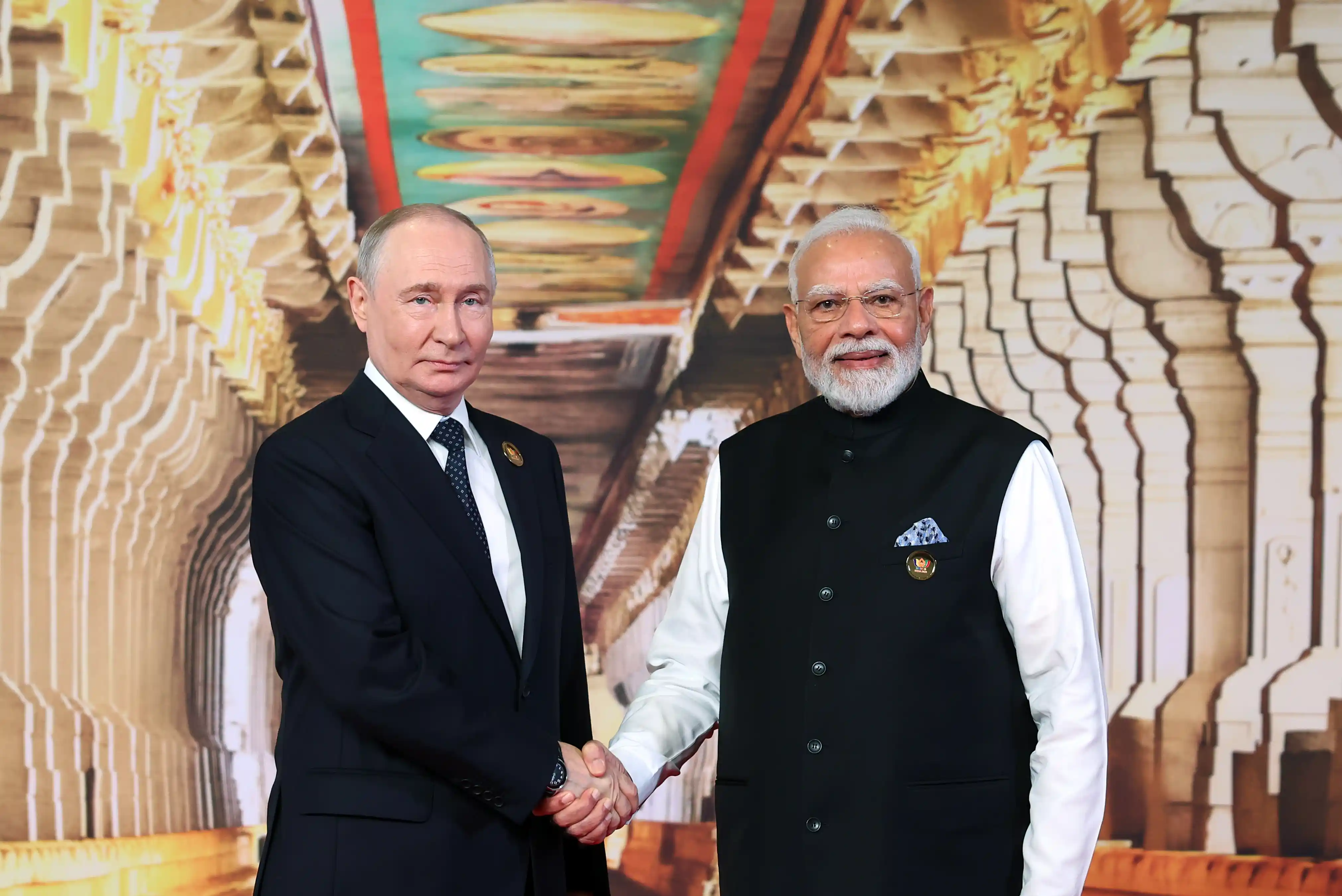
Russian President Vladimir Putin’s three-day presence in New Delhi, India, last week, on the margins of the 18th BRICS Summit, was not a ceremonial reprise of an old friendship. It was a working session between two states that still treat defense as the load-bearing wall of their relationship — even as the architecture around that wall is being rebuilt. Indian Prime Minister Narendra Modi and President Putin met on 11 September, their second encounter in a fortnight after Bishkek, and reviewed military-technical cooperation alongside trade, energy, nuclear power and the $100 billion bilateral trade target for 2030. The public language was careful. The defense agenda was not.
For more than six decades, Moscow and New Delhi have practiced a form of strategic intimacy that Western commentary routinely underestimates. The Soviet Union armed a non-aligned India when few others would. Russia inherited that role and, unlike many suppliers, accepted licensed production, co-development and a degree of operational secrecy that New Delhi prizes. The Special and Privileged Strategic Partnership declared in 2000 and upgraded in 2010 still rests on that habit of trust. The December 2025 annual summit in Delhi — the 23rd — already signaled the next phase: a shift from a buyer-seller model toward joint research, co-development and co-production under India’s Make in India program, including spare parts and components for Russian-origin platforms and eventual export to mutually acceptable third countries. This week’s talks continued that line rather than inventing a new one.
What was actually discussed on defense in India is now reasonably clear from both capitals. Three platforms dominated: the S-400 air-defense system, the BrahMos family, and the Su-57 fifth-generation fighter, with the Su-30MKI upgrade program and a wider offer of missiles, drones and counter-drone systems sitting just behind them. Russia also put the S-500 Prometey on the table as a possible upper tier above the S-400 — a longer-range, higher-altitude system aimed at ballistic and hypersonic threats — though that offer remains a pitch, not a closed track. Kremlin spokesman Dmitry Peskov said before the visit that Moscow remained committed to completing remaining S-400 deliveries, that the two sides were exploring BrahMos upgrades, and that the proposed supply of Su-57 aircraft — including India’s request for production technology — was on the agenda. Sensitive details, he rightly noted, would not be aired in public. That is how serious military-technical work proceeds.
The S-400 conversation is no longer theoretical. India’s 2018 contract for five Triumf systems, worth about $5.43 billion, has been delayed by the demands of Russia’s own war economy, but deliveries have resumed: the fourth regiment arrived earlier this year, and the fifth is expected before the end of 2026. New Delhi is now weighing five additional squadrons. Russia has submitted a detailed commercial bid, reportedly in the range of $5–6 billion, and has offered an Indian maintenance, repair, and overhaul facility rather than a full Make in India manufacturing line for the new batch. That is a pragmatic compromise. India needs coverage; Russia needs a solvent, long-horizon customer that pays and does not lecture.
Operation Sindoor in May 2025 supplied the operational argument that no brochure can. After the Pahalgam attack by elements in Pakistan, a four-day air and missile exchange with Pakistan put Indian S-400 batteries and Indo-Russian BrahMos missiles into combat. Indian officials later reported a surface-to-air engagement at 314 kilometers — the destruction of a Pakistani special-mission aircraft — described by India as the longest such kill in the public record. BrahMos strikes, numbering in the teens according to Indian accounts, hit airbases and air-defense nodes. Whatever the precise battle-damage assessment, the political effect in Delhi was unambiguous: Russian-origin systems performed under fire, in Indian hands, against a Chinese-equipped adversary. That is why additional S-400s and BrahMos-NG are not prestige purchases. They are lessons learned. The S-500 offer follows the same logic at a higher altitude: if the S-400 has been validated, Moscow wants India to consider the next layer, too. Export of a system Russia has only recently placed on its own combat duty is a harder promise than finishing S-400 kits already in the pipeline. It belongs in the conversation. It is not this week’s contract.
BrahMos remains the partnership’s most successful industrial template. Jointly developed and largely produced in India, it proves the two countries can move beyond licensed assembly. Peskov’s pre-visit remarks on improving the missile, adding capabilities and making it more competitive pointed to BrahMos-NG: a lighter, more compact variant intended for a wider set of Indian fighters, not only the heavy Su-30MKI. That is co-development in the proper sense — a product that can be exported, iterated, and owned jointly. If the relationship has a future beyond the next contract cycle, it will look more like BrahMos and less like a one-way shipment of finished batteries.
The Su-57 file is more contested, and therefore more revealing. Russia has offered India not merely the export Su-57E but a pathway toward local production, technology transfer and, in some public Russian formulations this year, unusually deep access to systems architecture. Hindustan Aeronautics has already conducted a feasibility review with Sukhoi; Russian specialists judged that HAL’s Nashik, Koraput and avionics facilities already cover a substantial share of the industrial base required. India wants production technology, not a black-box squadron. Russia is cautious about giving away the crown jewels of a fifth-generation program that only a handful of states possess. Peskov said as much: sophisticated machines are guarded; discussion continues because the partnership is special. That tension is healthy. A deal that transfers nothing will not survive India’s Atmanirbhar politics. A deal that transfers everything on day one is not how any serious aerospace power behaves. The middle path — staged ToT, Indian weapons integration, a two-seat or training variant, and a feed into India’s own AMCA program — is the only path that can close.
Around these headline systems sits a quieter, and in some ways more important, industrial agenda. India fields one of the world’s largest inventories of Russian-origin equipment: Su-30MKI fighters, T-90 tanks, a dense layer of missiles and sensors. SIPRI’s latest figures show Russia’s share of Indian major-arms imports falling from 70 percent in 2011–15 to 40 percent in 2021–25, with France and Israel gaining. That diversification is real and will continue. But category-level dependence tells a different story. Russia still accounts for the overwhelming share of India’s missile imports and remains central in air defense, engines and certain naval systems. An $11 billion “Super Sukhoi” upgrade of the Su-30MKI fleet — new AESA radars, avionics, electronic warfare suites and engines — would lock that fleet into a Russian-Indian modernization cycle for another generation. Spare-parts joint ventures, already endorsed in the December 2025 joint statement, are the unglamorous work that keeps squadrons flying when sanctions and wartime production strain official supply lines.
The logistics layer has also thickened. The Reciprocal Exchange of Logistics Support agreement, signed in February 2025, ratified by President Putin last December, and in force since January 2026, sets procedures for port calls, airfield use, exercises, humanitarian missions, and temporary deployments capped, unless otherwise agreed, at five warships, ten aircraft, and 3,000 personnel. It is not a basing pact. It is an enabler: Arctic access for India as the Northern Sea Route opens; Indian Ocean flexibility for Russian units; and a legal framework for servicing Indian ships and aircraft far from home. Combined with regular INDRA exercises and the working groups of the Inter-Governmental Commission on Military and Military-Technical Cooperation, it is the plumbing of a mature military relationship.
The meeting in New Delhi produced no theatrical signing ceremony for a fifth-generation fleet or an S-500 regiment, and that is as it should be. Major aviation and air-defense contracts take years to develop. What it did produce was continuity: an invitation from President Putin for the 24th annual summit in Russia, which Mr Modi accepted; a reaffirmation of Program 2030; and a shared understanding that defense cooperation will be judged by factories, timelines and combat performance, not communiqués. The partnership is no longer the monopoly it was in the 1970s. It does not need to be. In a world of fragmented supply chains and contested skies, a relationship that can still move S-400s, iterate BrahMos, float an S-500 option and seriously negotiate fifth-generation production is not a relic. It is a strategic asset—for both sides —if they have the discipline to treat it as industry rather than nostalgia.