
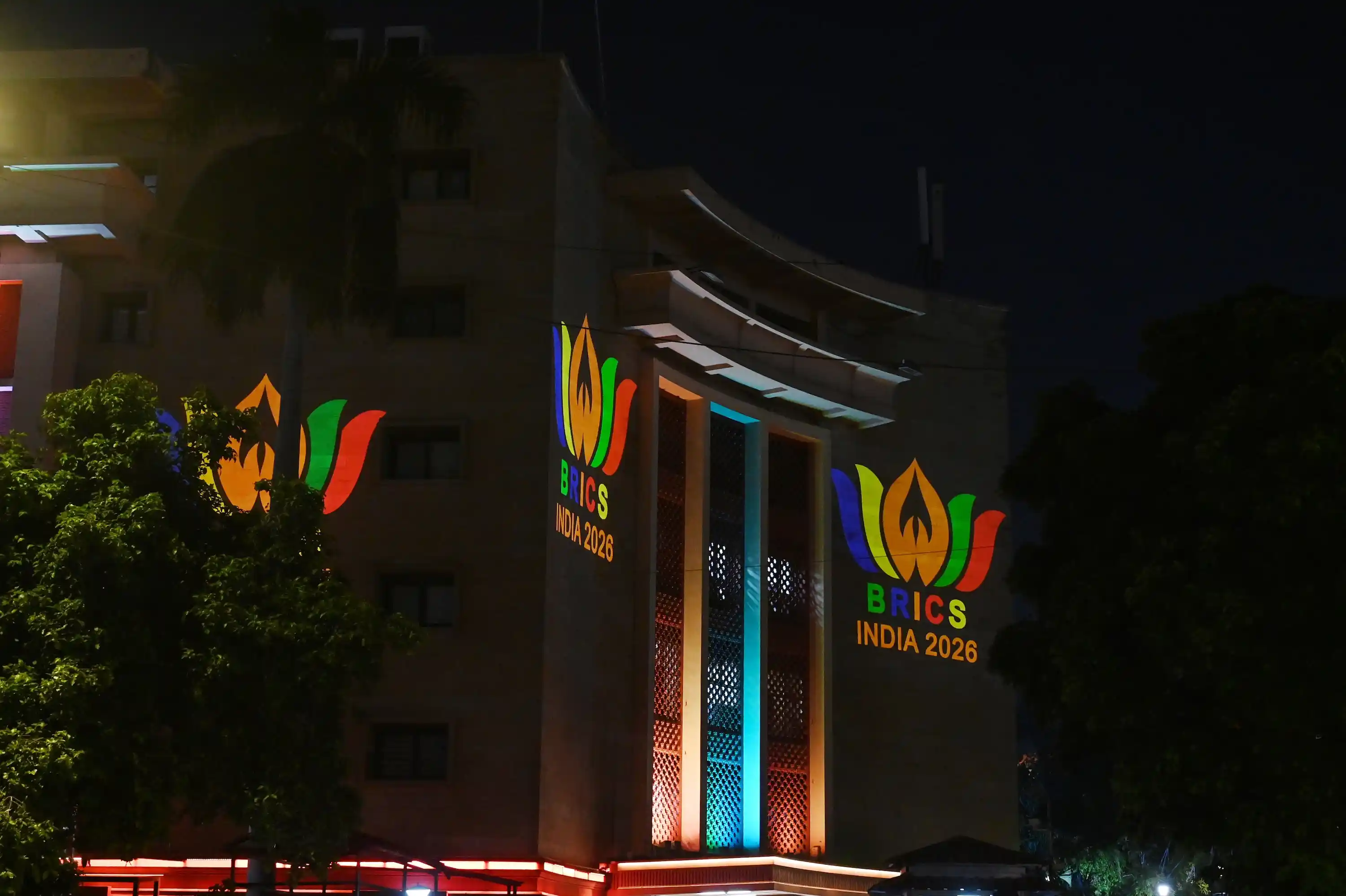
When leaders from eleven member states and a widening circle of partner countries gather at Bharat Mandapam in New Delhi this September for the 18th BRICS Summit, they will be marking more than a rotating presidency. They will be marking two decades of an idea — that the world’s fastest-growing economies need not wait for permission from the old order to shape a new one. India, chairing BRICS for the fourth time since 2012, has an opportunity this year to convert that idea into something more durable: a working architecture for development cooperation among the Global South.
The scale of what India is chairing has changed dramatically since it last held the gavel. Following the 2024 expansion, BRICS is no longer a five-country acronym but an eleven-member bloc accounting for roughly a third of global GDP, close to half the world’s population, and a substantial share of global trade and investment flows. That heft alone would justify attention. But the more interesting story of India’s 2026 chairship — built around the theme “Building for Resilience, Innovation, Cooperation and Sustainability” and Prime Minister Narendra Modi’s call for a “Humanity First” approach — is not about size. It is about substance: what does a bloc this large actually do for the developing countries that make up most of its membership and its partner list?
Over 350 meetings across more than 25 cities this year suggest India has treated the chairship less as a ceremonial rotation and more as a sustained diplomatic campaign. That effort culminates in a summit taking place against a genuinely fraught backdrop — rising tariff walls, fragmenting supply chains, and a multilateral trading system that developing economies increasingly experience as something done to them rather than with them. In that context, the argument for intra-BRICS trade and deeper South-South cooperation is not ideological; it is defensive. Countries that cannot count on the old rules-based order behaving predictably have every reason to build parallel channels of resilience.
What should give this year’s chairship intellectual weight, though, is India’s insistence that development cooperation cannot be reduced to finance alone. The Global Development Compact, first floated at the Voice of Global South Summit in 2024, is built on a more honest premise: capital without capacity building simply produces indebted infrastructure. Its five modalities — capacity building, trade for development, technology sharing, concessional finance and grants — read almost like a rebuke to decades of aid architecture that treated a wire transfer as the end of the relationship rather than the beginning of one.
The sectoral initiatives launched under India’s watch give this framework some texture. A BRICS vaccine research centre, a tuberculosis research network and an early-warning system for infectious disease outbreaks are modest but concrete responses to a lesson the pandemic taught brutally: health security cannot be outsourced to wealthier blocs that will look after themselves first when supplies run short. Similarly, the BRICS Network University and the technical and vocational training alliance point toward something more ambitious than diplomatic photo-ops — an attempt to build the human capital pipeline that trade and technology transfer alone cannot substitute for.
There is also a case to be made that India’s own instruments are becoming BRICS’ informal toolkit. DAKSHIN, its knowledge-sharing initiative launched in 2023, has already signed agreements with over 160 think tanks across some 95 countries, quietly building the kind of peer-learning network that development bureaucracies usually take a generation to assemble. And India’s digital public infrastructure — UPI chief among it — has become something of a demonstration model for how a middle-income country can leapfrog Western financial infrastructure rather than wait to inherit it.
BRICS, however, remains a coalition of countries with genuinely divergent interests — on de-dollarization, on relations with Washington, on how far institutional reform should go, and, this year in particular, on the optics of a possible visit by Chinese President Xi Jinping to New Delhi for the first time since 2019. Communiqués have grown harder to negotiate as membership has grown. The bloc’s greatest structural risk is not external pressure but internal incoherence.
That is precisely why the upcoming summit matters enormously. Twenty years in, BRICS has proven it can survive as a symbol of multipolarity. What it has not yet proven is that it can function as a mechanism of shared development. India’s chairship — through the Global Development Compact, triangular cooperation, and its own diplomatic instruments — is a genuine attempt to close that gap. Whether it succeeds will determine if BRICS becomes an institution the Global South actually relies on, or remains a summit the world merely watches.

