Political trust is already in place. The next phase should turn it into factories, technology partnerships, viable transport links and stronger connections between Central and South Asia.
India and Uzbekistan have spent years building political trust. The next phase of their relationship should be judged by something more demanding: whether that trust can produce factories, technology partnerships, efficient transport links and new opportunities for businesses and young professionals in both countries.
This matters because the bilateral relationship is reaching a point where ceremonial diplomacy is no longer enough. Trade has crossed roughly $1.5 billion, according to India’s Ministry of Commerce and Industry, but both sides accept that the figure remains below potential. The real opportunity lies not simply in doubling trade, but in changing its composition — from conventional exchange of goods to co-investment, co-production and access to third-country markets.
Critical minerals are an obvious place to start. Uzbekistan has significant mineral resources and is seeking investment in exploration, processing and higher-value manufacturing. India, meanwhile, needs secure and diversified supplies of minerals for electronics, batteries, renewable energy and advanced manufacturing.
A partnership built only around raw-material exports would be too narrow. The more strategic model is to create processing and manufacturing capacity in Uzbekistan with Indian investment, technology and market access.
Pharmaceuticals and digital technologies offer a second pillar. India’s strengths in generic medicines, medical technologies, software and digital public infrastructure match several of Uzbekistan’s development priorities.
The next generation of projects should therefore focus on localisation: pharmaceutical production, diagnostic services, telemedicine, joint software development, fintech, cybersecurity and start-up cooperation. For Indian firms, Uzbekistan can also serve as a platform for entering wider Central Asian markets.
Connectivity remains the biggest structural constraint. India and Uzbekistan do not share a land border, and high logistics costs limit the competitiveness of bilateral trade.
Chabahar Port and related transport corridors can help, but infrastructure alone will not solve the problem. Commercially viable routes require predictable tariffs, simplified customs procedures, digital cargo tracking and mutual recognition of standards. This is an area where sustained political attention can produce immediate economic dividends.
Human capital is another underused asset. More than 16,000 Indian students are studying in Uzbekistan, while thousands of Uzbek professionals and students have participated in Indian training and scholarship programmes.
These links should evolve beyond student mobility toward joint research laboratories, engineering and IT programmes, university–industry partnerships and professional networks connecting the two economies.
Energy transition can add another practical dimension. Uzbekistan is rapidly expanding renewable-energy capacity, while India has developed considerable experience in solar power, energy efficiency and clean-technology deployment. Cooperation in energy storage, water-saving technologies, cleaner manufacturing and climate-smart agriculture would connect bilateral economic priorities with sustainable development.
There is also a wider geopolitical logic. Uzbekistan sits at the heart of Central Asia; India is one of South Asia’s largest economic and technological centres. Stronger India–Uzbekistan ties can therefore contribute to a broader bridge between the two regions — provided connectivity is treated as an economic project rather than merely a diplomatic slogan.
Security cooperation reinforces this agenda. Both countries have an interest in stability in Afghanistan, counter-terrorism and secure trade routes. Their joint Dustlik military exercises are one visible part of a broader relationship in which economic connectivity and regional security increasingly depend on each other.
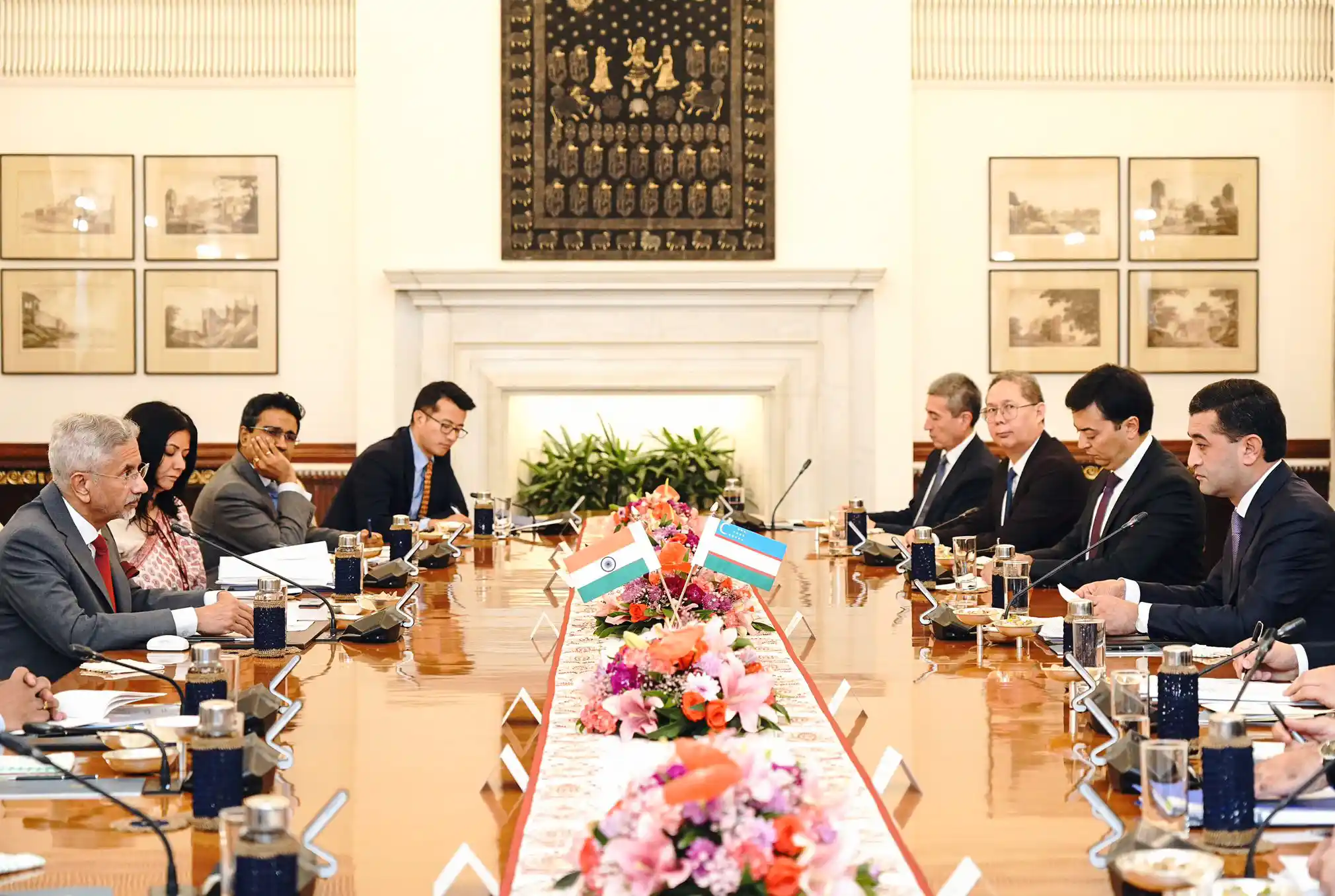
The forthcoming high-level dialogue should therefore be measured less by the number of agreements signed than by the mechanisms created to implement them. Each major commitment should have a timeline, responsible institutions, financing arrangements and measurable milestones. A smaller number of bankable projects would matter more than a longer list of memoranda.
For India, Uzbekistan offers more than a market: it is a strategically located partner with industrial ambitions, natural resources and growing links across Central Asia. For Uzbekistan, India offers technology, capital, skills and access to one of the world’s largest markets.
The political foundation already exists. The task now is to build an economic architecture on top of it. If both sides move from declarations to co-production, from connectivity plans to commercially viable routes, and from educational exchanges to innovation networks, India–Uzbekistan relations can become one of the more consequential partnerships linking Central and South Asia.