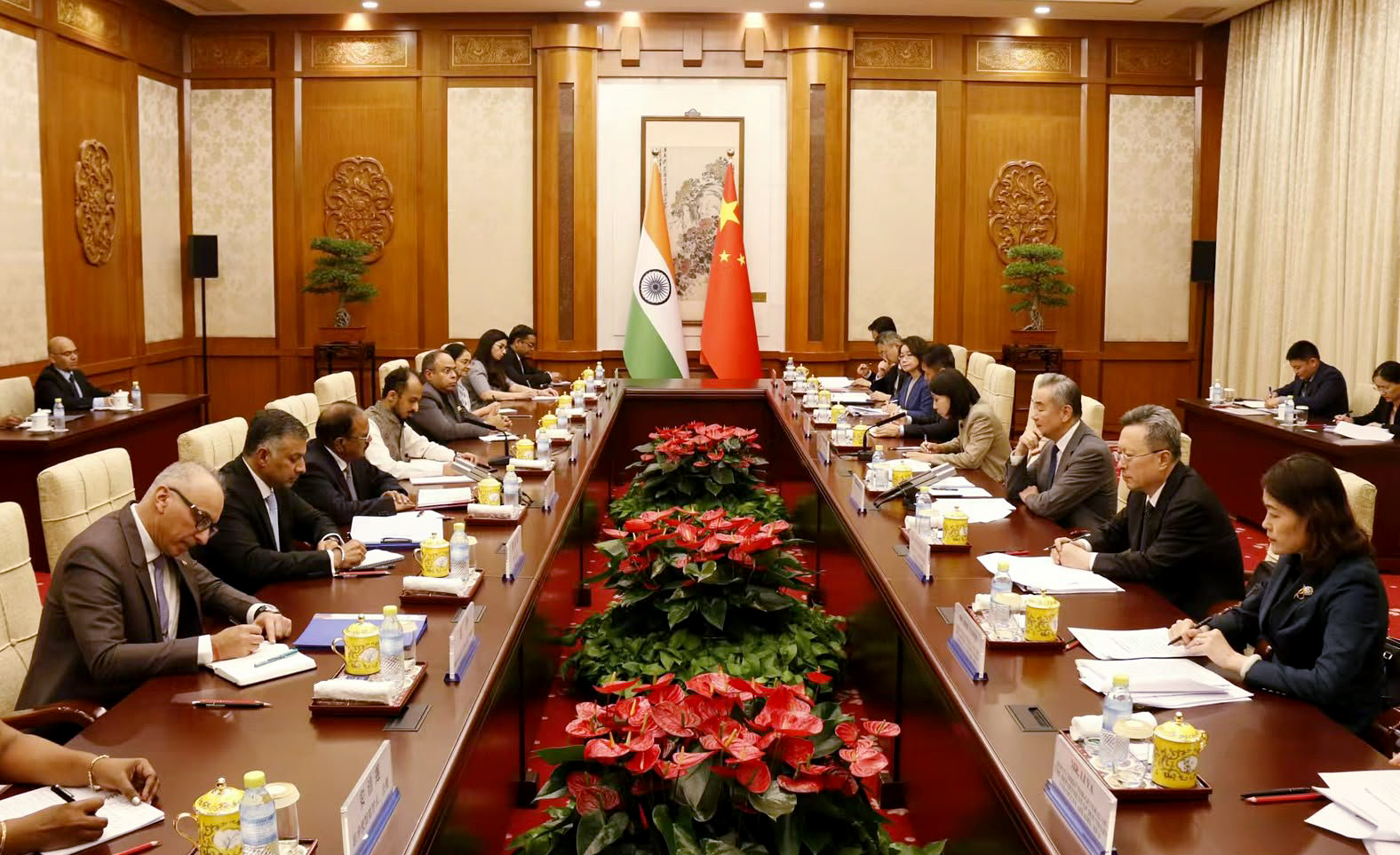
National Security Adviser Ajit Doval’s Beijing visit for the 25th round of India–China Special Representatives’ (SR) talks marked a vital milestone in boundary diplomacy, bringing engagement back to its highest dedicated political-security channel. While the talks were not expected to settle the boundary dispute outright, they helped determine whether the fragile post-2024 stabilisation of the Line of Actual Control (LAC) can evolve into a sustainable framework for managing competition.
During the visit, Doval held detailed discussions with Chinese Foreign Minister Wang Yi—China’s Special Representative on the boundary question—and also called on Vice-President Han Zheng. The agenda combined the immediate imperative of maintaining border peace with the broader task of rebuilding political, economic, and multilateral engagement.
A High-Level Channel Restored
The SR mechanism was established in 2003 to explore a political framework for resolving the India–China boundary question. It differs from military commander-level talks, which address immediate deployments and friction, and from the Working Mechanism for Consultation and Coordination (WMCC), which handles diplomatic coordination. The SR dialogue is intended to bring strategic direction to the dispute: identifying principles, political trade-offs, and a long-term basis for a settlement.
The 25th round carried significance in its own right. The mechanism had lost momentum during the severe deterioration in relations after the 2020 crisis in eastern Ladakh. Its revival underscores a shared recognition: tactical disengagement and local crisis management alone cannot create a stable bilateral relationship. The boundary issue remains political, historical, military, and territorial at once; it demands sustained direction from negotiators empowered to connect security concerns with the larger relationship.
The scale of the challenge remains substantial. India and China share an unresolved boundary extending about 3,488 km, with forces operating along different perceptions of the LAC. This dynamic goes beyond cartography—it creates recurring risks when patrols, infrastructure construction, surveillance, and competing claims converge in difficult terrain. An incident can quickly acquire national political significance and constrain diplomacy across other domains.
Doval’s meeting with Han Zheng gave the visit a broader political framing. According to official accounts, they discussed peace and tranquillity in border areas along with steps to improve relations across economic, political, and multilateral forums. This reflects a central tenet of India’s approach: normal bilateral engagement cannot be insulated from conditions on the border.
Key Drivers of the Engagement
The primary objective of the visit was to consolidate the gains made since the October 2024 understanding on patrolling arrangements in Depsang and Demchok. That arrangement led to disengagement and enabled the resumption of patrolling and grazing according to long-standing pre-friction practices. While a meaningful diplomatic and operational step after years of confrontation, it was a stabilisation measure rather than a strategic breakthrough. Discussions now focus on preventive mechanisms to ensure that routine activity does not recreate cycles of competing patrols, tactical obstruction, and military escalation.
A second driver is the ongoing effort toward gradual normalisation following the landmark October 2024 meeting between Prime Minister Narendra Modi and President Xi Jinping in Kazan, as well as their subsequent interaction at the SCO Summit in Tianjin. Doval’s visit offered an opportunity to take stock ahead of leader-level interactions at the September BRICS summit in New Delhi. In diplomatic terms, the SR dialogue helps prepare the ground by clarifying where cooperation is feasible and where restraint remains necessary.
Third, both states have incentives to prevent frontier volatility from narrowing their wider strategic options. India must manage a complex external environment while protecting territorial interests and maintaining strategic autonomy. China, too, benefits from predictability along the Himalayan border amid geopolitical and economic pressures.
This explains why the agenda encompassed economic, political, and multilateral matters. India and China cooperate in groupings like BRICS and share overlapping interests in Global South issues, trade governance, and climate diplomacy. However, from India’s perspective, expanding broader engagement requires verified peace and tranquillity at the LAC.
Key Outcomes and Operational Focus
The talks focused on establishing a more reliable border management architecture. Both sides reaffirmed their commitment to the 2005 Political Parameters and Guiding Principles, agreeing to use the SR mechanism to pursue a fair, reasonable, and mutually acceptable settlement. Doval noted that under the direction of both leaders, relations have returned to the “right track” and border areas have maintained overall peace. Furthermore, both sides agreed to host the 26th round of SR talks in India.
Operational priorities discussed during the round included:
- Patrolling Protocols: Reinforcing notification, deconfliction, and rapid communication protocols when patrols encounter one another.
- Verification Mechanisms: Monitoring compliance with disengagement arrangements to ensure objective verification.
- Crisis Communication: Strengthening military-to-military hotlines and standard procedures for handling tactical incidents.
- Restraint: Maintaining force posture restraint and managing infrastructure activity near sensitive points.
- Resuming Exchanges: Welcoming the steady resumption of cross-border exchanges, including the Kailash Manasarovar Yatra and border trade.
Doval reiterated the imperative of clarity, emphasizing that peace and tranquillity must rest on reciprocity, verification, and predictability rather than forward deployments or physical obstruction.
Strategic Significance Beyond the Frontier
The broader significance of Doval’s visit lies in demonstrating that security dialogue can proceed alongside strategic competition. Doval characterized India and China as “partners, not competitors,” underscoring that a stable and predictable relationship serves the interests of both nations and the wider region.
This framework does not require either side to abandon core interests; rather, it sets guardrails on competition. For India, this means maintaining deterrence and border vigilance while pursuing diplomacy. For China, it involves acknowledging that stable ties require addressing Indian concerns along the LAC directly.
The shared public vocabulary of strategic perspective, mutual trust, and proper management of differences provides a constructive platform. However, trust in this relationship will ultimately be restored through consistent, verifiable compliance with agreed conduct on the ground.
The 25th round demonstrated incremental progress. By reaffirming existing understandings, tasking working mechanisms with specific protocols, and scheduling the next round in India, the visit restored strategic diplomacy at a critical juncture. It reflects a realistic ambition: ensuring competition remains managed while reducing the likelihood of conflict.